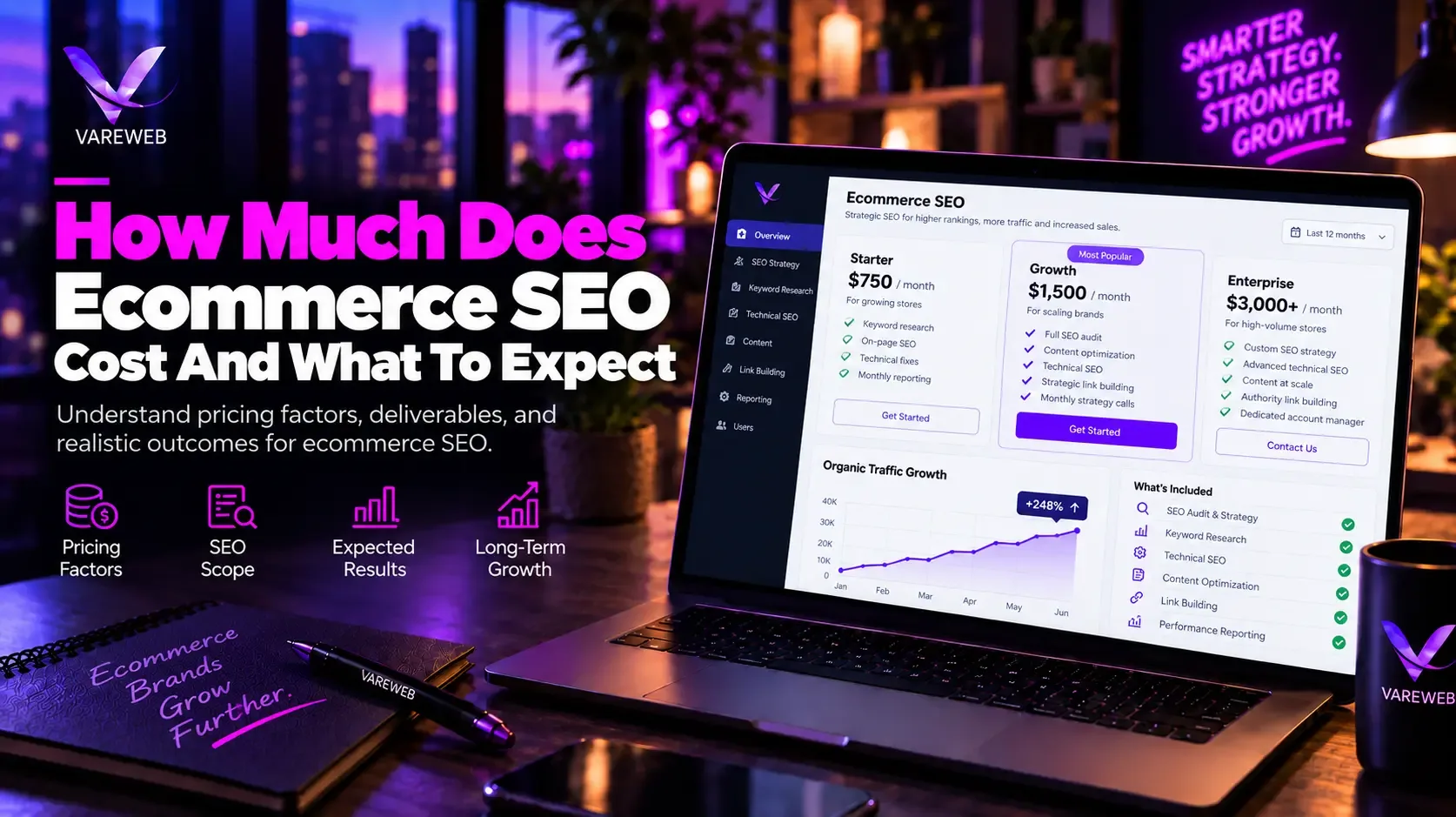
Quick Answer: Professional ecommerce SEO for scaling brands typically costs $2,500 to $10,000+ per month on retainer, or $5,000 to $25,000+ for one-off technical audits and platform migrations. Budget packages at $500 to $1,500 a month usually buy a few hours of plugin tweaks and low-quality links, which is a financial trap for any store competing nationally. Real ecommerce SEO is an infrastructure investment, and it pays back over six to twelve months, not thirty days.
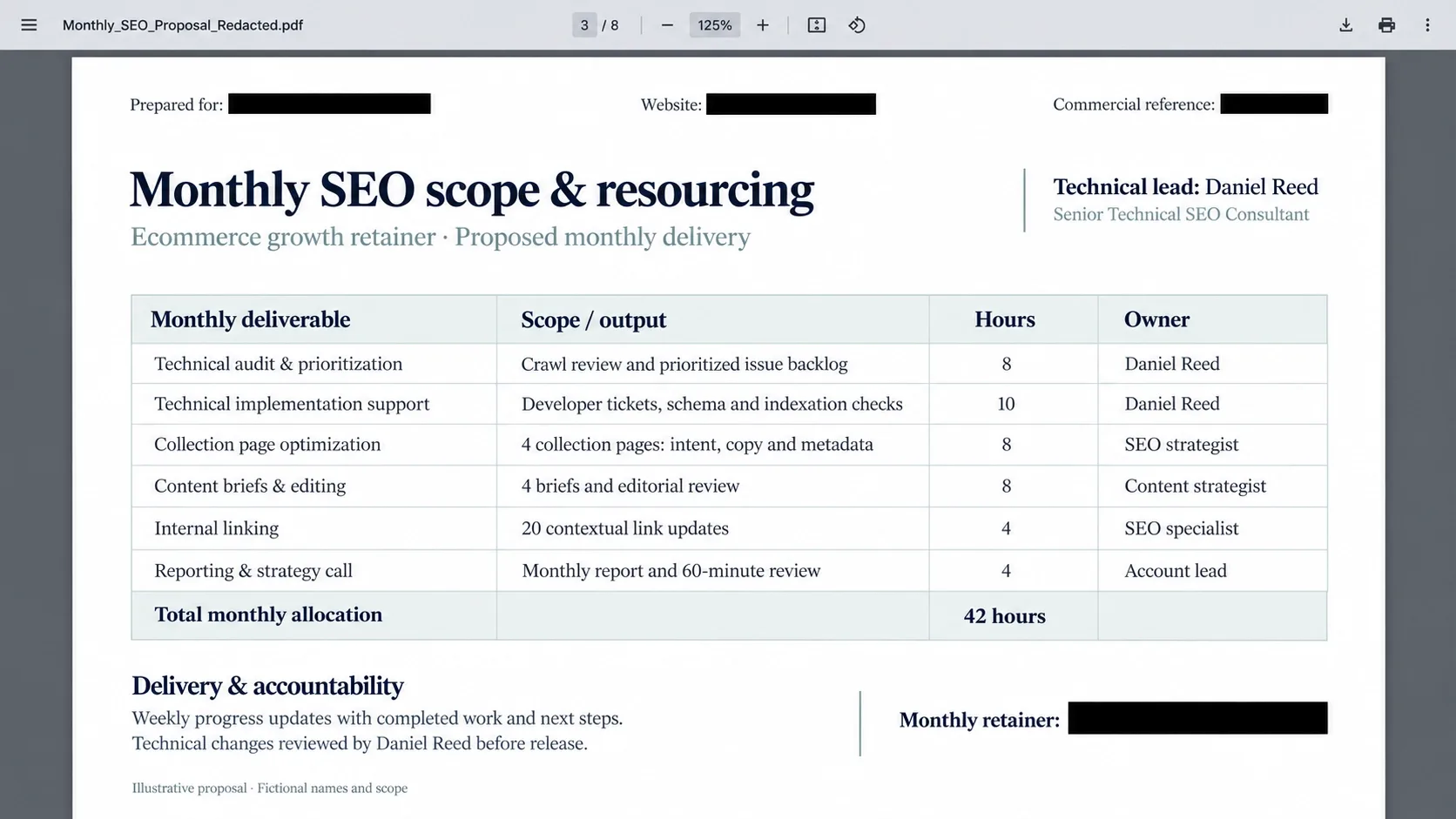
Every ecommerce SEO proposal I read is answering the same hidden question: how many hours of whose time are you actually buying? Price follows from that, not from the logo on the pitch deck. In Goodfirms' April-May 2026 survey of 300+ SEO agencies, 48% of agencies charged between $1,500 and $5,000 a month, 43.3% charged less, and only 5.5% charged more. Among agencies serving stores, 67% sat in that middle band and 22% charged $5,000 or above. North American agencies landed at $2,500 to $10,000+. That is where my range comes from.
In my conversations with eCommerce founders, the biggest source of frustration is almost always a previous agency that promised "page one in 30 days." Money was rarely the real problem. The problem was paying for activity (reports, directory links, meta tag tweaks) instead of engineering. Here is the financial and operational reality of what quality organic growth costs in 2026.
Start with the store itself. Architecture is the largest hidden line item in any proposal. A catalog with clean URLs, controlled faceted navigation and structured data from launch needs a fraction of the cleanup that a bolted-together one does, which is why our eCommerce web development services build search architecture and custom JSON-LD schema directly into the store from day one. Less post-launch technical debt means a smaller SEO bill.
One caution before the numbers. Survey data is self-reported by agencies and directional, and I'm blending it with what I see when scoping stores. Treat every range below as the start of a conversation, not a quote.
eCommerce SEO Pricing Matrix: Cost Tiers, Deliverables and Store Size
| Pricing tier | Monthly / project cost | Typical deliverables and scope | Expected results and risk profile |
|---|---|---|---|
| Low-Cost / Budget | $500-$1,500 per month | On-page basics, plugin settings, meta tweaks, a few directory or guest links, templated monthly report. Suits stores under about 100 SKUs in low-competition niches. | Slow, shallow gains. High risk of spammy links and untouched technical debt for any store competing nationally. |
| Mid-Tier / Growing DTC | $2,500-$5,000 per month | Technical audit and fixes, category and product page optimization, schema, content, a few quality links per month. Fits roughly 100 to 5,000 SKUs. | First signals around months 2-3, traction by months 5-6. Moderate risk, mostly if the dev team cannot ship fixes. |
| Enterprise / High-SKU | $7,500-$10,000+ per month | Faceted navigation and crawl-budget control, multi-market SEO, digital PR, dev sprint support, analytics, AI visibility. Fits 5,000 to 50,000+ SKUs. | Compounds over 6-12 months. Lower risk, but only with engineering access and senior oversight. |
| One-Off Project / Migration | $5,000-$25,000+ one-time | Technical audit, redirect mapping, schema overhaul, launch QA, 30-90 days of monitoring. | Protects existing revenue rather than growing it. Low risk when scoped properly, expensive when skipped. |
How to read this matrix. The ranges assume a North American agency or consultant, because that is where the survey's $2,500 to $10,000+ band sits. The same survey put South Asian and Southeast Asian agencies at roughly $500 to $2,000+ a month, and noted that the gap mostly reflects labor costs rather than a gap in expertise, while also warning that quality varies widely at every price point. Location is not a verdict. Ask who will actually touch your site, what they have shipped on stores your size, and whether they can work with your developers. Those answers tell you more than the country on the invoice.
The Complete Breakdown: How Much Does Ecommerce SEO Cost And What To Expect in 2026
Pricing is driven by catalog size, technical debt, platform complexity and niche competition. Cheap SEO tends to cost more in the end, because somebody has to clean it up. It helps to know what the money actually buys: senior strategy time, engineering hours to fix and monitor the site, content production, link acquisition, and the tooling underneath all of it. A fair proposal tells you roughly how those five are weighted. A vague one hides them inside a single monthly number.
The 4 Common Pricing Models
Monthly retainers ($2,500-$10,000+). The industry standard, for a reason: SEO compounds. A canonical fix in month two makes the category content from month five rank faster, and links earned in the first quarter lift everything after them. A retainer pays for sustained engineering, content and link acquisition rather than a fixed task list. The 2026 survey flagged a hybrid of retainer plus milestone fees as the fastest-growing structure, which suits a store that needs a migration or a digital PR push on top of steady work.
Project-based pricing ($5,000-$25,000+). Use it when the work has an end: a platform migration, a technical audit, a schema overhaul. The survey put project work at $2,500 to $20,000+ and standalone full audits at $1,500 to $5,000, which fits small catalogs. Large catalogs and replatforms quote higher in my experience, because redirect mapping across thousands of URLs is slow, careful work. I explain why migrations deserve their own budget in how to migrate your website without losing SEO rankings.
Hourly consulting ($150-$350+ per hour). Best for strategy, dev-team oversight and architectural audits where you need senior judgment rather than volume. Keep the market in perspective: the survey places senior US, UK and Australian specialists at $100 to $200 an hour, and only 3.1% of respondents charged above $200. The top of my range is for specialists who also read code.
Performance-based SEO. The hard truth is that revenue-share or rank-based pricing sounds buyer-friendly and rarely is. Providers drift toward easy keywords that hit the contract metric instead of the ones that sell. Attribution is muddy when algorithm updates and seasonality move traffic together. And the incentive to cut corners is built in. The survey itself calls this model rare and risky. I would only consider it as a small bonus layered on a real retainer.
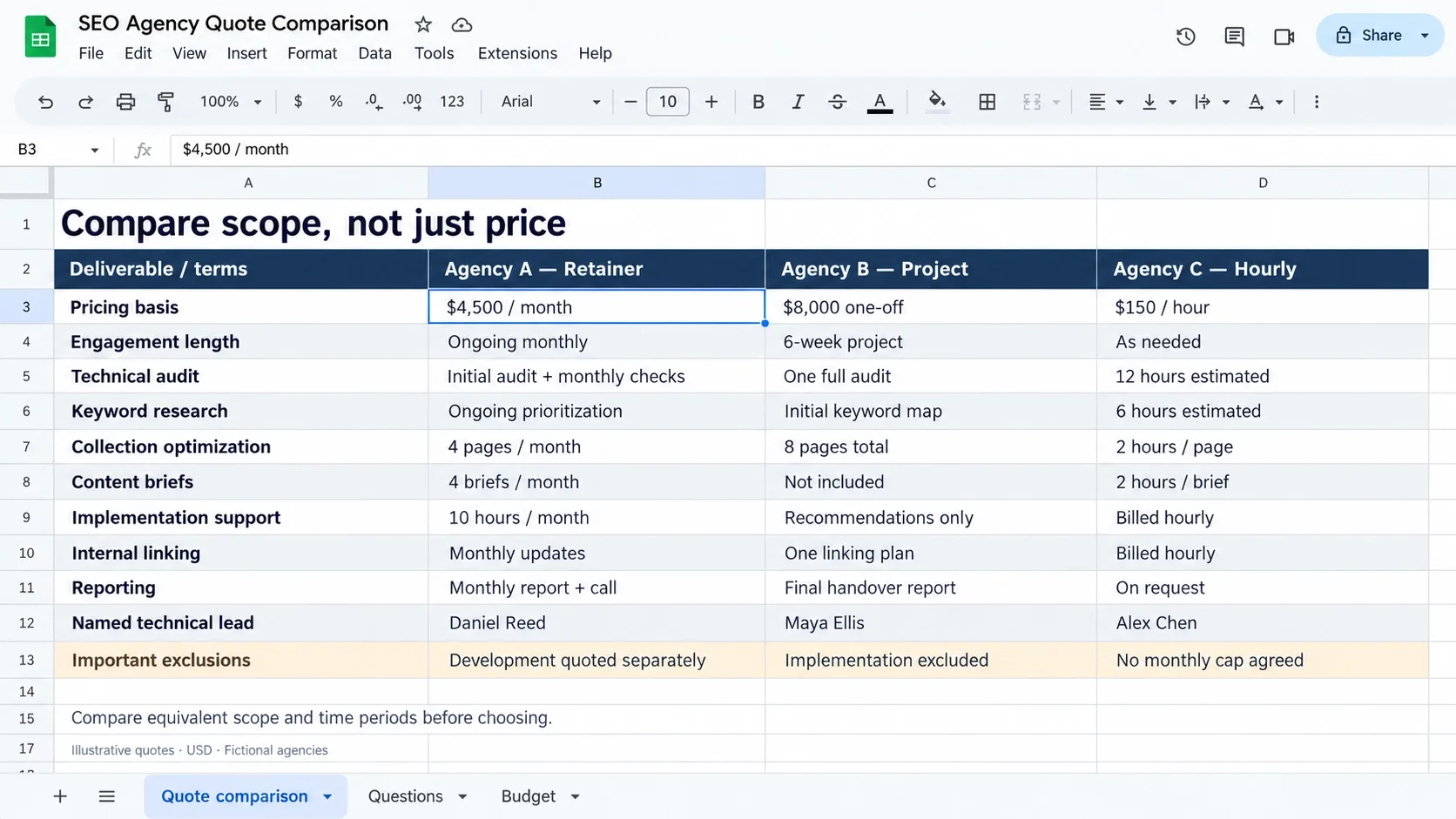
What gets billed on top of the retainer. Ask about this before you sign. The same survey priced link building at $500 to $3,000+ a month, content creation at $100 to $500+ per piece, digital PR at $2,000 to $8,000+ a month, and standalone AI and GEO optimization at $900+ a month, climbing toward $2,500 at the enterprise tier. None of those is a scam. They are real work. The trap is a retainer that looks affordable because the expensive parts are quietly excluded.
What Drives the Cost? Five Variables
Whether you pay $3,000 or $10,000 a month comes down to these.
Catalog volume and SKU complexity
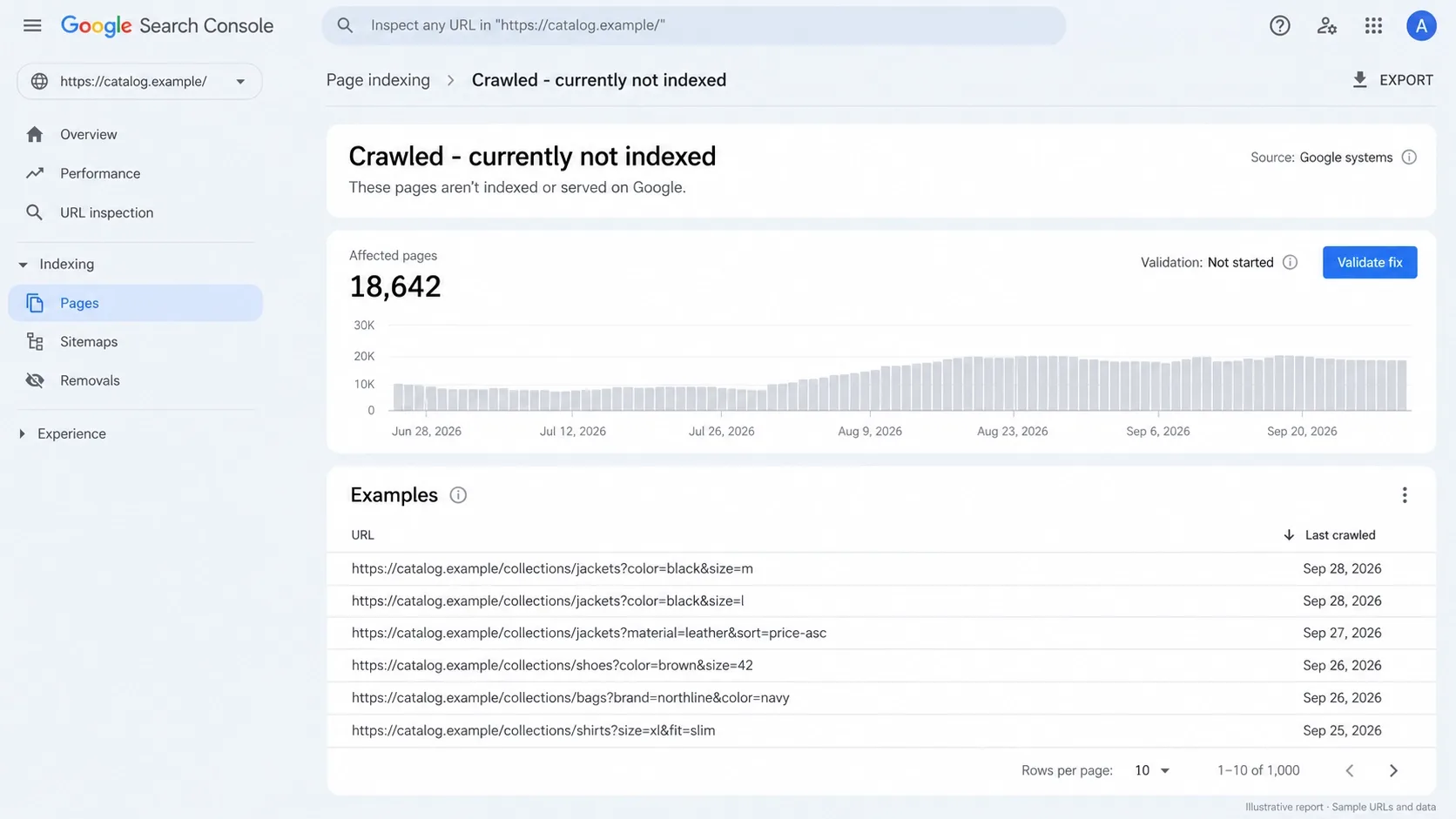
A 50-SKU store needs a clean template, sensible categories and good product copy. A 20,000-SKU catalog with thousands of faceted navigation and tag combinations is a different engineering problem, because every filter permutation can spawn an indexable URL competing for the same crawl budget. The agency survey summed it up as 50,000 SKUs meaning 50,000 SEO challenges. Templates and rules make that tractable, and building them takes senior hours.
Existing technical debt
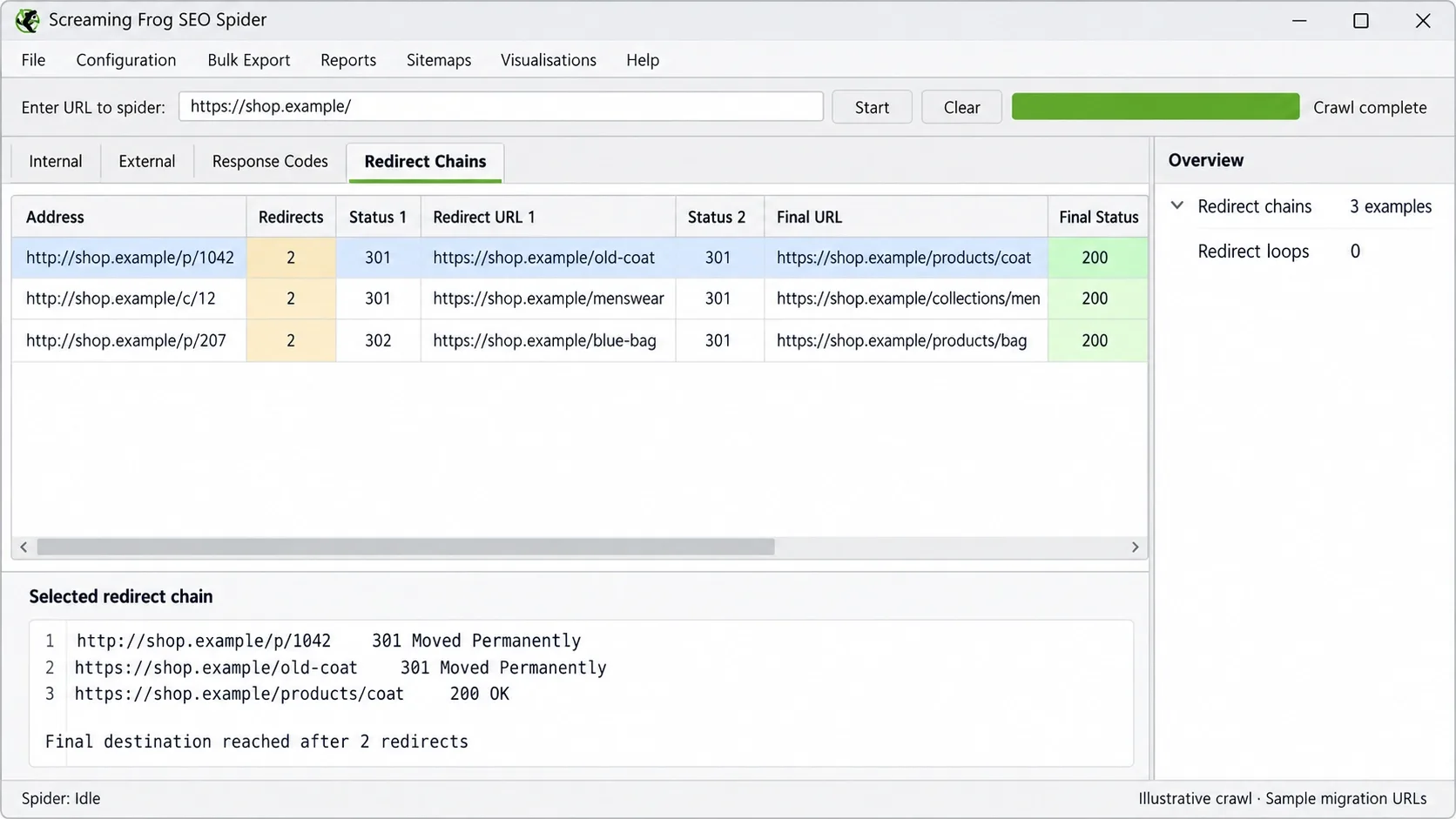
Legacy canonical loops, bloated theme code and redirect chains left over from three old migrations all eat dedicated engineering hours before growth work even starts. I list the usual platform-specific offenders in common Shopify SEO issues and how to fix them and common WooCommerce SEO issues and how to fix them. A store with heavy debt often pays a premium for months one to three, then settles into a lower steady state.
Platform Constraints
Native Shopify and WooCommerce builds are cheaper to optimize because the patterns are well known, and I compare the trade-offs in Shopify vs WooCommerce in 2026. Custom headless and composable builds give total control over URLs and rendering, but they remove the built-in SEO features, so someone has to engineer sitemaps, canonicals and schema from scratch. Minhaj, our Head of Development, explains that engineering reality in Headless Shopify: what it is, how it works, and do you really need it, and the SEO scope grows to match.
Competitive SERP landscape
Ranking for "mens leather jackets" against billion-dollar retailers needs far more authority and content than ranking in a specialist B2B niche. Look at who holds the top ten. If it is marketplaces and three nine-figure brands, budget for link acquisition and digital PR on top of on-page work. If it is a handful of small specialists, a lean technical-plus-content plan can win.
Content and backlink deficits
Count the net-new category copy, buying guides and comparison content your domain lacks, and the authority links needed to compete. The survey priced link building as an add-on at $500 to $3,000+ a month and digital PR at $2,000 to $8,000+. A "cheap" retainer that includes neither is not cheap, it is incomplete.
How the variables combine. Two hypothetical stores show the spread. Store A has 300 SKUs on a well-built Shopify theme, clean URLs and a niche where the top results are small specialists. It sits comfortably in the mid-tier at roughly $2,500 to $3,500 a month. Store B has 15,000 SKUs on a heavily customized WooCommerce build, thousands of indexable filter pages, three old migrations of redirect debt, and competitors that include marketplaces. It needs an upfront cleanup project and then $7,500 to $10,000+ a month. Same industry, same word 'ecommerce', a threefold difference in honest pricing. These are illustrations, not client results.
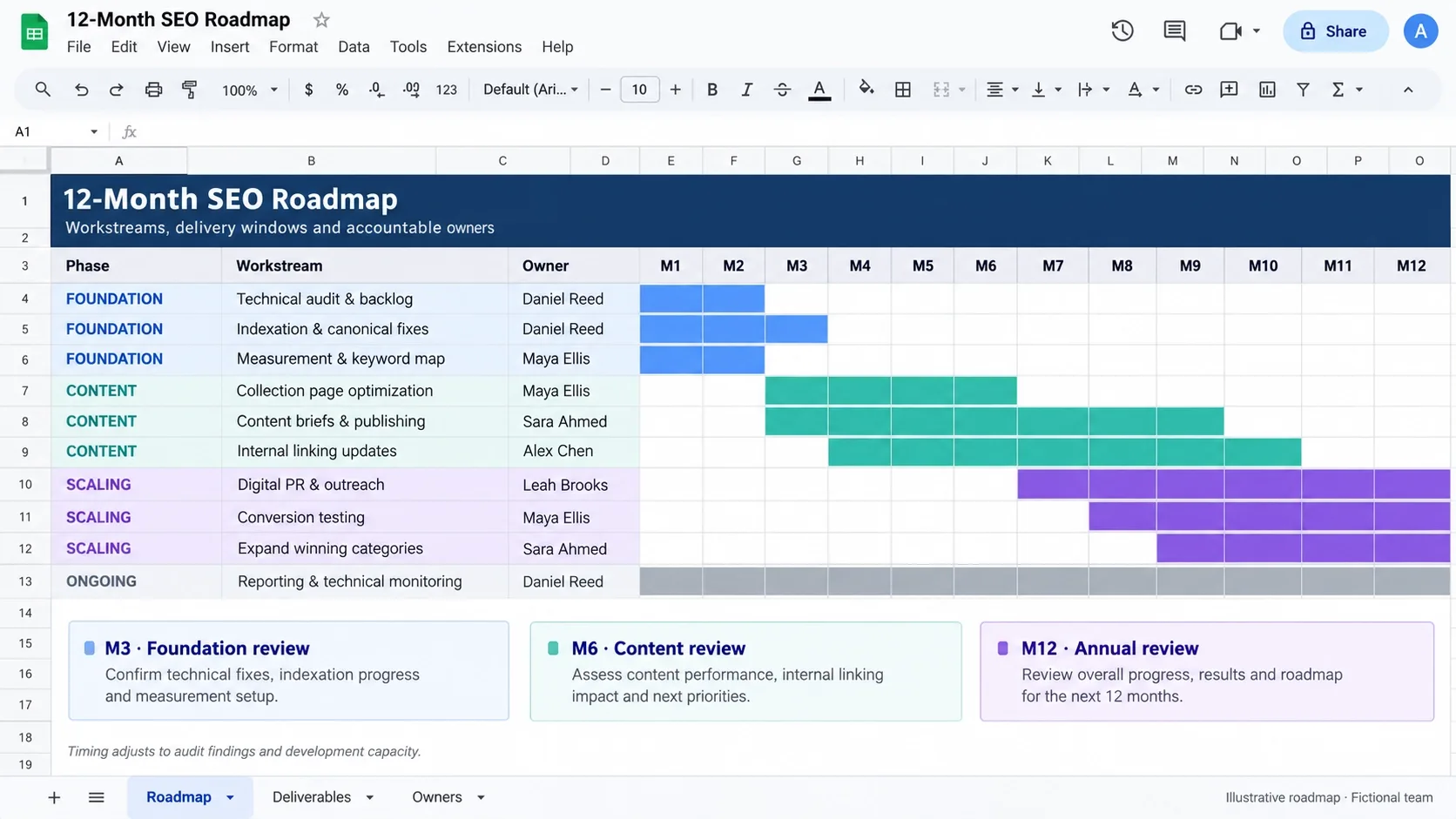
Month-by-Month Expectation Roadmap
In the 2026 survey, agencies serving ecommerce reported first signals around month two, meaningful traction around month five and full ROI around month eight. I plan on a more cautious six-to-twelve-month horizon, because stores carrying technical debt start slower. Here is what a legitimate campaign should show you at each phase.
Months 1-3: Foundation and triage. A deep technical audit, Core Web Vitals cleanup (I cover the levers in how important page speed is for SEO in 2026), custom JSON-LD schema deployment, keyword-to-URL mapping and quick-win fixes. I set out the schema rules in how to structure product schema for AI Overviews and ChatGPT citations. By day 90 you should be able to point at a changelog of shipped fixes, not a list of recommendations.
Months 4-6: Content and engine building. Category page optimization, which I walk through in how to optimize ecommerce category pages for SEO in 2026, a commercial blog hub, AEO and GEO work so product and category content can be cited in AI answers (I cover what earns citations in how to get your website cited by AI search engines), and the first digital PR and link acquisition. Expect impressions and non-branded clicks to rise before revenue does.
Months 7-12: Compounding revenue and scaling. High-intent keyword movement, non-branded search growth, conversion rate optimization on landing pages and expansion into secondary category clusters. This is where design earns its keep, and I lay out the fundamentals in ecommerce web design best practices.
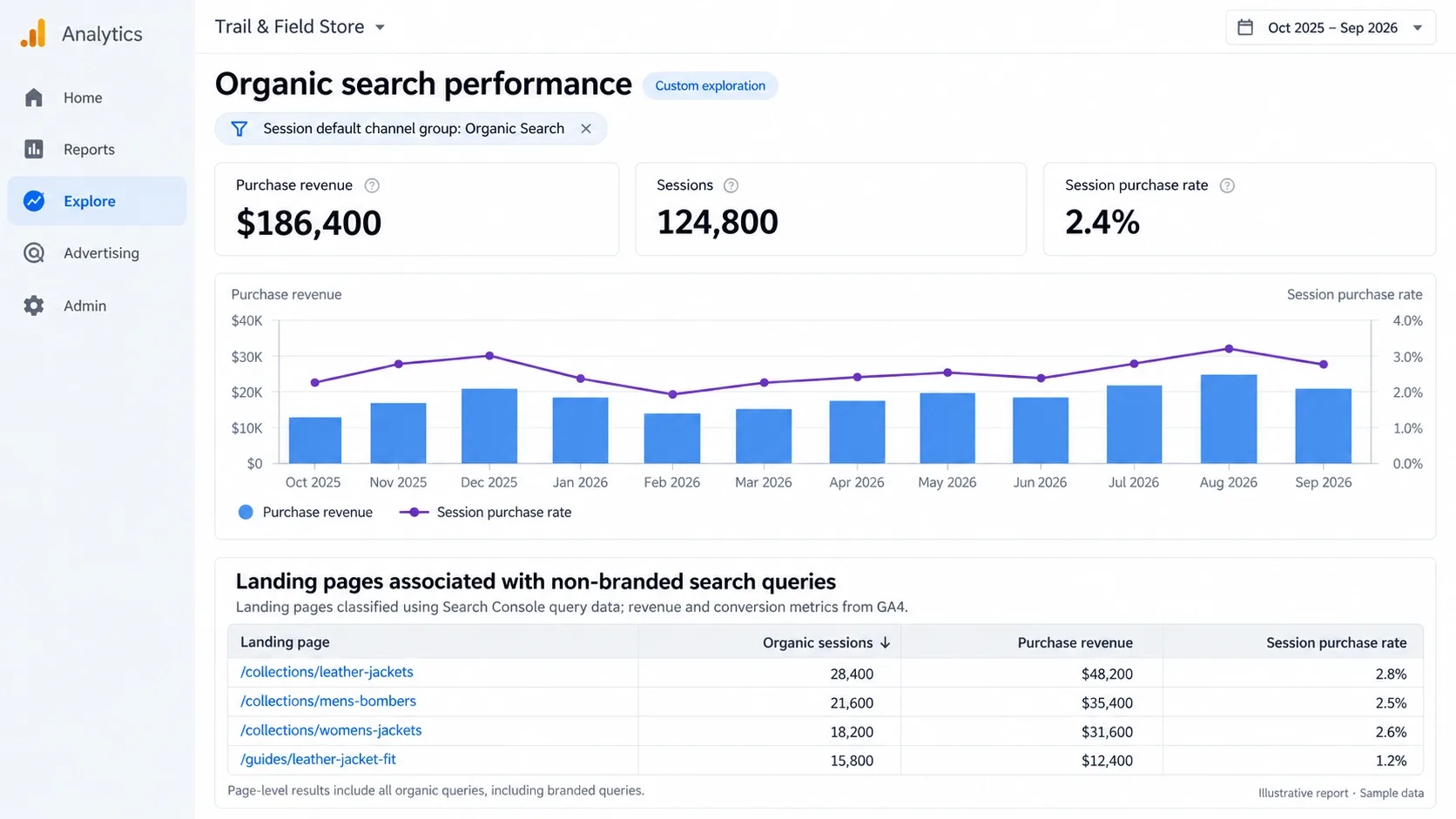
What every monthly report should contain. A changelog of what shipped on your site that month. Non-branded organic revenue and conversion rate, not just sessions. Pages indexed versus pages submitted. Link placements with the source URLs. Content published and the URLs it targets. And the priorities for next month, with owners. If a report cannot answer what changed on the site and what it did to revenue, it is a status update, not an SEO report. I track the weekly signals behind these numbers in what weekly SEO metrics you should measure.
Red Flags and Scams: How to Spot a Cheap SEO Trap Before Signing
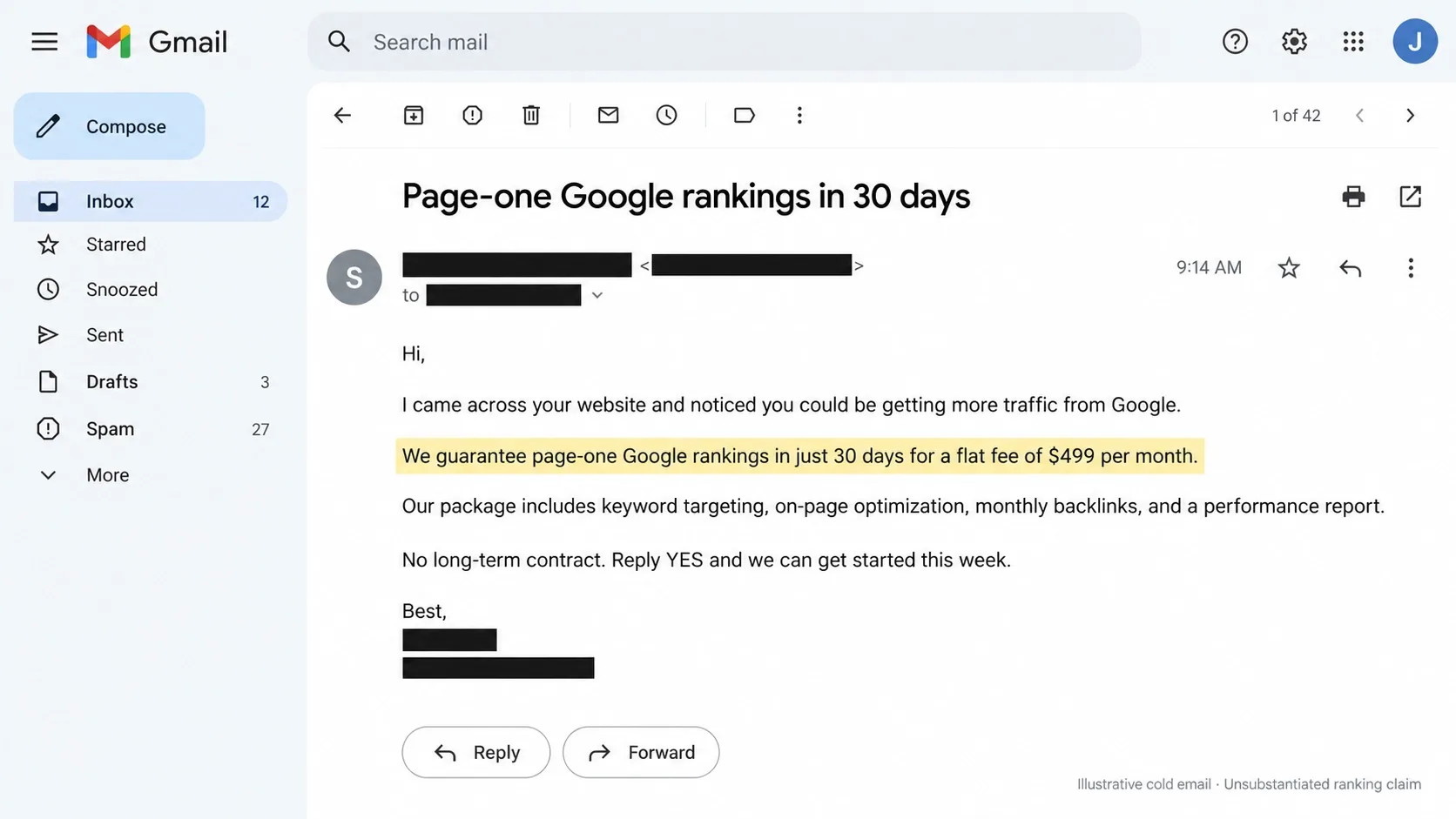
"Page one in 30 days." Google's own guidance on hiring an SEO is unambiguous: no one can guarantee a number one ranking, and anyone alleging a special relationship with Google should be avoided.
"1,000 backlinks for $200." Links at that price are automated or spun. In the survey I cited above, sub-$300 "comprehensive SEO" was flagged as templated at best and spam at worst, while genuine link building ran $500 to $3,000+ a month.
Vanity reporting. Monthly decks celebrating impressions and arbitrary keyword movement without tying anything to organic revenue, conversion rate or technical health. When evaluating a proposal, the first thing I look at is whether you are charged for actual technical execution or just fluff reporting like "monthly meta tag submission" and "bookmarking links."
Lock-in without checkpoints. A twelve-month minimum with no milestone reviews is a bet that you will not look closely. Ask for a three-month review gate tied to shipped deliverables, and a clear exit if they are missed.
Black-box workflows. An agency that will not tell you where links come from or how content is produced is hiding something. At the audit stage, grant read-only Search Console access and nothing more; Google advises exactly that. If you want a second opinion on a proposal, it is a normal part of an ecommerce SEO review.
How to Calculate Your Ecommerce SEO ROI
Run SEO like the capital investment it is. Start with unit economics: your customer acquisition cost from paid channels, and the customer lifetime value of the customers SEO would bring in. Then work backward from the spend. Breakeven sessions equal monthly SEO spend, divided by gross margin per order, divided by conversion rate. Now look at the numbers, using a hypothetical store with round figures, not a client result.
Say the retainer is $4,000 a month, average order value is $85, gross margin is 45% and organic conversion rate is 1.8%. Each first order earns $38.25 in gross profit. You need about 105 incremental orders a month to cover the retainer, which means roughly 5,800 extra organic sessions. Now add repeat purchases. If the average customer orders 2.2 times, a new customer is worth about $84 in gross profit, and breakeven drops to roughly 48 new customers, or about 2,600 sessions. Same spend, very different verdict. That gap is why LTV belongs in the model.
Revenue lags, so track leading indicators while you wait for it: indexed pages as a share of submitted pages, non-branded impressions, the share of commercial queries where category pages hit page one, Core Web Vitals pass rate and link velocity. AI answers also muddy attribution, because a shopper can read your content in an overview and buy through a direct visit two weeks later. Watch branded search growth alongside last-click revenue so the picture stays honest.
Paid reach, meanwhile, is rented. SE Ranking's July 2026 study of 50,032 commercial keywords found Google's AI Mode showing a text ad on 29.45% of commercial queries, and for about 88% of those ad keywords the advertiser's domain was not among the sources AI Mode cited. For roughly 85% of them the advertiser had no organic presence at all. Buying the slot buys the slot and nothing more. Organic equity is a separate asset that keeps building after the invoice is paid.
FAQs
How long does it take for ecommerce SEO to show real ROI?
Plan for six to twelve months. In a 2026 survey of 300+ agencies, those serving ecommerce reported first signals around month two, meaningful traction around month five and full ROI around month eight. Stores with heavy technical debt, thin category content or a weak backlink profile start slower because the foundation work has to land first. Judge progress by non-branded organic revenue and shipped fixes, not by rankings alone.
Why is ecommerce SEO generally more expensive than local SEO?
Scale and complexity. A local service business optimizes a handful of pages around a city, while a store manages thousands of product and category URLs, faceted navigation, schema, crawl budget and competition from marketplaces. The 2026 agency survey put local SEO at $500 to $1,500 a month and ecommerce mostly at $1,500 to $5,000 or more. More URLs and more engineering mean more senior hours.
Should I hire an in-house SEO specialist or an agency?
Hire in-house when you have enough ongoing work, developer access and budget for a senior person plus tools. One specialist rarely covers technical SEO, content, link acquisition and analytics at the same depth. Agencies bring a bench and cross-store pattern recognition. Many scaling brands land on a hybrid: an in-house owner who sets priorities, with an agency or consultant for technical depth and link work.
Can I do ecommerce SEO myself without an agency?
Yes, for a small catalog on a well-supported platform. Set up Search Console, fix titles, write real category copy and keep the site fast. It breaks down around faceted navigation, canonical logic, schema and redirect mapping, where one mistake can deindex hundreds of pages. Be honest about your time, because DIY SEO costs hours you could spend running the business.
What is the difference between a technical SEO audit and ongoing monthly SEO?
An audit is a one-off diagnosis: what is broken, what it costs you and what to fix first. Ongoing SEO is the work of fixing it and building on it, month after month, through content, links and monitoring. An audit without implementation is a document. Implementation without an audit is guesswork.
How does AI search (ChatGPT, Google AI Overviews) affect ecommerce SEO pricing in 2026?
It is pushing retainers up. In the 2026 survey, 54.3% of agencies raised prices in 2025-2026, and adding GEO and AEO services was the single most-cited reason, often billed as an add-on averaging $900+ a month. Ask any agency which platforms it monitors and what the reporting looks like before paying extra.
How do I know if my current SEO agency is actually doing good work?
Ask for three things: a changelog of fixes shipped on your site, reporting tied to non-branded organic revenue and conversion rate, and the source of every link they build. Good agencies answer immediately. If your reports are mostly impressions and keyword movement, you are looking at reporting theater.
What percentage of my ecommerce revenue should I allocate to SEO?
There is no universal percentage, and I distrust anyone who quotes one. Work backward instead: decide the incremental organic profit you need, estimate the sessions and orders required, and fund the budget that makes that plausible within twelve to eighteen months. My planning rule is to want expected organic contribution margin to exceed spend by a healthy multiple once the campaign matures. A store with strong margins and high repeat purchase can justify a higher share than a thin-margin one.

Written by
Kashaf
Kashaf is a veteran SEO specialist with deep expertise in AI SEO, generative engine optimization, ORM, web strategy, and marketing automation. With a Master's in Computer Science, he blends search strategy with technical insight into websites, automation workflows, and AI-driven platforms, helping brands dominate traditional search while adapting to the future of AI-powered discovery.