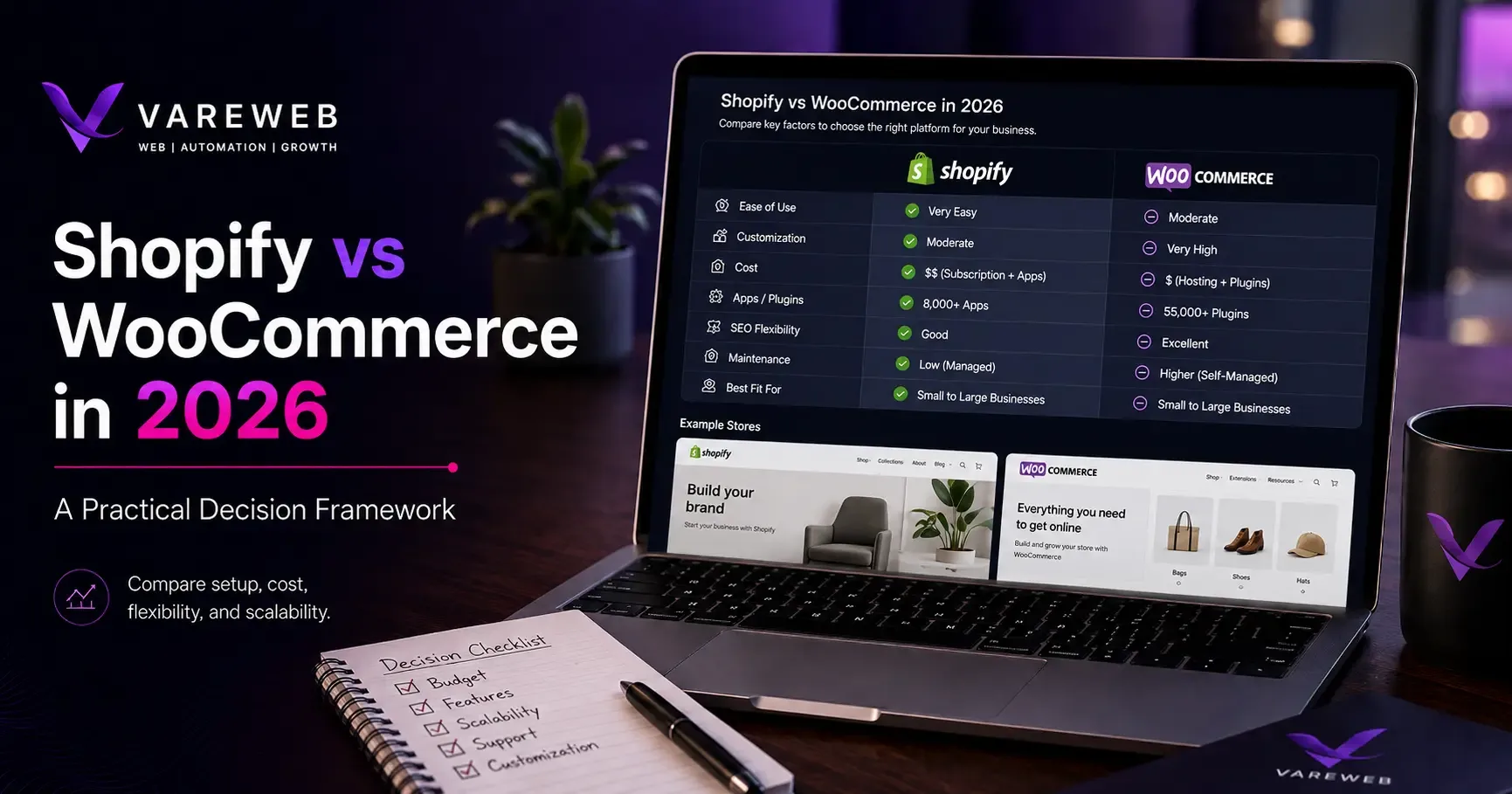
Quick Answer: Shopify and WooCommerce are not universally better or worse than one another; they are designed for different types of merchants. The right choice depends on how much control your business needs, the technical resources you realistically have available, and how quickly you want to launch and start selling. Shopify usually suits businesses that prioritize simplicity and speed, while WooCommerce is better suited to merchants who want greater flexibility and hands-on control.
I get asked "Shopify or WooCommerce?" more than almost any other question that lands in my inbox, and I still refuse to answer it the way people want me to. Not because I'm dodging it. Because the honest answer depends on details the question itself leaves out. What's your monthly revenue actually doing right now? Is there a developer you can call at 9pm on a Friday when checkout breaks? Is your growth story built on blog content and organic search, or on paid ads and a product page that loads in under two seconds? People want a winner declared. What they actually need is closer to a mirror.
Between them, these two platforms carry a genuinely enormous share of the web's commerce. WooCommerce alone accounts for 48.1% of all the e-commerce systems that W3Techs tracks across its surveys, which makes it, by a wide margin, the single most-used ecommerce technology on the open web. Shopify sits behind it at 31.7% of tracked e-commerce systems - second overall, but with a noticeably different kind of merchant behind those numbers: fewer total stores, concentrated more heavily among brands doing real transaction volume through a fully hosted checkout. Together, the two platforms make up close to four out of every five ecommerce systems W3Techs can identify on the live web. If you're choosing a platform in 2026, you are almost certainly choosing between these two, whether or not you've said that out loud yet.
I've laid out a broader framework for picking among all the major ecommerce platforms - Shopify, WooCommerce, BigCommerce, Adobe Commerce - in How to Choose the Right Ecommerce Platform for Your Business in 2026, if your shortlist hasn't narrowed yet. This piece assumes it has. If you're down to Shopify versus WooCommerce specifically, here's what I've learned building, auditing, and migrating stores on both - where each one earns its reputation honestly, and where the marketing pages oversell it
Here's the core difference, stated plainly before anything else: Shopify is a fully hosted, managed platform. You pay a monthly subscription, and Shopify hands you hosting, SSL, a CDN, PCI-compliant checkout, and infrastructure that just works, bundled into that fee. WooCommerce is the opposite kind of product entirely. It's a free, open-source plugin that installs on top of WordPress. The plugin itself costs nothing. Everything underneath it - hosting, security patching, performance tuning, backups, uptime - is your responsibility, or your developer's.
Shopify simplifies operations by centralizing the technical stack in one place, on Shopify's terms. WooCommerce hands you deep control over that same stack, entirely on your terms, at the cost of owning it. Neither trade is free. You're either paying in platform constraints or paying in ongoing maintenance hours. What usually goes wrong, in my experience, is founders picking a platform on sticker price alone, without pricing in which side of that trade-off their team is actually equipped to manage.

Platform Overview: What Shopify and WooCommerce Really Are in 2026
A lot of the confusion I run into in client meetings starts from a fuzzy version of the distinction above, so it's worth being precise before comparing features line by line.
Shopify: hosted, managed, opinionated by design
Shopify is a closed, fully hosted SaaS ecommerce platform. You sign up, pick a plan, and Shopify runs the servers, issues the SSL certificate, operates the CDN, and handles PCI compliance for you automatically. Themes are built in Shopify's own Liquid templating language. Extensions come through an app ecosystem of roughly 8,000 apps rather than open-source plugins. You never touch a server, and that's the point - Shopify trades flexibility for reliability, and it's opinionated about exactly where that line sits.
WooCommerce: open-source, self-hosted, unopinionated
WooCommerce is a free plugin for WordPress, maintained by Automattic. Install WordPress, install WooCommerce, and you have the bones of a store - but you choose the host, you manage updates, and you own every performance and security decision that Shopify makes invisibly on your behalf. In exchange, you get full code-level access: PHP, HTML, CSS, JavaScript, and a plugin ecosystem numbering in the tens of thousands. Nothing about WooCommerce tells you no. That's simultaneously its best feature and, left unmanaged, its most common failure mode.
Hosted vs open-source: the trade nobody explains well
Every platform conversation eventually collapses into this one real distinction: software as a service platforms versus open-source, self-hosted ones. Shopify, BigCommerce, and Wix sit in the first bucket. WooCommerce, PrestaShop, and Adobe Commerce sit in the second. Hosted platforms handle your servers, security patching, uptime, and a good chunk of scaling automatically - you're renting infrastructure and accepting the constraints bundled with it. Open-source platforms flip that arrangement entirely: you get code-level control over almost everything, but hosting, performance, and security become your job instead of the platform's.
I'd frame it as less technical responsibility versus more technical control, not better versus worse. In my audits, the platform is rarely the actual point of failure - the build discipline sitting on top of it usually is. If you land on Shopify, look for a team offering Shopify Development Services That Work With the Platform, Not Around Its Limits, don't get a generic build wrapped around a purchased theme with your logo swapped in. If WooCommerce fits your stage better, the same logic applies in reverse, arguably with higher stakes: WooCommerce Website Development Services matters more on WooCommerce than on almost any other single decision, because nothing in WooCommerce's architecture stops a build from quietly accumulating forty plugins and running on hosting that was never built to handle real transaction volume.
Ease of Use and Setup Experience
Shopify's onboarding is genuinely fast. A non-technical founder can register a domain, pick a theme, add products, and configure Shopify Payments in an afternoon. Basic setup runs in hours, not days, for a simple catalog. Nothing about that first week requires a developer on standby.
WooCommerce asks more of you before you sell a single product. You need WordPress installed, a host selected and configured, a theme chosen, WooCommerce activated, and a payment gateway connected - each one a small decision with downstream consequences. None of it is difficult individually. Stacked together, it's a meaningfully longer runway, measured in days rather than hours for anyone without prior WordPress experience.
What I actually watch for on early client calls isn't which platform is "easier" in the abstract - it's whether the person in front of me has done this before. Founders who've never touched a CMS underestimate WooCommerce's setup curve almost every time. Developer-led teams underestimate how quickly Shopify's guardrails start to chafe once they need something the platform simply wasn't built to do out of the box.
There's a middle scenario worth naming honestly: a founder who is technical enough to be dangerous, but not experienced enough to know where WooCommerce's real landmines sit. That's the profile I see get into the most trouble - confident enough to skip a proper hosting evaluation, not experienced enough to recognize a page-builder conflict with checkout before it costs a launch week. If that's you, the fix isn't necessarily switching platforms. It's getting a second set of eyes on the stack before it goes live, not after something breaks.
Cost and Total Cost of Ownership
This is where I see the most expensive mistakes get made, because the monthly plan price is the least interesting number in the entire decision.
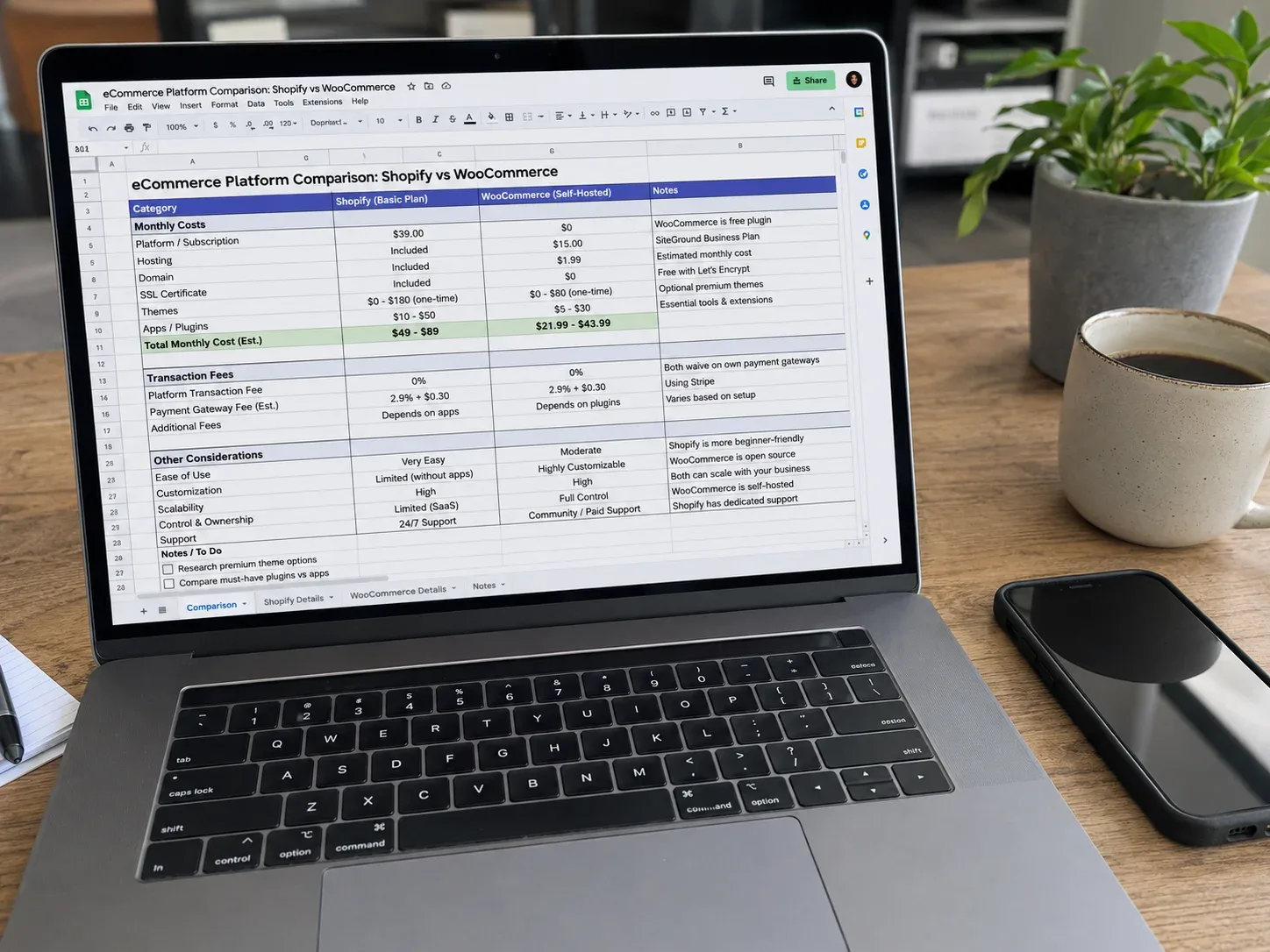
Shopify's cost stack: Plan pricing scales from roughly $39 a month on the entry tier up through Advanced, with Shopify Plus sitting well above both for enterprise-tier needs. If you use a third-party payment gateway instead of Shopify Payments, Shopify layers on an additional transaction fee - as high as 2% on the entry plan, dropping as you move up tiers, and disappearing entirely if you use Shopify Payments. Hosting, SSL, security, and CDN are bundled into that monthly fee; you never see a separate line item for any of them.
WooCommerce's cost stack: The plugin itself is free. Real costs live in hosting (WooCommerce-optimized managed hosting runs meaningfully more than generic shared hosting, and for good reason), premium plugins and themes, developer time for setup and ongoing maintenance, and payment gateway fees - Stripe's standard 2.9% plus $0.30 being the common baseline, with no additional platform-level transaction fee stacked on top. I've covered the store-size-by-store-size cost breakdown in more depth in How Much Does an E-commerce Website Cost?, including a table most first-time founders find useful for budgeting an initial build.
The pattern I see most often: "cheaper" WooCommerce quietly becomes expensive once you price in hosting quality and maintenance hours nobody budgeted for at launch. "Expensive" Shopify can end up cheaper overall by removing technical overhead your team was never going to hire for anyway. Total cost of ownership over 24 months - not the plan price on the pricing page - is the number that actually decides which platform is cheaper for your specific business.
What this actually costs by revenue stage
Rough bands, not hard rules, because real businesses rarely sit neatly inside them:
- Under roughly $50K/year: simplicity and low overhead beat feature depth every time on either platform. A lean Shopify setup with a handful of apps, or a modest WooCommerce build on solid managed hosting, will both out-earn a fully custom build you cannot maintain.
- Roughly $50K-$500K/year: this is where the platform decision starts to compound. Integrations, better reporting, and early B2B needs begin to matter, and whichever platform you picked starts showing its real maintenance profile, not just its onboarding experience.
- $500K+/year: Shopify Plus or a dedicated WooCommerce hosting and development retainer both start earning their higher cost here, though plenty of stores at this level still run comfortably on standard tiers of either platform.
One pattern I see constantly at the early stage: founders spend weeks comparing plan tiers feature by feature and end up further from a decision than when they started. Past a certain point, more comparison isn't more clarity - it's a way of postponing a choice that's ultimately about your team's capacity, not the spreadsheet.
Performance, Core Web Vitals, and Reliability
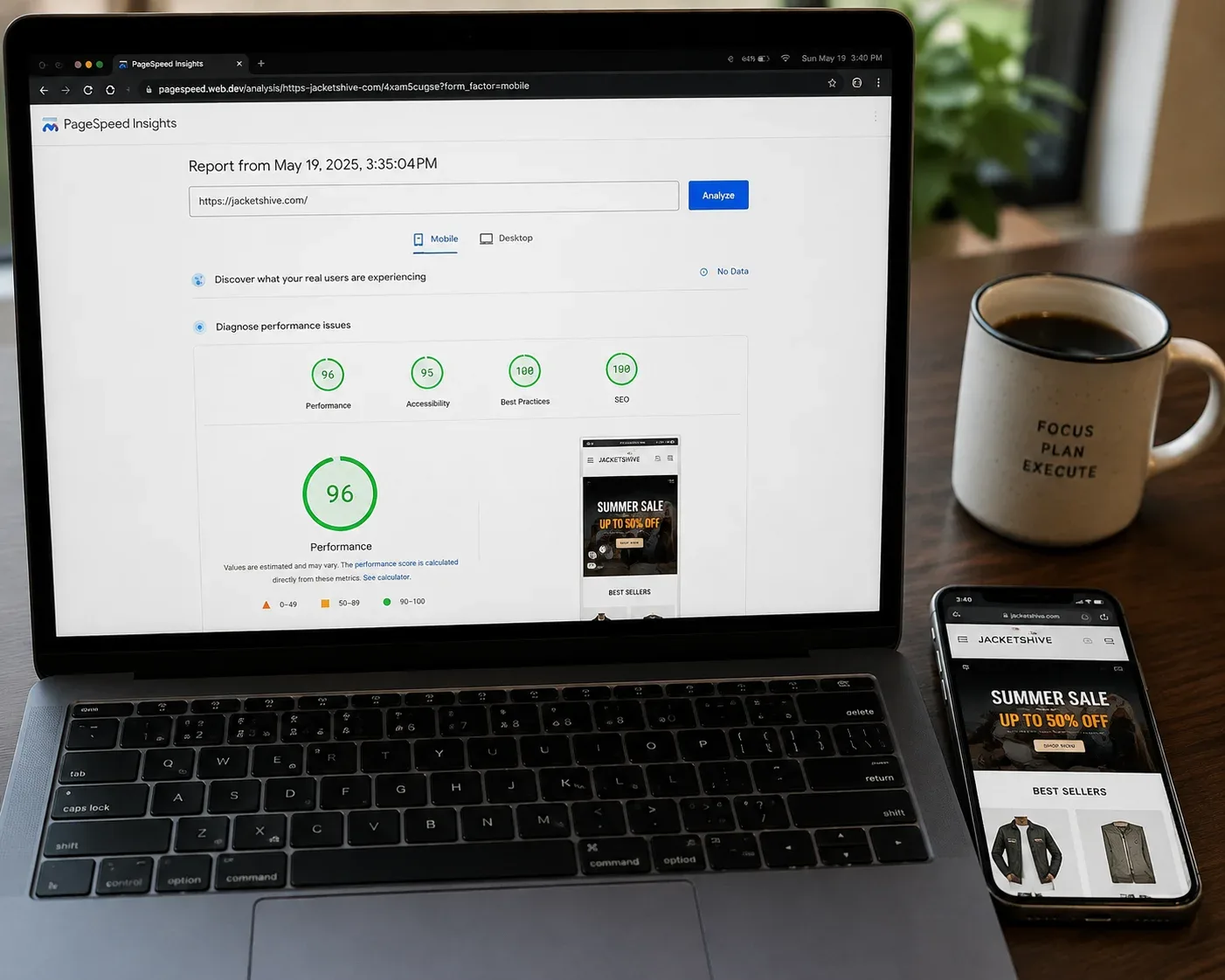
Shopify runs on managed global infrastructure with automatic image optimization and a CDN baked in. Most stores I audit hit strong Core Web Vitals scores with minimal manual tuning, simply because the platform's defaults are already reasonably fast.
WooCommerce's performance is entirely a function of hosting quality and plugin discipline - there's no platform-level floor protecting you from a bad decision here. I've audited WooCommerce stores running on $5-a-month shared hosting with no object caching and no OPcache configured, trying to process real order volume, and the ceiling on that setup isn't a code problem. It's a server problem that more optimization work simply can't fix. Move the same store to WooCommerce-optimized managed hosting - WP Engine, Kinsta, Pressable - and the performance conversation changes entirely, often more than months of front-end tuning would have moved it.
Neither platform gets a pass on speed being optional. Slow pages cost rankings and they cost sales on either platform, and the fix looks different depending on which one you're on: an app audit on Shopify, a hosting and plugin audit on WooCommerce.
SEO and Content Capabilities
Shopify gives you the SEO essentials: editable titles and meta descriptions, alt text, basic schema, canonical tags, and an app ecosystem to extend what's missing. Its URL structure is fixed in places - /collections/, /products/ - which limits full control over information architecture. What it wins back is speed and stability with minimal technical effort, which quietly helps SEO even when nobody on the team is actively optimizing for it.
WooCommerce, running on WordPress, gives you the opposite trade: deep control over URLs, taxonomies, and content architecture, plus a mature SEO plugin ecosystem - Yoast, Rank Math - and genuinely strong blogging tools for brands where organic content drives real acquisition. The flexibility is real. So is the requirement that someone actually use it well; WooCommerce doesn't optimize itself the way Shopify's defaults quietly do.
Ecommerce SEO specifically has its own failure patterns that neither platform solves automatically - category pages cannibalizing each other, faceted navigation generating thousands of near-duplicate URLs, product feeds falling out of sync with Merchant Center. That's genuinely different work from blog SEO, and it's why SEO Services for eCommerce That Go After Revenue, Not Just Rankings exists as a distinct engagement from general SEO - the technical crawl issues and category-page architecture matter more on a store than they do on a service business's blog, regardless of which platform is underneath it.
There is also a newer layer sitting on top of classic SEO in 2026: whether AI shopping assistants and AI Overviews can parse your catalog well enough to cite it. That rewards the same fundamentals that already mattered for search - clean schema, genuine product content, stable URLs - rather than anything platform-exclusive. A store with thin, manufacturer-pasted product descriptions and no structured FAQ content is invisible to an AI answer engine on either platform. A store with real editorial content, complete schema, and a clear content architecture is legible to one, also on either platform. The platform decides how much friction stands between you and that outcome. It doesn't decide the outcome itself.
AI Features and Future-Ready Commerce
Shopify has invested directly in native AI tooling - Shopify Magic for product descriptions, email content, and merchandising assistance, built into the platform rather than bolted on. The company's own most recent quarterly results reported AI-driven traffic and orders growing roughly threefold year over year, alongside GMV crossing $115 billion for the quarter - evidence, at minimum, that AI-assisted commerce is no longer a roadmap slide for Shopify but a measurable share of current merchant activity.
WooCommerce doesn't have an equivalent native suite. What it has instead is a plugin ecosystem building AI functionality on top of the open platform - third-party tools connecting to language-model APIs for content generation, product recommendations, and customer service. It works, and for a content-heavy WooCommerce store the same WordPress ecosystem that makes SEO flexible also makes AI tooling flexible. It's just fragmented across multiple subscriptions rather than unified inside one admin panel.
If AI-assisted content and marketing workflows genuinely matter to how you plan to run the store day to day, Shopify's native approach removes friction WooCommerce simply hasn't consolidated yet. If you're comfortable stitching together the right plugin stack - and on WooCommerce, you already are, by necessity - the gap closes considerably.
Customization, Flexibility, and Control
Shopify gives you theming through Liquid and an app ecosystem - real, but bounded by platform rules. Checkout customization is largely reserved for Shopify Plus; on standard Shopify, you can adjust branding and add upsell blocks, but not core checkout logic or field structure. That's a hard platform limit, not a workaround waiting to be found.
WooCommerce gives you full code access - PHP, HTML, CSS, JavaScript - and functionally unlimited customization for product logic, checkout flow, and user journeys, provided you or your developer can build it. Complex membership models, unusual pricing logic, and non-standard commerce experiences are all realistic on WooCommerce in a way they simply aren't on standard Shopify.
The honest read: WooCommerce is the better fit when you need highly custom flows, complex subscriptions, or business logic a template platform resists, and you have real development capacity to build and maintain it. Shopify is the better fit when you're comfortable working inside its guardrails in exchange for not having to build or maintain the infrastructure yourself.
Shopify Plus vs. WooCommerce With a Dedicated Dev Team
This comparison changes shape once you're past the early stage and evaluating enterprise-tier options. Shopify Plus brings managed infrastructure at scale, checkout extensibility that standard Shopify doesn't offer, multi-storefront management through the Organization dashboard, and dedicated platform support - at a significantly higher monthly cost than standard Shopify, and often with more complex agency support required to use it well.
WooCommerce paired with a strong development team brings the opposite trade at a similar investment level: full control over checkout logic, no platform licensing fee stacking on top of hosting and developer costs, and the ability to build genuinely custom commerce experiences a template platform can't express. What it doesn't bring is Shopify's managed reliability - at enterprise transaction volume, hosting architecture and database performance become serious engineering problems that a dedicated team has to own directly rather than delegate to a platform vendor.
I don't have a universal answer for which one wins at this tier, and I'd be skeptical of anyone who claims to. What I do have is a pattern: multi-brand operations and businesses with genuinely unusual checkout requirements tend to land on Shopify Plus or a headless build. Content-heavy publishers and businesses with deep custom logic tend to land on WooCommerce with real engineering behind it. Both are legitimate answers to the same question, depending on which constraints your business can actually absorb.
Conversion and Checkout Experience
Shopify's native checkout - Shop Pay, one-click payment options, a purchase flow refined across millions of merchants - is a genuine structural advantage for standard consumer ecommerce. It's fast, trusted, and it converts well without custom engineering.
WooCommerce's checkout is more flexible but ships with more decisions attached: which page builder, if any, sits near it; which checkout plugin handles field logic; how cleanly it's isolated from theme styling that might conflict with it. I've seen WooCommerce checkouts break silently under a page builder fighting a checkout-optimization plugin - nobody catches it in staging, and it surfaces during a traffic spike, which is exactly the worst possible time for it to happen.
Reducing abandonment matters on either platform, and most of the fixes - transparent shipping costs, fewer form fields, multiple payment options, mobile-first design - apply regardless of which one you're running. I go deeper on the specific tactics in How to Reduce Cart Abandonment in 2026, and most of it transfers directly whether your cart lives on Shopify or WooCommerce.
Security, Compliance, and Maintenance
Shopify handles PCI DSS compliance and infrastructure security automatically - patches, certificate renewal, and platform hardening are Shopify's problem, not yours. Your remaining responsibility narrows down to app permissions and admin access hygiene. Even on Shopify Plus, where the store is a bigger target by transaction volume, the compliance burden that would otherwise sit on a merchant's plate is largely absorbed by the platform. I've written a more detailed rundown of the specific controls worth layering on top in How to Protect Your Shopify Plus Website from Hackers.
WooCommerce puts security and PCI responsibility squarely on you, your host, and your developer. Outdated plugins with known vulnerabilities on a store processing payment data isn't a theoretical risk - it's the single most common attack vector I see in incident reports from clients who came to me after something had already gone wrong. A managed update schedule, rather than reactive patching after a breach notification, is the difference between the two outcomes.
Neither platform is inherently less secure than the other. Shopify removes infrastructure risk by centralizing it under one vendor's control. WooCommerce distributes that same risk to whoever is running your update and hosting discipline - a fine trade if that discipline genuinely exists, and a serious liability if it doesn't.

Where Merchants Are Actually Moving in 2026
Platform switching is more common than most people expect, and it runs in both directions. Store-tracking data from Store Leads shows WooCommerce's live-store count contracting through the middle of 2026, with WooCommerce losing roughly as many merchants to Shopify over a recent 90-day window as it gained from Shopify over that same period - a genuinely close-to-even exchange, not a one-directional exodus in either direction. That symmetry matters. It means the "right" platform genuinely varies by merchant, rather than one platform objectively winning migrations at scale.
Migrating between the two is a real project either direction - product data, customer records, order history, and content all need to move cleanly, with every changed URL mapped to a 301 redirect so existing search rankings survive the transition. I go through the full process, platform-agnostic, in How to Migrate Your Website Without Losing SEO Rankings, and the same discipline applies whether you're moving Shopify to WooCommerce or the other way around: baseline first, redirect map before the build, monitoring plan before launch.
If you're actively considering a move, the honest question isn't "which platform is objectively better" - it's whether the reason you're moving is a platform limitation you've genuinely hit, or a maintenance problem you could fix on the platform you're already on. I've watched founders migrate away from a perfectly good WooCommerce build because a bloated plugin stack made the platform feel broken, when the actual fix was a plugin audit that would have cost a fraction of a full replatform.
Common Mistakes I See Founders Make
These repeat across industries and revenue sizes, on both platforms. If you recognize your business in more than one, it is worth slowing down before you commit.
- Choosing based on a competitor's stack rather than your own constraints - what works for a brand with a five-person dev team rarely transfers cleanly to a two-person operation.
- Underpricing WooCommerce by comparing the free plugin cost against Shopify's monthly fee, while ignoring hosting, premium plugins, and developer hours entirely.
- Overbuying Shopify Plus or a heavy WooCommerce dev retainer before revenue or catalog complexity actually justifies the overhead, then paying enterprise-tier costs for capabilities nobody on the team uses.
- Migrating platforms to fix what is actually a maintenance problem - a bloated plugin stack, an unmanaged app count - that would have been cheaper to clean up than to replatform away from.
- Treating either platform's own marketing page as a neutral comparison. Every platform's "vs." page is written to win, not to inform, which is exactly why independent audits and hands-on testing still matter.
Shopify vs WooCommerce: The Full Comparison
A side-by-side view of where the two platforms genuinely differ, stripped of marketing framing from either side:
|
Factor |
Shopify |
WooCommerce |
|
Platform type |
Fully hosted SaaS |
Free, open-source plugin on WordPress |
|
Setup time |
Hours to a few days for a simple store |
Days, longer without prior WordPress experience |
|
Monthly cost (entry tier) |
~$39+/month, scales by plan |
Plugin is free; hosting typically $20-$150+/month |
|
Transaction fees |
Up to 2% on non-Shopify Payments gateways; 0% on Shopify Payments |
None at the platform level; standard gateway fees apply |
|
Hosting & infrastructure |
Managed by Shopify, bundled into plan cost |
Self-managed or via managed WooCommerce hosting |
|
Performance out of the box |
Strong defaults, minimal tuning needed |
Fully dependent on hosting quality and plugin discipline |
|
SEO & URL control |
Solid basics; fixed URL patterns in places |
Deep control over URLs, schema, and taxonomies |
|
Content & blogging |
Secondary to the storefront |
Native strength via WordPress |
|
AI tooling |
Native (Shopify Magic) built into the platform |
Plugin-based, more fragmented, added cost |
|
Customization ceiling |
Bounded by platform rules; checkout limited outside Plus |
Effectively unlimited with development resources |
|
Checkout customization |
Restricted on standard plans; full control on Shopify Plus |
Fully customizable, but requires careful implementation |
|
Security & PCI compliance |
Handled automatically by Shopify |
Owned by the merchant, host, and developer |
|
Maintenance burden |
Low; platform handles patching and uptime |
Ongoing; updates, backups, and monitoring required |
|
Best fit |
Non-technical founders, fast-moving DTC and retail brands |
Content-driven brands with real developer capacity |
Decision Framework: Matching the Platform to Your Actual Situation
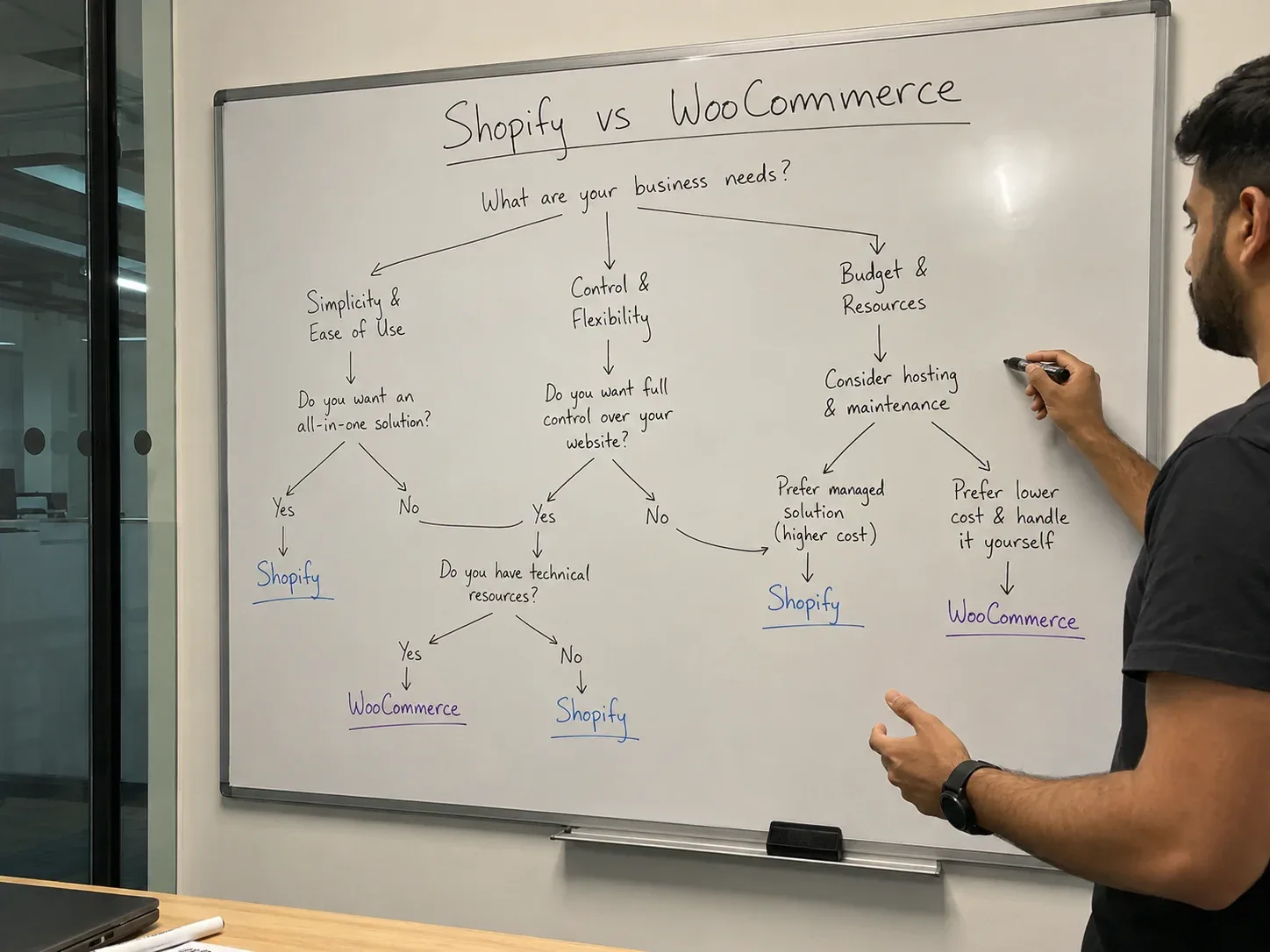
Ask yourself these questions honestly, not aspirationally:
- What is your revenue right now, and what's a realistic target 24 months out - not the target in the pitch deck?
- Do you have in-house technical capacity, or a reliable development partner on call?
- How central are content and organic search to how you plan to acquire customers?
- Do you need custom checkout logic, complex subscriptions, or unusual buyer journeys?
- How comfortable is your team with owning hosting, security, and performance directly?
Non-technical founder, small team, need to launch fast: Shopify is usually the lower-risk starting point - faster launch, less maintenance, a predictable monthly cost.
Content-driven brand with real developer capacity: WooCommerce is often the stronger long-term choice, provided hosting and plugin discipline get treated as first-class parts of the build rather than an afterthought.
Either direction, the platform decision only gets you halfway there. Whoever builds it - eCommerce Web Development Services Built to Sell, Rank, and Get Cited by AI is the way I'd describe what that build actually needs to cover in 2026 - determines whether the platform's strengths show up in the finished store or get buried under a rushed implementation.
Final Perspective
Platform choice doesn't decide your success on its own, and I want to be blunt about that because plenty of comparison articles imply otherwise. What it actually decides is what will be harder or easier for you, every week, for the next couple of years. That's exactly why it's worth thinking past the pricing page and into your actual daily reality before you commit.
Choosing between Shopify and WooCommerce in 2026 isn't about picking a winner. It's about picking the constraints you can genuinely live with - and building on top of that choice with enough discipline that the platform's weaknesses never get the chance to show up in front of a customer.
Practical Checklist
☐ What is our current monthly revenue and realistic 24-month target?
☐ Do we have in-house developers, or a dependable agency partner on retainer?
☐ How much does organic search and content marketing drive our acquisition?
☐ Do we need custom checkout logic, subscriptions, or non-standard buyer flows?
☐ What's our honest comfort level with owning hosting and security directly?
☐ What is our true budget - platform fees, apps or plugins, and developer hours, not just the sticker price?
☐ Are we optimizing for speed to launch, or long-term control?
☐ Can this platform grow with us for 24 months, or are we choosing today's convenience over tomorrow's ceiling?
Frequently Asked Questions
Is Shopify better than WooCommerce for beginners?
For most non-technical founders, yes - Shopify removes hosting, security, and infrastructure decisions from your plate entirely, which matters more at the beginning than any single feature comparison.
Is WooCommerce better than Shopify for SEO?
WooCommerce generally gives more direct control over URLs, schema, and content architecture. Shopify's speed and stability out of the box can partly close that gap without any extra technical effort.
Which platform is cheaper at high revenue?
It depends more on hosting quality and app or plugin choices than on the platform itself. Shopify's bundled infrastructure can outperform WooCommerce's maintenance costs at scale; a well-run WooCommerce store with disciplined hosting can still come out ahead. Model your specific total cost of ownership rather than trusting either platform's default assumption.
Does Shopify's transaction fee actually matter?
Only if you're not using Shopify Payments. Use Shopify's own payment processor and the additional transaction fee disappears entirely - a detail a lot of cost comparisons skip.
Can WooCommerce match Shopify on raw speed?
Yes, but only with the right hosting and plugin discipline. Nothing about WooCommerce's architecture makes it inherently slower - cheap hosting and plugin bloat do that, not the platform itself.
Which platform is better for AI-assisted content and marketing?
Shopify's native tooling is more unified out of the box. WooCommerce can match most of it through plugins, but expect a more fragmented stack and additional subscription costs.
Which is safer from a security standpoint?
Shopify centralizes infrastructure security and PCI compliance under one vendor. WooCommerce distributes that responsibility to you and your host - equally safe if that discipline is real, meaningfully riskier if it isn't.
Can I migrate from WooCommerce to Shopify, or the reverse?
Yes, in either direction, and it happens constantly - recent store-tracking data shows a genuinely close-to-even exchange of merchants moving each way. A clean migration needs a full redirect map and a proper post-launch monitoring window regardless of direction.
Should a content-heavy brand default to WooCommerce?
Usually, if there's real developer capacity behind it. Content and blogging are where WooCommerce's WordPress foundation earns its keep. Without that technical capacity, the content advantage tends to get eaten by maintenance problems instead.
Should a founder without a developer default to Shopify?
In most cases, yes. The absence of in-house technical capacity is the single strongest signal toward Shopify in almost every audit I run.
Is Shopify Plus worth the higher cost over standard WooCommerce hosting?
Only once you have hit a specific, real limitation - checkout extensibility, multi-storefront management, or transaction volume standard Shopify genuinely cannot support. Paying for Plus-tier capability before you need it is one of the more common overspending patterns I see in audits.
Does platform choice affect how AI shopping assistants find and cite my store?
Indirectly. AI systems care about clean structured data, genuine content, and stable site architecture - all achievable on either platform if they are built in deliberately. Shopify's native schema defaults give you a small head start; WooCommerce can match it entirely with the right implementation.

Written by
Kashaf
Kashaf is a veteran SEO specialist with deep expertise in AI SEO, generative engine optimization, ORM, web strategy, and marketing automation. With a Master's in Computer Science, he blends search strategy with technical insight into websites, automation workflows, and AI-driven platforms, helping brands dominate traditional search while adapting to the future of AI-powered discovery.