
Quick Answer: Weekly SEO tracking isn't about reacting to every small change in traffic or rankings. It's about catching six leading indicators before they develop into larger visibility or revenue problems: technical and crawl health, commercial-intent drop-offs on revenue-driving pages, priority keyword and SERP feature volatility, AI Search citation and referral changes, Core Web Vitals spikes, and sudden backlink or referring-domain losses. Monitor these areas consistently each week, and your monthly SEO reporting can focus more on strategy, growth, and opportunities rather than explaining problems after they've already caused damage.
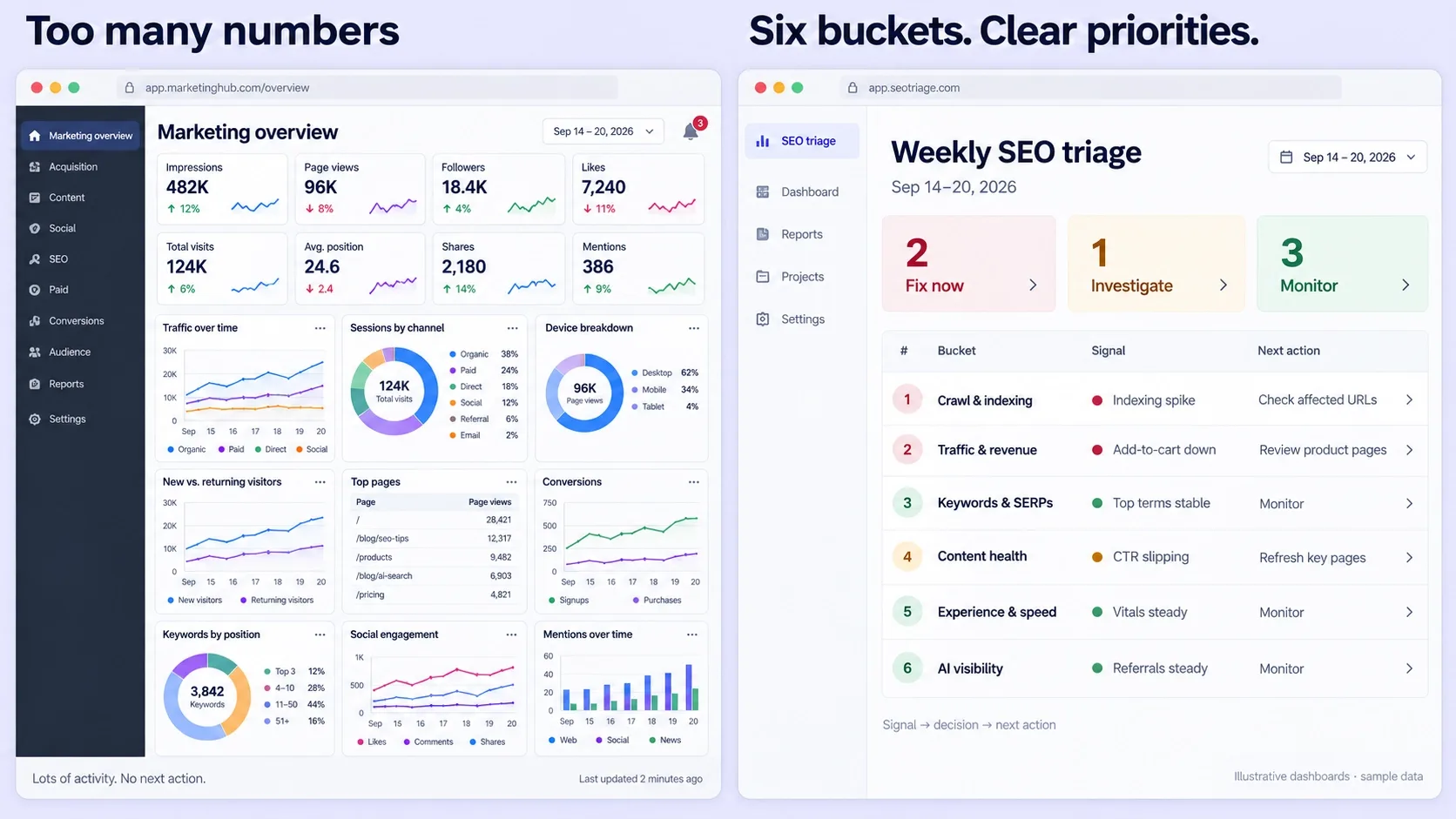
Most SEOs waste their Monday mornings looking at metrics that don't change week to week. Domain authority barely moves in a month, let alone seven days. Broad keyword rankings bounce around from personalization and algorithm noise that has nothing to do with your site. None of that tells you anything actionable on a Monday.
Here's the reality that should reframe your whole reporting cadence: SparkToro and Similarweb's June 2026 clickstream study found that 68.01% of US Google searches in the first four months of 2026 ended without a click at all - up from 60.45% just two years earlier. Read that again. Two out of three searches now resolve without anyone reaching your site, regardless of how well you rank. If your weekly report still leads with "organic traffic," you're measuring a number that's actively lying to you about whether your SEO is working.
This is exactly the kind of architectural blind spot we fix when providing eCommerce web development services - bloated, poorly instrumented sites make it nearly impossible to separate a real technical failure from normal search volatility, because nobody's tracking the leading indicators that would have flagged it three days earlier.
Bloated Sites Make Every Metric Lie to You
You can't separate a real technical failure from normal search volatility when nobody's tracking the leading indicators that would have flagged it three days earlier. Vareweb builds ecommerce sites instrumented properly from day one - so the data you're staring at Monday morning actually means something.
Quick Overview: The Six Buckets Worth Checking Weekly
| # | Bucket | What It Catches Early | Where to Check It |
|---|---|---|---|
| 1 | Technical & Crawl Health | Server errors, indexing anomalies, and sitemap issues | Google Search Console Crawl Stats and indexing reports |
| 2 | Commercial Intent & Revenue | Wrong-intent traffic, CTR decay, and add-to-cart drop-off | GA4 + GSC, segmented by page category |
| 3 | Priority Keywords & SERP Features | Multi-position ranking drops and lost snippets or local pack visibility | A scoped rank tracker focused on priority money keywords |
| 4 | AI Search & GEO Visibility | Citation loss, referral changes, and potential zero-click cannibalization | AI referral reports and consistent fixed-prompt testing |
| 5 | Core Web Vitals & UX | INP spikes, mobile LCP degradation, and emerging UX issues | CrUX, real-user monitoring, and PageSpeed Insights |
| 6 | Backlink & Referring Domain Health | Lost high-authority links and unusual or potentially harmful link spikes | GSC Links report plus an external backlink analysis tool |
The Difference Between Leading and Lagging SEO Metrics
Lagging metrics tell you what already happened. Total organic traffic, domain authority, monthly revenue - all real, all worth reporting monthly, and all useless for a Monday-morning triage session because by the time they've moved, the damage is already baked in.
Leading metrics tell you what's about to happen. A crawl rate that dropped 40% this week. A spike in "Discovered - currently not indexed" URLs. An INP reading that jumped past 500ms on your top category page. None of these show up in a monthly traffic chart yet - they're the early tremor before the earthquake shows up in revenue three weeks later.
Now look at the data on why this distinction has gotten sharper, not softer. When AI Overviews appear on a search result, click-through rates on the organic results below them drop by close to 60% - a genuinely brutal number that means the same ranking position is worth a fraction of what it was two years ago. Weekly tracking exists to catch the technical and structural shifts causing that decline before an entire month gets written off as "algorithm volatility."
What Weekly SEO Metrics Should You Measure
Bucket 1: Technical SEO And Crawl Health
This is triage, not strategy. You're looking for anomalies, not trends.
Crawl stats - 5xx and 4xx errors. Open Search Console's Crawl Stats report under Settings weekly, not monthly. A server error spike here is often the first visible sign of a hosting problem, a bad deploy, or a plugin conflict - and I've caught a 5xx spike on a Tuesday that would have gone unnoticed until a monthly report showed a mysterious revenue dip three weeks later. By then it's not a five-minute fix. It's a client call explaining lost revenue.
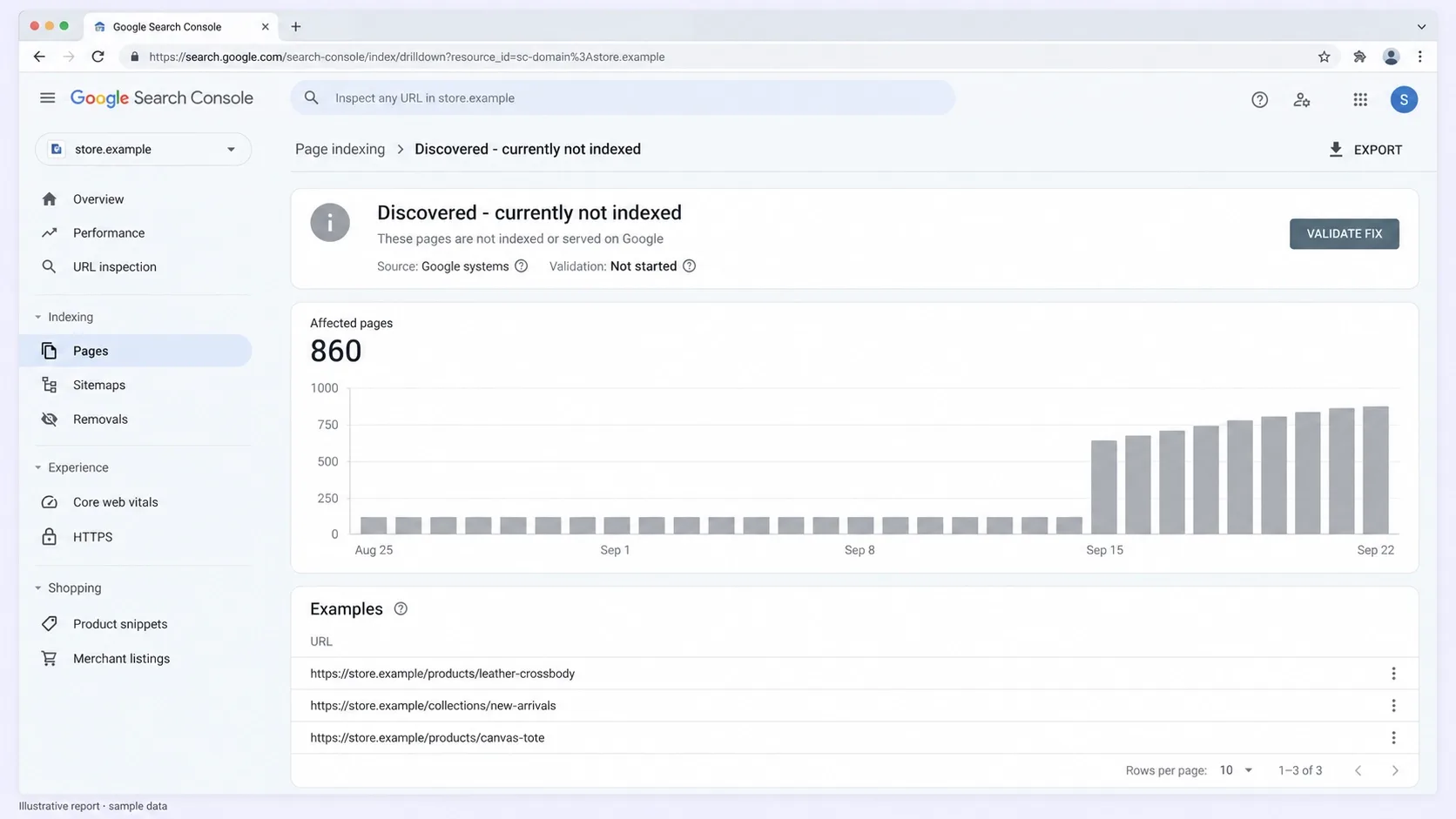
Index coverage anomalies. A sudden jump in "Crawled - currently not indexed" usually signals a content quality problem - thin pages, duplication. A jump in "Discovered - currently not indexed" signals something more structural: crawl budget exhaustion or a broken internal linking path Google can't justify following. This exact failure mode is what I keep documenting across Common Shopify SEO Issues and How to Fix Them and Common WooCommerce SEO Issues and How to Fix Them - platform-specific plugin conflicts are a disproportionate cause of both patterns.
Platform Plugin Conflicts Are a Disproportionate Cause of This
Crawl budget exhaustion and broken internal linking paths show up constantly on Shopify and WooCommerce stores running conflicting plugins - and most teams don't catch it until a monthly report shows a mysterious dip three weeks later. Vareweb audits crawl health as a standing part of every ecommerce build.
XML sitemap processing. Did your dynamically generated sitemap actually regenerate this week, or did an app update silently break the cron job producing it? Sitemaps fail quietly. Nothing alerts you. You just stop seeing new URLs get discovered, and by the time someone notices, it's been broken for a month.
JavaScript rendering timeouts. Check whether Googlebot is abandoning your pages before critical JS finishes executing - compare the rendered HTML in Search Console's URL Inspection tool against what a user actually sees. A growing gap between the two is a silent crawl-budget tax nobody notices until rankings for JS-dependent content quietly erode.
I've traced this exact pattern back to a faceted-navigation bug more than once: crawl requests to product pages drop 40% week over week, with no corresponding drop in total site crawl volume. That's not Google losing interest in you - it's Google redirecting budget toward URLs it now considers higher priority, usually because something changed in your internal linking or a filter combination started generating thousands of low-value parameter URLs competing for the same budget. Catch that Monday, and it's a redirect rule. Catch it in next month's traffic report, and it's a quarter of lost visibility on your highest-revenue pages.
Bucket 2: Commercial Intent And Revenue
Overall traffic is a vanity number dressed up as a business metric. Split it by page category before it means anything.
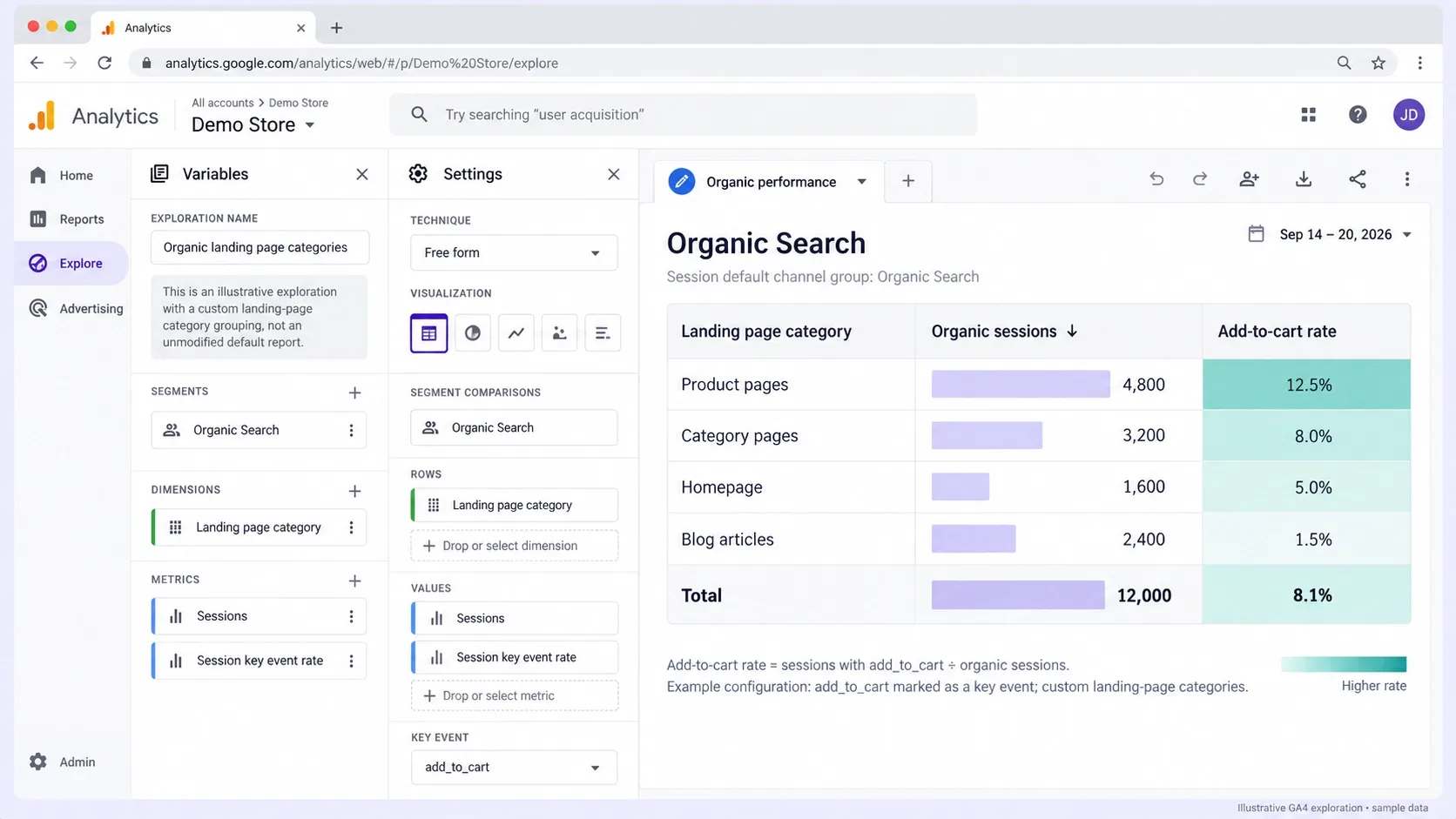
Organic revenue and leads by page category. Don't look at site-wide organic sessions. Segment GA4 by product pages, service pages, and blog content separately - blog traffic can climb 20% while the pages that actually generate revenue quietly bleed visibility, and a blended number hides that completely.
Non-branded click-through rate. Track CTR week over week on your priority URLs in Search Console's Performance report, filtered to non-branded queries. If impressions hold steady but CTR drops, one of two things happened: a competitor's title tag is winning the click, or an AI Overview is now sitting above you and absorbing the click before your listing is even seen. This is exactly the discipline behind ecommerce-specific SEO - a blended, site-wide CTR number can't tell you which category is actually losing ground.
A Blended CTR Number Can't Tell You Which Category Is Losing Ground
Site-wide averages hide exactly the kind of category-level decay that costs revenue before anyone notices. This is the discipline behind ecommerce-specific SEO - segmenting by page category, not celebrating a traffic number that's quietly the wrong traffic.
Add-to-cart rate from organic. Tie organic sessions directly to GA4's add_to_cart event, segmented by landing page. Traffic up with ATC rate down means you attracted the wrong search intent - often a sign that new content is ranking for informational queries that were never going to convert, diluting a previously healthy conversion rate.
I've sat in the Monday standup where this played out: a blog post ranked for a broad, high-volume informational term, organic sessions jumped 30% that week, and everyone celebrated. Three weeks later, revenue was flat and nobody could explain why "traffic is up" hadn't translated into anything. Segmented weekly tracking would have shown it immediately - the new sessions landed almost entirely on one blog URL with a near-zero add-to-cart rate, while traffic to the actual product pages hadn't moved at all. The lagging monthly report eventually shows the same flat revenue. It just shows it three weeks too late to do anything about the celebration that happened in between.
Bucket 3: Priority Keyword And SERP Feature Volatility
Yes, I just told you broad keyword rankings are noise - and they still are. This bucket is not that. The distinction matters enough to state plainly: tracking a thousand keywords weekly is theater. Tracking twenty to thirty keywords tied directly to revenue pages is triage, and the two get confused constantly because they look identical in a rank tracker's UI.
Build a scoped priority list, not a full-catalog tracker. Pick the queries actually driving pipeline - the terms your highest-converting category and product pages rank for - and track only those weekly, separate from whatever broad tracker runs monthly. A single-position wobble on that list is still noise. A multi-position drop, three spots or more in a week, on a term that's held steady for months, is a signal something real changed - a competitor shipped a better page, an algorithm update reweighted intent, or your own page quietly regressed.
SERP feature presence is the leading indicator most trackers bury. Losing a featured snippet, a People Also Ask inclusion, or local pack placement you'd held for months frequently precedes a full ranking drop by days or weeks - the feature loss is Google's first, quieter signal that it's reassessing the page, before the standard blue-link position moves at all. I've watched a local pack drop on a Wednesday turn into a full page-two ranking by the following Monday, and the teams still checking only monthly never saw the warning shot.
Twenty Money Keywords Beat a Thousand-Keyword Tracker
Scope is what separates signal from noise here, and most teams never make the call to narrow it. Vareweb sets up weekly tracking scoped to the keywords and AI citations that actually move revenue - not a dashboard nobody reads on a Monday.
Bucket 4: AI Search And Generative Engine Visibility
This is the bucket most 2022-era SEO reporting templates don't have a column for, and it's the one growing fastest.
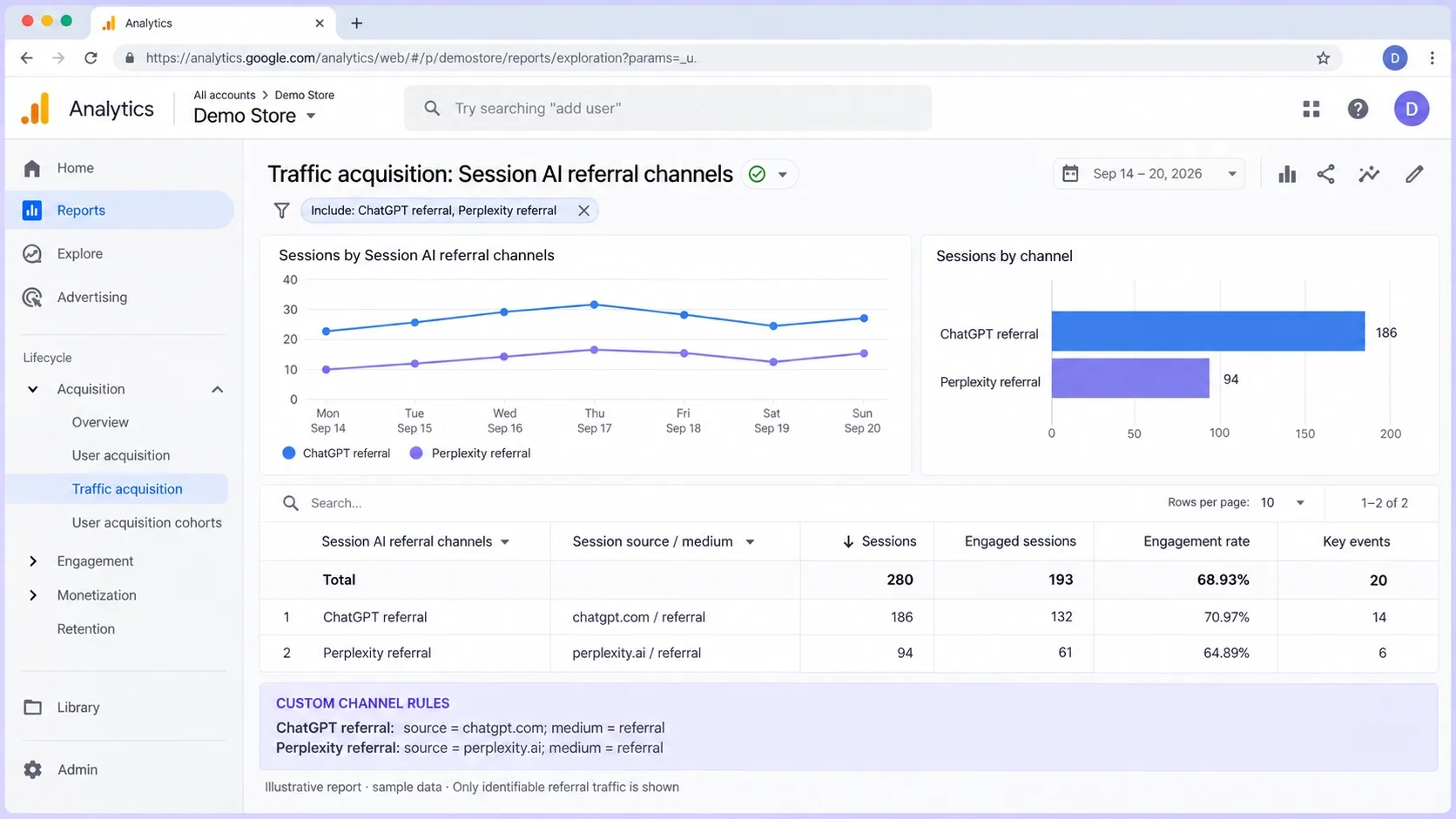
Referral traffic from LLMs. Set up a channel grouping in GA4 that isolates referrals from chatgpt.com, perplexity.ai, and Claude's domains. It's usually a small number today. Small and rapidly growing is a trend worth a weekly glance, not a monthly one - the platforms driving that traffic are shifting share fast enough that a monthly check misses the inflection point. ChatGPT alone now commands roughly 79% of global AI chatbot usage, which tells you exactly where to weight your prompt-testing effort if you can only cover one platform closely each week.
AI Overview impressions and citation tracking. Zero-click behavior is now the default outcome, not the exception, for a huge share of informational queries. Search Console won't show you whether you're cited inside an AI Overview directly - you need either an enterprise rank tracker with AI-tracking built in, or a manual weekly pass: run a fixed set of ten to fifteen prompts around your core topics against ChatGPT, Perplexity, and Google's AI Mode, and log which domains get cited. It's unglamorous. It's also the only reliable signal available right now.
Branded search variations. Watch for new branded query patterns - "[Brand] reviews," "[Brand] vs [competitor]," "is [Brand] legit" - appearing or spiking week over week. A sudden cluster can mean an AI system summarized something about you inaccurately, and people are now searching to verify it. Clean, consistent structured data across your site is the single best defense against being misrepresented in a synthesized answer in the first place.
Bucket 5: Core Web Vitals And UX
INP spikes. Interaction to Next Paint is the metric replacing older, gentler thinking about interactivity, and it's brutally sensitive to a single bad script. Use Chrome UX Report data or real user monitoring to catch a script that's freezing the main thread before Google's field data catches it and demotes the page for you. A third-party chat widget or a poorly built filter script is the usual culprit, and it rarely shows up in a lab test - only in real user data.
Mobile LCP degradation. Here's a real number worth sitting with: current field data shows just 6.3% of active WooCommerce stores pass all three Core Web Vitals in real Chrome user data. That's not a WooCommerce-specific failure - it's what happens on any stack where nobody's watching LCP week to week. A single unoptimized hero image pushed live on a Tuesday can undo a month of careful performance work by Friday, and a weekly check catches it while it's still a five-minute fix. I go deeper on the specific levers that move these numbers in How Important Is Page Speed for SEO in 2026? and 10 Best UI/UX Design Tips for Good Core Web Vitals.
Bucket 6: Backlink & Referring Domain Health
This one gets skipped in most weekly reporting because it feels like a monthly concern. It isn't, not entirely - the sudden events in this bucket are exactly the kind of thing a monthly cadence catches three weeks late.
Lost high-authority backlinks. A partner site redesign, a guest post getting pulled during a content cleanup, a resource page dropping your link during its own maintenance pass - any of these can quietly remove a link that was doing real authority work. Check Search Console's Links report weekly against last week's export, or use an external backlink tool's lost-link alert. A single lost link rarely moves rankings on its own, but a cluster of losses in one week is worth knowing about before it compounds into a visible authority dip.
Toxic or spam link spikes. A sudden, unexplained surge in low-quality referring domains - often from scraper networks or, less commonly, a negative SEO attempt - is far easier to document and disavow while it's a fresh, isolated spike than after it's blended into months of normal link acquisition and become impossible to isolate cleanly.
Which Numbers on Your Dashboard Are There for Comfort, Not Signal?
Domain Authority, broad keyword rankings, blended traffic, bounce rate - if your weekly report still leads with these, you're spending Monday morning on noise. Vareweb builds dashboards around the six buckets that actually predict revenue movement, not the ones that feel reassuring to screenshot.
The "Vanity Metrics" You Need to Stop Tracking Weekly
Be honest with yourself about which numbers on your dashboard are there for comfort, not signal:
- Domain Authority / DR. Takes months to meaningfully shift. Checking it weekly is checking noise.
- Broad keyword rankings. Volatile, personalized per searcher, and increasingly disrupted by AI-generated results above the fold. A position-3-to-position-5 wobble on a Tuesday means almost nothing - this is the noisy version of Bucket 3, not a replacement for it.
- Overall organic traffic. Too noisy, and it blends high-value commercial pages with top-of-funnel blog traffic that was never going to convert. Segment it or don't bother looking weekly.
- Bounce rate. A dead metric GA4 itself has moved past. Track engagement rate instead - it accounts for the sessions that genuinely interacted with the page rather than penalizing every quick, satisfied exit.
How to Build Your Weekly SEO Dashboard
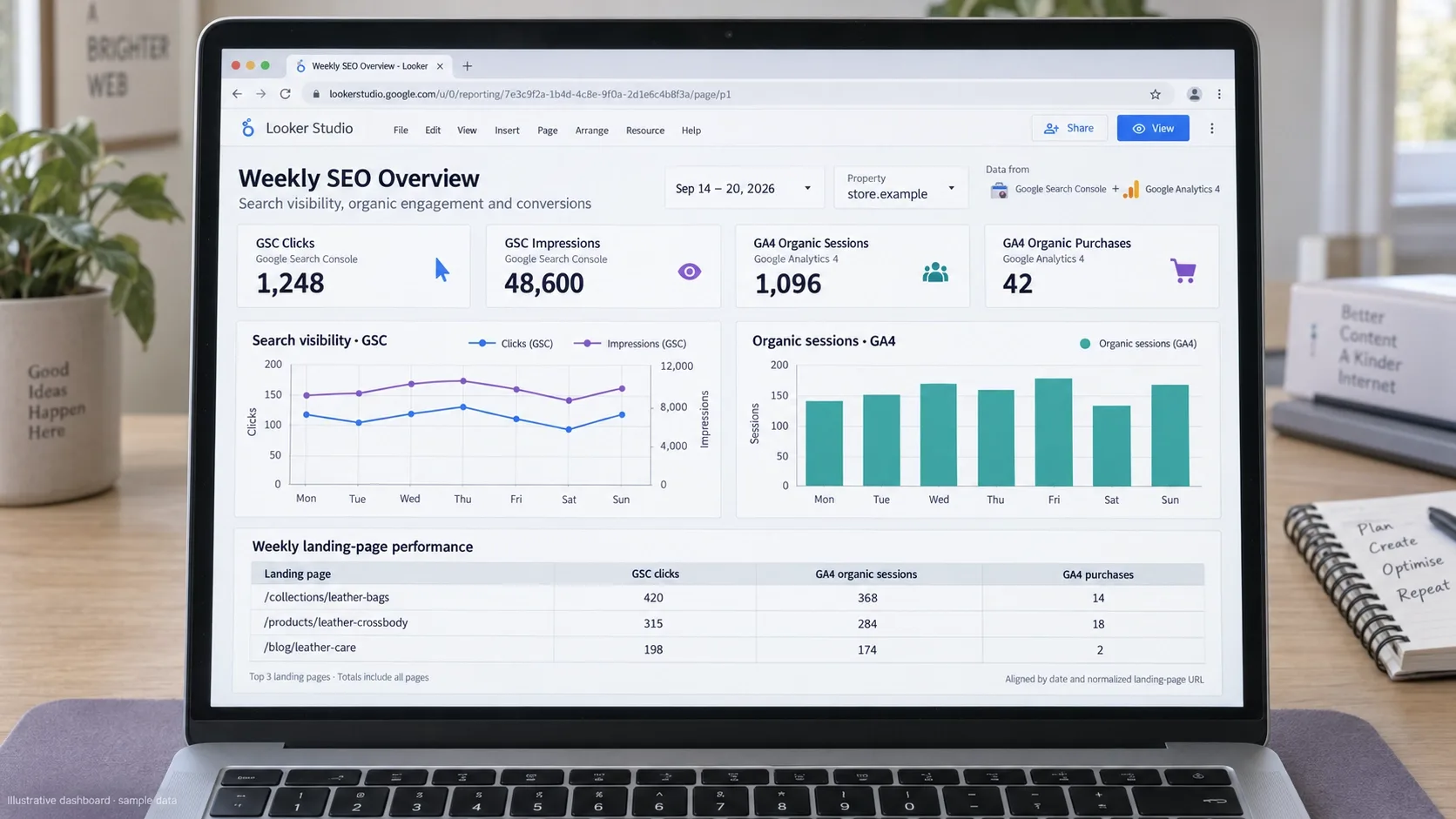
Looker Studio and BigQuery. Blend Search Console data - for technical health - with GA4 data - for commercial intent - into one view rather than toggling between two platforms every Monday. The moment you can see a crawl anomaly next to a revenue-by-category chart, patterns jump out that neither tool shows in isolation.
Log file analyzers. Worth the setup on any enterprise site - they show you exactly how Googlebot is spending its crawl budget, which pages it's hitting repeatedly, and which important pages it's ignoring entirely. Search Console gives you a sample. Log files give you the whole picture.
Ready for a Dashboard That Actually Catches Problems on Monday?
Vareweb builds the technical foundation and the tracking layer together - clean crawl health, segmented revenue data, AI citation monitoring - so weekly reporting becomes strategy instead of damage control. One team, accountable for the whole result.
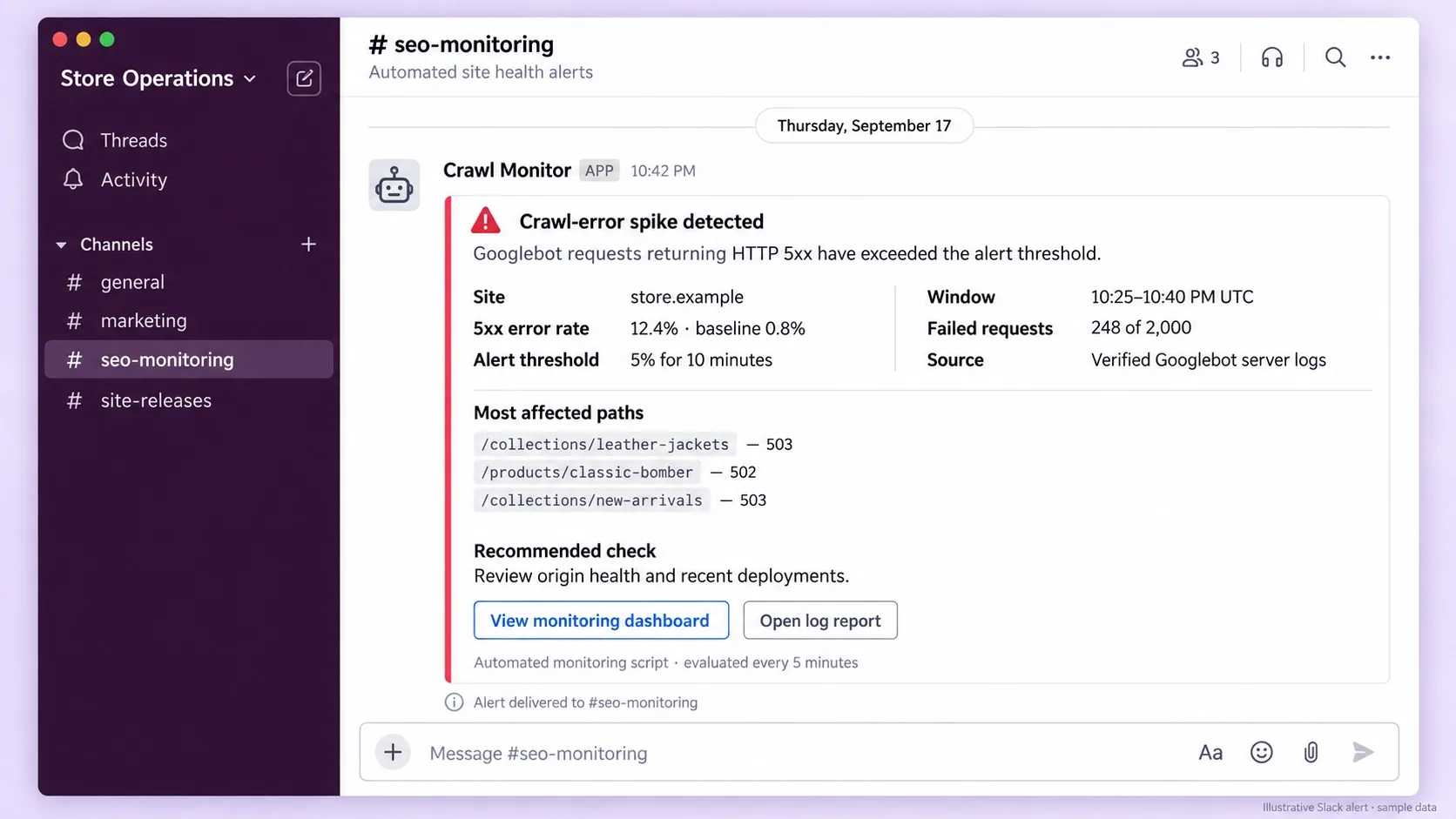
Alerting systems. Set up automated Slack or email alerts for traffic and crawl-rate drops rather than relying on someone remembering to check a dashboard every Monday. A custom script against the Search Console API, or a monitoring tool built for this, catches a Thursday-night problem before it's had four days to compound. This is the same discipline behind web analytics done properly - the goal isn't more data, it's data that reaches someone before it's too late to act on.
FAQs
How much time should a weekly SEO audit actually take?
Thirty to forty-five minutes for a focused triage pass across the four buckets - this is meant to be a scan for anomalies, not a full audit. A full technical audit still belongs on a monthly or quarterly cadence.
Why is my organic traffic up but my revenue down?
Almost always an intent mismatch - new content or rankings are pulling in visitors searching for something adjacent to, but not actually matching, what converts. Segment traffic by page category before assuming the SEO program itself is failing.
Can I track Google AI Overview clicks in Search Console?
Not directly and not reliably yet - Search Console doesn't cleanly separate AI Overview impressions from standard ones in most accounts. Manual prompt testing and a dedicated AI-tracking tool currently fill that gap.
What is the difference between a weekly SEO report and a monthly one?
Weekly is triage: leading indicators, anomalies, things that need action inside 48 hours. Monthly is strategy: trends, revenue attribution, and decisions about where to invest the next quarter's effort.
How do I track ChatGPT referral traffic?
Build a custom channel grouping in GA4 isolating referral traffic from chatgpt.com, perplexity.ai, and other AI domains. The volume is often still small, but the growth rate is the number worth watching weekly.
Should I report weekly metrics to the CEO?
Only the anomalies worth acting on - a CEO doesn't need a crawl stats chart every Monday. Weekly tracking is an operational tool for the SEO team; monthly and quarterly reporting is what belongs in front of leadership.
What is the most dangerous technical SEO metric to ignore?
Index coverage anomalies, specifically a rising "Discovered - currently not indexed" count. It's the quietest failure mode on this entire list, and by the time it shows up in a traffic chart, you've usually already lost weeks of visibility you can't easily get back.
Do zero-click searches mean SEO is no longer worth doing?
No - branded search, local queries, and high-intent transactional searches still send real clicks. What changes is which metrics prove the program is working; impressions and citation presence matter alongside clicks now, not instead of them.
Isn't tracking keywords weekly the vanity metric this article warned against?
Only at broad scale. Tracking hundreds of keywords weekly is noise - tracking twenty to thirty money keywords for multi-position drops and SERP feature loss is Bucket 3, and it's one of the highest-signal checks on this entire list. Scope is what separates the two, not the metric itself.

Written by
Kashaf
Kashaf is a veteran SEO specialist with deep expertise in AI SEO, generative engine optimization, ORM, web strategy, and marketing automation. With a Master's in Computer Science, he blends search strategy with technical insight into websites, automation workflows, and AI-driven platforms, helping brands dominate traditional search while adapting to the future of AI-powered discovery.