
Quick Answer: To make ecommerce product information easier for AI Overviews, ChatGPT, Perplexity, and other AI search systems to understand, give crawlers clean, consistent, machine-readable facts alongside useful on-page content. Structure relevant Product, Offer, AggregateRating, and FAQPage data correctly in JSON-LD, and keep important fields such as price and availability consistent with what shoppers can actually see on the page. An llms.txt file can provide additional guidance for AI crawlers, but it should complement - not replace - schema markup, crawlable page content, and strong technical SEO.
Here's the painful truth about AI search: no amount of good writing fixes ambiguous data. JSON-LD stopped being a Rich Snippets checkbox two years ago and became the actual data infrastructure Generative Engine Optimization runs on - the difference between a product ChatGPT recommends by name and one it never mentions at all usually comes down to whether the schema block on that page resolves cleanly, regardless of how well the copy around it reads.
JSON-LD now runs on 55.5% of the web, and the gap widens the higher you climb the ranking ladder - W3Techs' own numbers put it at 60.4% among the top 1,000 sites versus 55.5% overall, as of this month. Microdata sits at 21.3% and shrinking. That's not a trend to watch from the sidelines; it's already the baseline. In my technical audits, the stores getting cited by ChatGPT all share the exact same JSON-LD architecture, and the ones that don't get cited almost never have a content problem - they have a data problem, which is exactly why our approach to AI-ready eCommerce development treats schema as infrastructure to architect on day one, not a plugin to bolt on before launch.
Is Your Schema a Liability or an Asset?
JSON-LD now runs on the majority of the web, and the gap between cited and invisible products almost always comes down to whether that data block resolves cleanly. Vareweb treats schema as infrastructure to architect from day one, not a plugin bolted on before launch.
Quick Overview: The Four Schema Types and What Breaks Them
| Schema Type | What It Tells the AI | Creates Problems If... |
|---|---|---|
| Product | Product name, brand, SKU or GTIN, and description | Identifiers are generic, inaccurate, or duplicated across product variants |
| Offer | Price, currency, availability, and other offer details | Price or stock information is stale or conflicts with the visible product page |
| AggregateRating | Overall rating and total review count | The structured rating does not match the reviews and ratings visible on the page |
| FAQPage | Structured questions and answers that make page information easier to interpret | Answers in the markup differ from the FAQ content users can actually see on the page |
Why AI Systems Demand Structured Data
Traditional SEO ran on keyword proximity and link graphs. AI search runs on entity resolution - the model needs to confirm, with confidence, that this exact page describes this exact product at this exact price before it will stake a citation on it. Confidence is the operative word. An LLM doesn't reward effort; it rewards certainty.
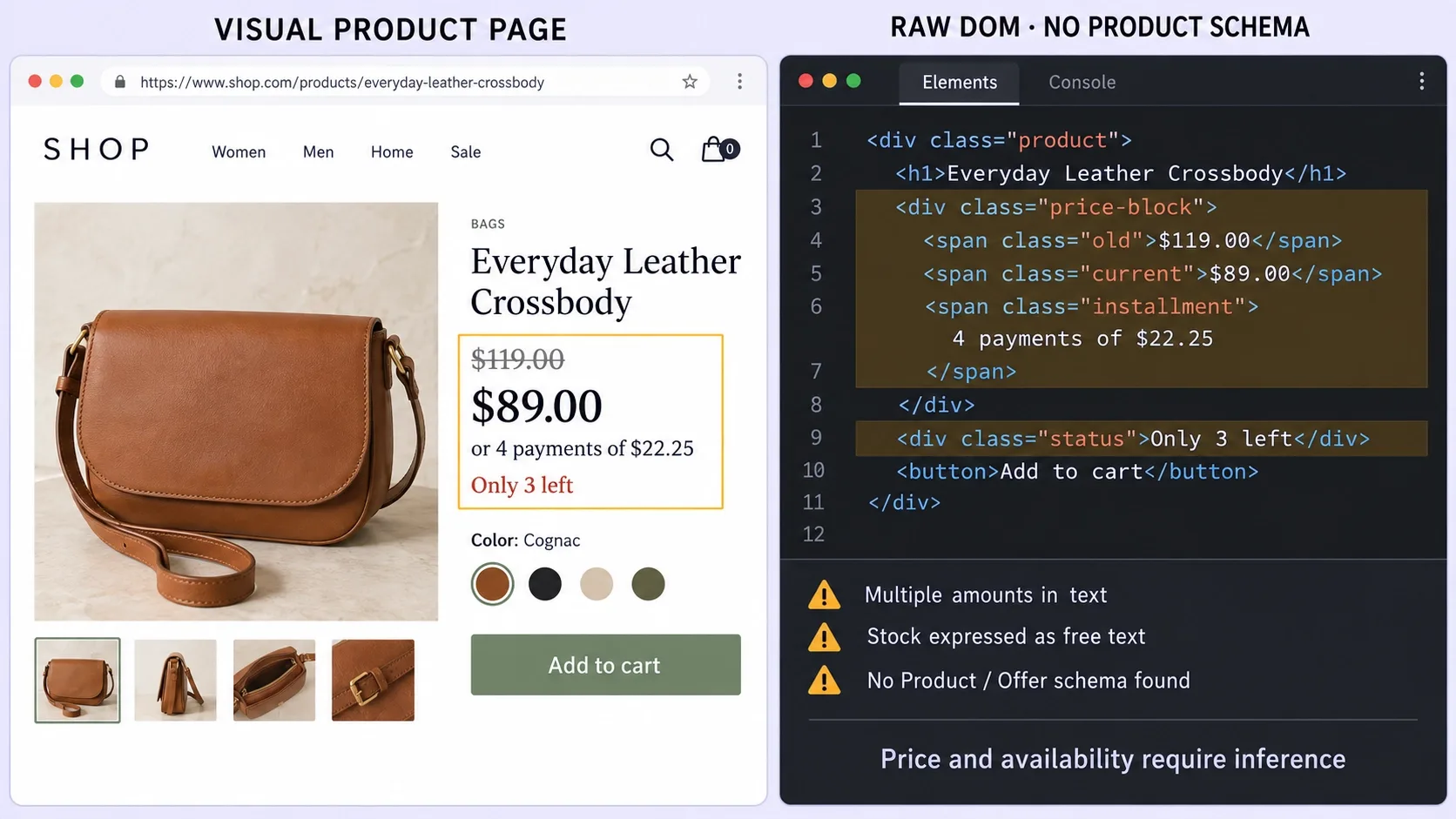
When a crawler hits a product page with no schema, it falls back to parsing the DOM with NLP - guessing at price from a <span class="price-247b"> tag, guessing at stock from color-coded CSS it can't actually see. That guess carries risk the model would rather not take. Given a competitor with a clean JSON-LD block sitting one search away, the model cites the competitor. Not because your product is worse. Because your data made you a liability.
One nuance worth being precise about: Google deprecated FAQ rich results in the SERP, not FAQ schema itself. The markup still does real work - it's one of the cleanest, most direct signals you can hand an LLM for conversational extraction, even with the visual snippet gone from Google's results page.
Picture the failure mode concretely: a shopper asks ChatGPT for "a waterproof 35-liter backpack under $100 with good reviews." The model isn't reading your marketing copy to answer that - it's filtering candidate products by three structured fields at once: category and capacity from Product, price ceiling from Offer, and review quality from AggregateRating. A page with all three resolves cleanly into the answer. A page missing even one of them doesn't get filtered in at all; it simply never enters the candidate set, and no amount of persuasive writing recovers a product that was never considered in the first place.
The Core Schema Types You Must Implement
1. Product Schema - The Foundation
This is the identity layer: name, brand, description, and real identifiers - SKU and, where you have one, GTIN. AI systems use these fields for entity resolution across the web, matching your listing against manufacturer data, review aggregators, and competitor pages. A vague or duplicated identifier doesn't just weaken the listing - it makes the entity itself ambiguous, and ambiguous entities don't get cited.
Implementation rule: every variant (size, color) needs its own SKU inside the same Product block, not a copy-pasted parent SKU repeated across five variants. That single habit is responsible for more "why isn't my bestseller showing up" tickets than almost anything else I've audited.
One Copy-Pasted SKU Can Cost You a Citation
Duplicated identifiers across product variants are the single most common cause of "why isn't my bestseller showing up" - and it's exactly the kind of detail a generic template misses. Vareweb builds schema architecture as a standing part of Ecommerce SEO, not an afterthought.
2. Offer Schema - The Transactional Layer
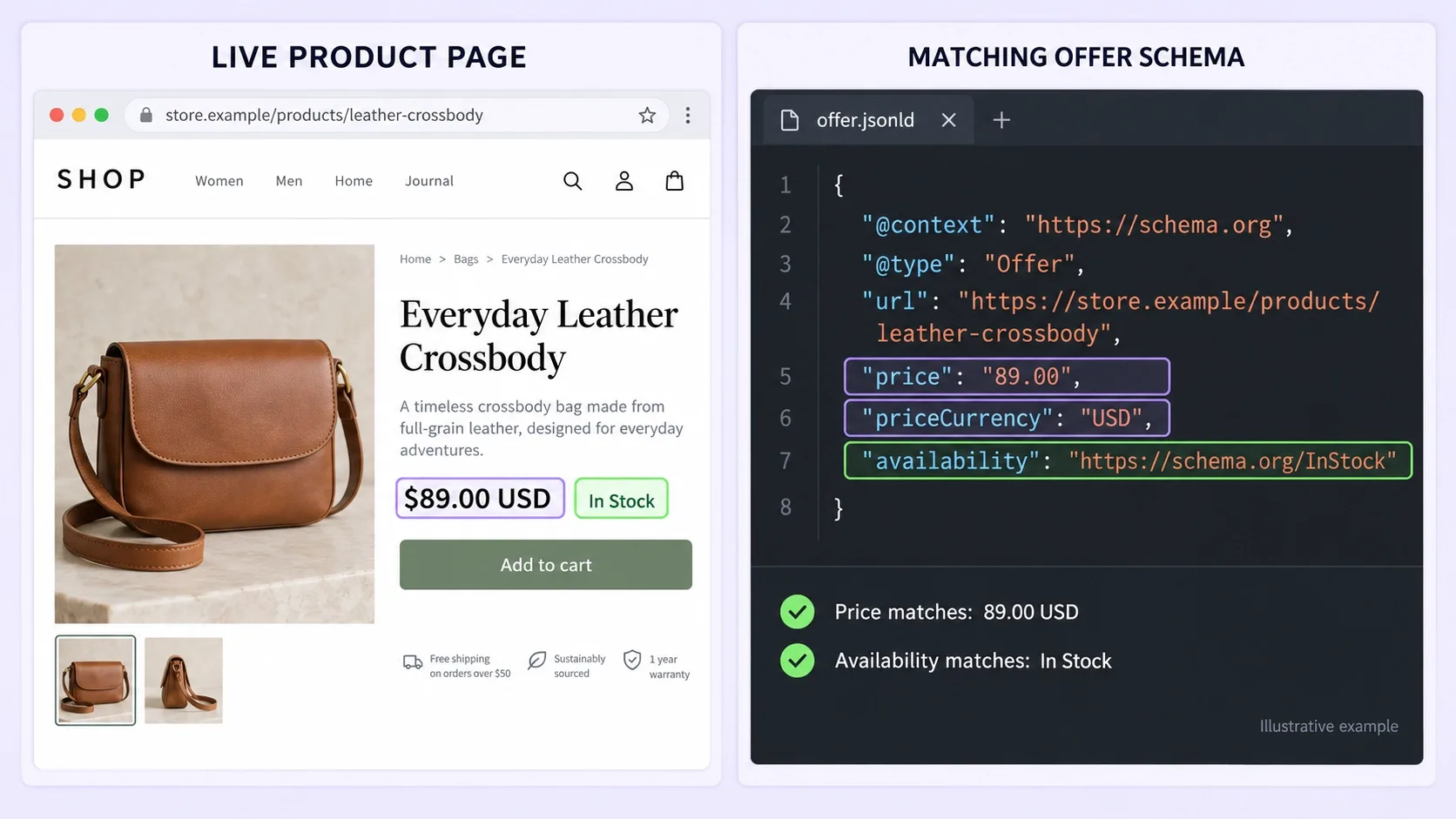
Price, priceCurrency, and availability, reported live. This is the schema type where stale data does the most damage, because it's the type an AI has the least tolerance for getting wrong - a wrong price isn't a UX nitpick, it's a wrong answer given to a shopper with a card in hand.
Stale stock data instantly kills AI citations in a way stale copy never does. A model that cited an out-of-stock product yesterday learns fast that your feed can't be trusted, and it starts weighting your domain down for future queries in the same category - quietly, with no notification, no manual action in Search Console to warn you it happened.
3. AggregateRating and Reviews - The Social Proof Layer
Review count and average rating, nested inside the Product block. This is the field AI systems lean on hardest when a query asks for "the best" version of something - a comparative query the model can't answer from price and description alone.
Non-negotiable rule: the number in your schema has to match what a human see rendered on the page. A 4.8-star aggregate sitting on top of twelve visible reviews, when your schema claims 340, isn't just a Manual Action risk in Search Console. It's exactly the kind of inconsistency that teaches a model your feed can't be trusted anywhere else on the site either.
4. FAQPage Schema - Conversational Extraction
Structured question-and-answer pairs, written the way a buyer would actually ask them - "Does this run small?" beats "Sizing Information" as a heading every time, because it's closer to the literal prompt a shopper types into ChatGPT.
Keep answers self-contained. A model extracting from FAQPage schema for a conversational response won't go fetch surrounding paragraph context to complete a half-answer - if the answer needs the sentence before it to make sense, it won't get extracted cleanly, and it won't get cited. This whole layer of work - matching structured data to what a buyer actually types - is exactly what Ecommerce SEO should mean in 2026, not a keyword list handed to a copywriter.
Stale Price Data Doesn't Fail Visibly - It Fails Silently
A schema block that was correct at launch and never syncs again is worse than no schema at all. Vareweb builds live, real-time schema sync into every ecommerce build, so price and stock data can't quietly drift out of trust.
The Rise of llms.txt in eCommerce Architecture
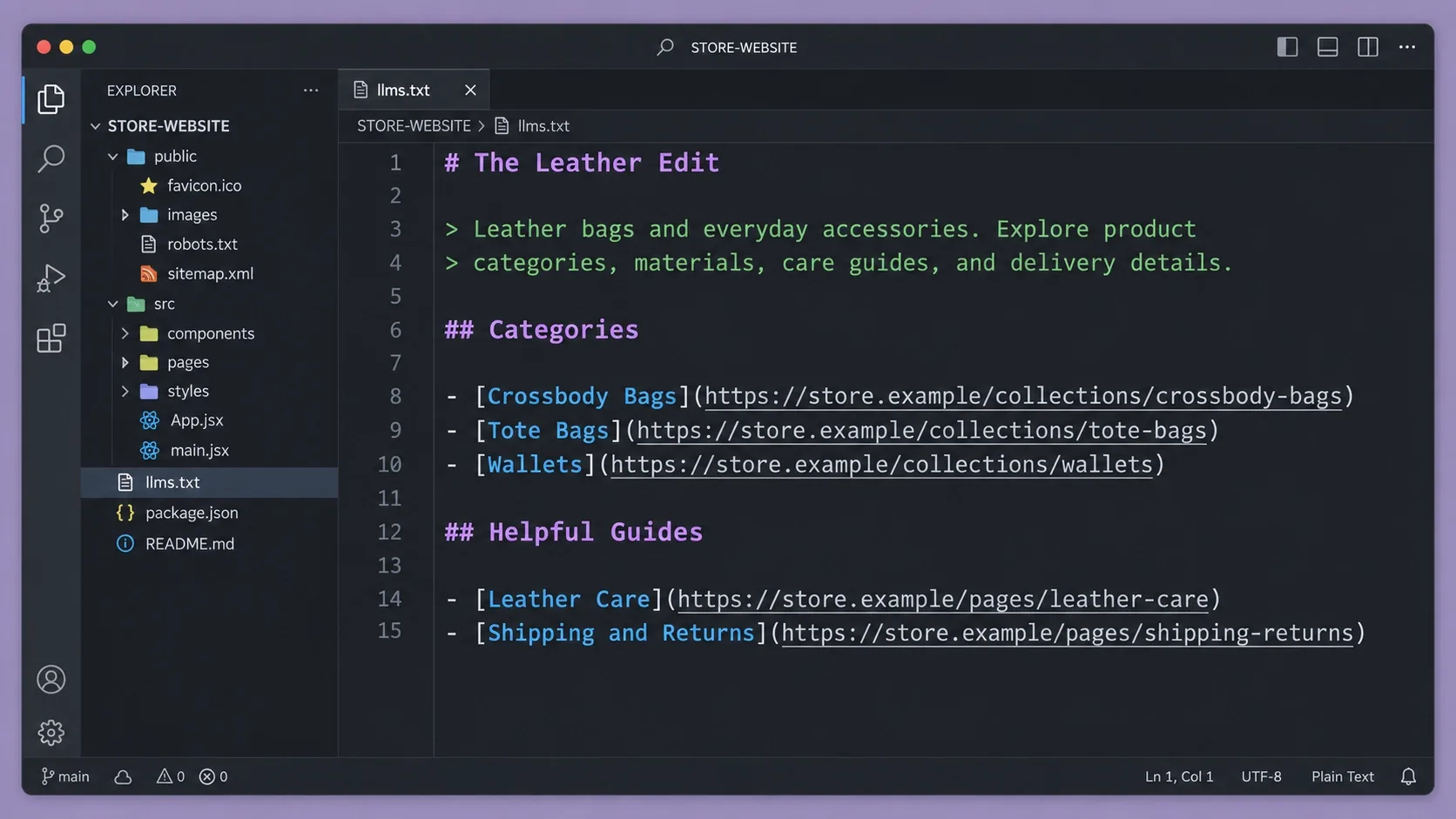
llms.txt is a Markdown file at your site root - think robots.txt, but instead of telling crawlers what they're allowed to fetch, it tells language models what your site actually contains, in a format that doesn't require rendering a single line of JavaScript to parse.
For a high-SKU catalog running heavy client-side rendering, this matters more than it sounds like it should. It acts as a curated directory - core categories, policy pages, top products - that lets an AI agent bypass DOM weight and edge-cached fragments entirely and get straight to a clean summary of what you sell and how your policies work. It's still an emerging standard, not a guarantee, but it's a cheap file to maintain against a real, growing class of AI traffic. I go deeper on the broader access side of this in Tips to Build AI-Agent-Friendly Websites.
2026 Reality Check: ChatGPT Already Reads Feeds, Not Pages
This isn't theoretical anymore, and it's worth being specific about why. OpenAI's Instant Checkout launched in ChatGPT in September 2025, running on the Agentic Commerce Protocol it co-built with Stripe, starting with Etsy sellers and expanding toward Shopify merchants including Glossier, SKIMS, and Spanx. By March 2026, OpenAI pulled the in-chat purchase step back out and repositioned the whole system around product discovery instead - shoppers ask, ChatGPT recommends, the purchase completes on the merchant's own site.
What didn't change is the part that matters for this article: the recommendation itself is assembled from a submitted product feed, not from a crawl of your product page. OpenAI's own stable schema requires nine fields per item - identifier, title, description, URL, brand, seller name, image, availability, and price - and when that feed disagrees with what's rendered on your live page, the feed is treated as the source of truth. Your beautifully written product copy is invisible to this system. Your structured data is the entire conversation.
That's the 2026 pattern worth internalizing: Google Merchant Center, Bing Shopping, and OpenAI's product feed are three separate submissions in three separate formats, all sourced from the same underlying product data your JSON-LD should already be modeling cleanly. Get the schema right once, at the data layer, and every downstream feed - present or still unannounced - gets easier to generate correctly instead of patched together by hand each time a new AI surface launches.

Code Example: A Nested JSON-LD Block
Here's the shape a clean implementation actually takes - Product, Offer, and AggregateRating nested in one block, not scattered across three separate script tags fighting for the same @context:
{
"@context": "https://schema.org/",
"@type": "Product",
"name": "Trail-Ready Waterproof Backpack 35L",
"sku": "TWB-35L-GRN",
"brand": { "@type": "Brand", "name": "YourBrand" },
"description": "35-liter waterproof backpack with reinforced base.",
"offers": {
"@type": "Offer",
"priceCurrency": "USD",
"price": "89.00",
"priceValidUntil": "2026-12-31",
"availability": "https://schema.org/InStock",
"url": "https://example.com/products/trail-ready-35l"
},
"aggregateRating": {
"@type": "AggregateRating",
"ratingValue": "4.7",
"reviewCount": "212"
}
}
JSON-LD, placed as a <script type="application/ld+json"> in the <head> or just before </body>, has effectively replaced Microdata as the only format worth implementing today - it doesn't require inline attributes scattered through your markup, and it's the format every major AI crawler is built to parse first. One rule overrides everything else here: schema must exactly match what's visibly rendered. A mismatch doesn't just risk a manual action from Google - it's precisely the kind of gap that produces an AI hallucination about your own product, credited to your own domain.
Clean Code in a Blog Post. Is Yours Actually Clean in Production?
One tidy example is easy. Keeping every variant, every price update, and every review count in sync across a full catalog is where most implementations quietly break down. Vareweb builds and maintains schema at scale, not just at launch.
Common Schema Mistakes That Break AI Visibility
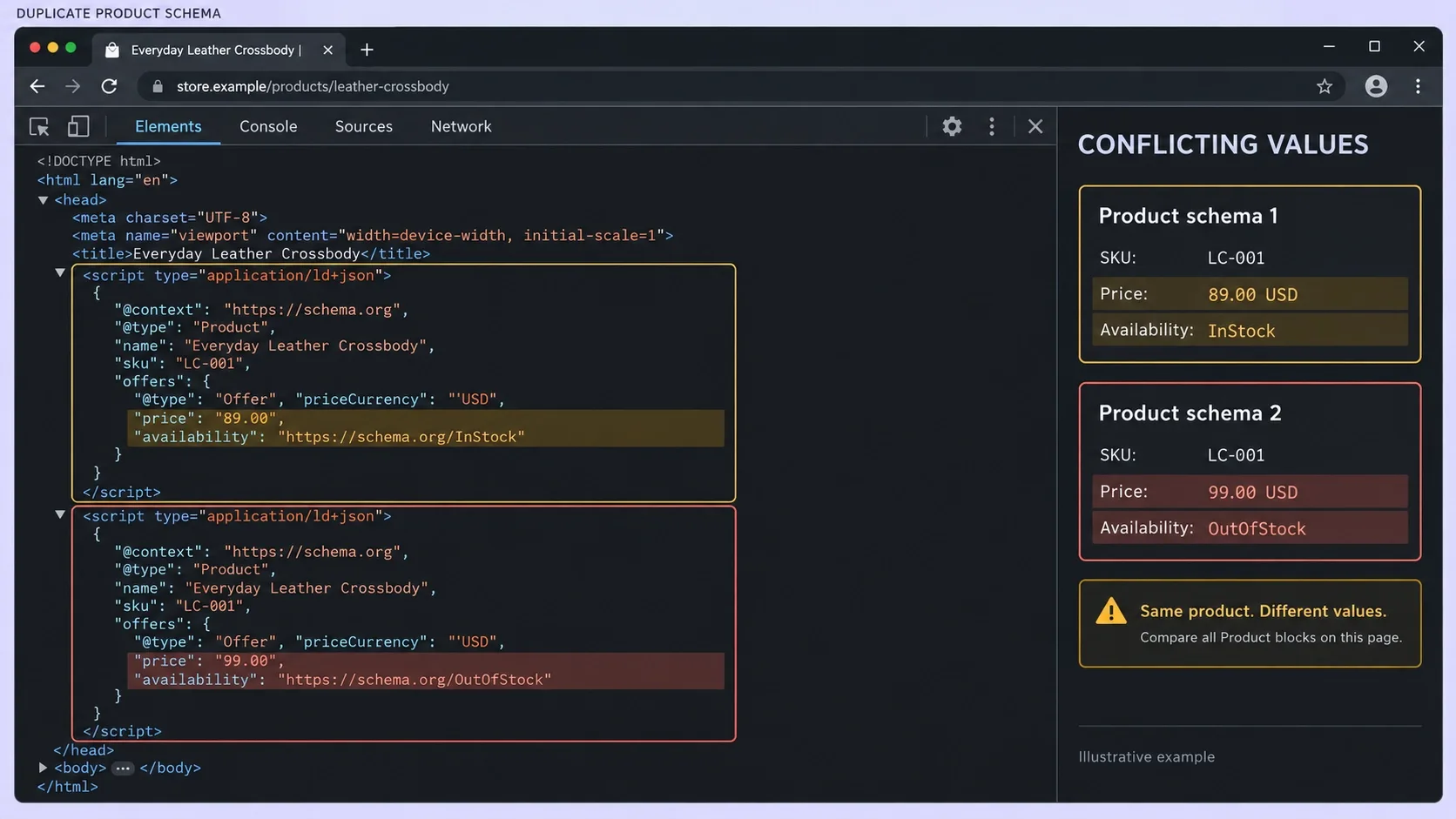
Conflicting plugin injections. Outdated or stacked Shopify and WooCommerce apps are a frequent cause of duplicate, conflicting @context blocks on the same page - one plugin outputs Product schema, a second SEO app outputs its own competing version, and a crawler parsing both doesn't know which one to trust. I've documented the platform-specific version of this pattern in Common Shopify SEO Issues and How to Fix Them and Common WooCommerce SEO Issues and How to Fix Them.
Missing `priceValidUntil` or broken real-time sync. A price field that was correct at deploy time and never updates again is worse than no price field at all, because it fails with false confidence instead of failing visibly.
Placeholder text and hardcoded variables. "Sample Product Name" or a hardcoded $0.00 left in a template because a developer meant to swap it before launch. These slip through code review constantly because they render fine visually - nobody notices until a crawler takes the literal string at face value.
Missing or reused GTIN/MPN identifiers. A generic or shared identifier across your whole catalog doesn't just risk a Merchant Center disapproval - it strips an AI system of the one cross-reference it uses to confirm your product is the same real-world item a manufacturer or a review aggregator is also describing. Without that match, the model treats your listing as an unverifiable claim rather than a confirmed fact, which is a quiet, permanent way to lose a citation you'll never see a rejection notice for.
How to Validate and Measure AI-Readiness
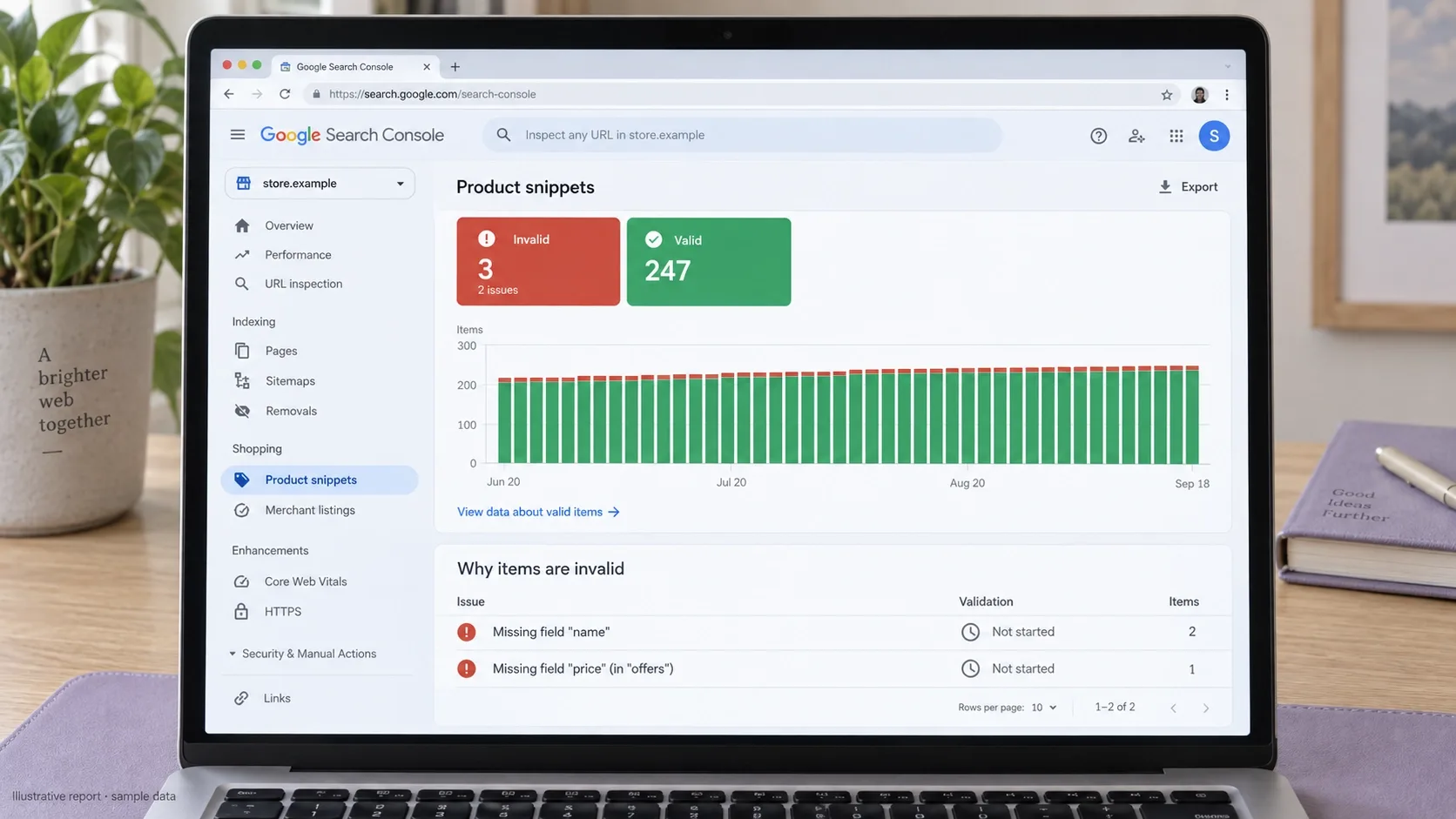
Run every template through Google's Rich Results Test and the structured data documentation before shipping, not after. Then watch Search Console specifically for "unparsable structured data" errors - they're easy to miss because they don't tank your rankings the way a manual action does; they just quietly make you invisible to a class of traffic you can't see in most analytics setups yet.
For the AI-citation side specifically, there's no dashboard that hands you this - you have to go get it manually. Run a fixed set of real buyer queries against ChatGPT and Perplexity every month - "best waterproof backpack under $100" - and track whether your domain shows up, drops off, or gets replaced by a specific competitor. That competitor's schema is worth auditing next.
Technical Checklist
☐ Is JSON-LD used exclusively, with Microdata fully removed from templates?
☐ Are Product, Offer, and AggregateRating nested correctly inside a single block?
☐ Does the schema price and stock status match the live page exactly, in real time?
☐ Has the codebase been audited for duplicate schema injected by conflicting plugins?
☐ Is priceValidUntil set and actively maintained on every Offer block?
☐ Have you implemented an llms.txt file at the root for AI crawler access?
☐ Does FAQPage schema match the visible Q&A content word for word?
Ready to Make Your Products Actually Citable?
Vareweb architects schema, structured data, and the technical SEO underneath it as part of every ecommerce build - so your products show up in AI answers, not just search results. One team, accountable for the whole result.
Frequently Asked Questions
Does ChatGPT actually read JSON-LD schema?
Yes, directly - ChatGPT Search and Perplexity both rely on structured data during retrieval to resolve exactly what a page is describing, rather than inferring it from surrounding prose alone.
Do I need custom development, or is a standard Shopify plugin enough?
For a small catalog, a well-configured plugin can cover the basics. Past a few hundred SKUs, or with any variant complexity, conflicting plugin output becomes the norm rather than the exception, and custom implementation stops being optional.
What happens if my schema price doesn't match my page price?
At minimum, you risk a manual action for misleading markup. At worst, an AI system cites a price that's simply wrong, credited to your domain, to a shopper who never even loaded your page.
How long does it take for AI Overviews to pick up new schema?
There's no fixed window - it depends on crawl frequency for your domain and how quickly the change propagates through Google's index. Weeks is a realistic expectation, not days.
Is FAQ schema still relevant in 2026 if Google removed FAQ rich snippets?
Yes. The visual snippet is gone from the SERP, but the structured Q&A format remains one of the most directly extractable content types for conversational AI answers - it just stopped being a Google ranking-display feature and became an AI-parsing feature instead.
Does ChatGPT's product discovery replace the need for on-page schema?
No - it sits on top of it. OpenAI's product feed is a separate submission from your JSON-LD, but both should be generated from the same clean underlying product data. Fix your schema first; the feed gets easier to build correctly once the source data is trustworthy.
Should I submit a separate feed to OpenAI in addition to my Product schema?
If you want visibility in ChatGPT's shopping discovery specifically, yes - it's a distinct submission from Google Merchant Center and from your on-page JSON-LD, even though all three should trace back to the same product database.
What's the single highest-priority fix if I can only do one thing this month?
Fix your Offer schema's price and availability sync first. It's the field with the least tolerance for error, the one most likely to be stale on an unmaintained site, and the one that does the most damage to trust when it's wrong.

Written by
Kashaf
Kashaf is a veteran SEO specialist with deep expertise in AI SEO, generative engine optimization, ORM, web strategy, and marketing automation. With a Master's in Computer Science, he blends search strategy with technical insight into websites, automation workflows, and AI-driven platforms, helping brands dominate traditional search while adapting to the future of AI-powered discovery.