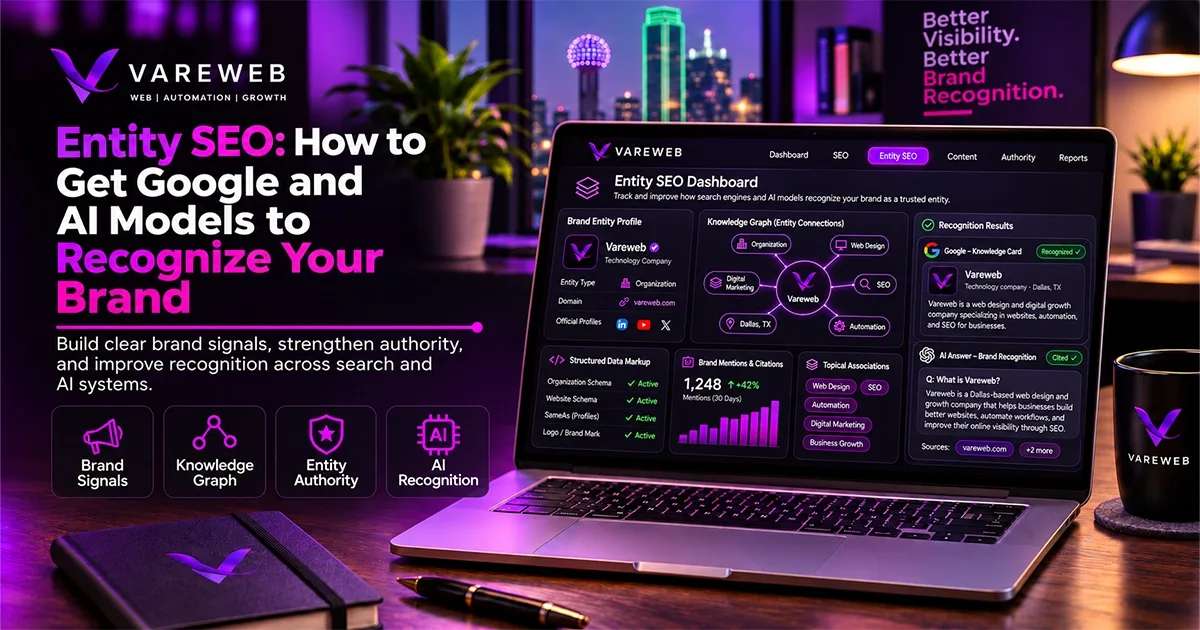
Quick Answer: Entity SEO is the shift from ranking for keyword strings to making your brand a clear, machine-readable "thing" that Google's Knowledge Graph and AI models can identify, verify and describe correctly. You build it with one canonical About page that states your facts plainly, nested Organization and Person JSON-LD tied together with stable @id values and sameAs links, and steady mentions of your brand on trusted sites in your category.
When a brand tells me ChatGPT recommends their competitor instead of them, the first thing I audit isn't their keywords. It's their entity data.
Most of the time, the machines are simply confused. The founder's name is spelled two ways, the company "launched" in three different years depending on which directory you read, and the LinkedIn page describes a service the business dropped in 2022.
That confusion now costs real visibility. At Google I/O 2026, Google said AI Overviews has over 2.5 billion monthly active users and AI Mode has passed 1 billion. Those systems answer with entities: brands, people, products and places they can identify with confidence.
Keywords dictate what a page says. Entities dictate who a brand is. If you don't have a canonical entity home, AI models guess, and they usually guess wrong.
Quick Overview: The Entity SEO Workflows at a Glance
| Workflow and what you build | How you know it works | Common mistake |
|---|---|---|
|
Canonical entity home One fact-first About page with legal name, founding year, leaders, location and core services |
Knowledge Graph and AI answers repeat the same facts | Marketing copy instead of facts |
|
Organization and Person JSON-LD Nested schema with stable @id values and a clean sameAs list |
Validators show one connected graph, no conflicts | Different schema on every template or subdomain |
|
Mention velocity and digital PR Steady brand mentions next to your category on trusted sites |
AI tools name you for category prompts | Mass press releases on unrelated sites |
|
Author entity reconciliation Real author pages with Person schema tied to the Organization |
Authors show up as recognized experts | Anonymous or "Admin" bylines |
|
Knowledge Graph claim and correction Verified panel access and evidence-backed edit requests |
Panel facts match your About page | Expecting a panel in weeks |
|
Share of Model Presence A fixed prompt set tested monthly across AI tools |
Your mention rate and accuracy rise | Tracking only keyword rankings |
The Death of Strings: Why Keywords Fail in the LLM Era
Google said "things, not strings" when it launched the Knowledge Graph back in 2012. For most of the decade after, you could still win with strings. Pick a keyword, match the page to it, earn links, rank.
That playbook breaks down when the answer engine isn't ranking pages but describing brands.
OpenAI said in March 2026 that ChatGPT has more than 900 million weekly active users. The Reuters Institute's Digital News Report 2026, based on 97,520 respondents in 48 markets, found 10% of people now use AI chatbots for news each week, rising to 16% of under-35s. People are asking machines to summarize the world, and those machines pull from what they already "know" about each entity, plus what retrieval returns at answer time.
That retrieval step is called Retrieval-Augmented Generation (RAG). The model searches, pulls a handful of passages and writes an answer from them. If your brand data is inconsistent across those passages, the model has to reconcile conflicting facts on the fly.
That's where entity bleed starts. I've seen AI answers credit a brand's founder to a competitor, place a company in the wrong city and list services it never offered, all because the source data disagreed with itself.
Entity bleed usually comes from a handful of predictable places:
- A rebrand nobody finished: the old name still lives on directories, press pages and a dormant social profile.
- A moved office: two addresses floating around, each with its own reviews and citations.
- A shared name: another company, product or person with the same or similar name, and nothing on your site that separates you.
- Plugin-generated schema: three tools each declaring a slightly different organization on the same page.
Keyword tools can't show you any of this. A rank tracker will happily report you're #3 for "B2B logistics software" while ChatGPT tells buyers you went out of business. I warn about this gap in my guide on how to choose an SEO company: an agency that only reports keyword positions is measuring half the board.
Good search engine optimization in 2026 still needs keywords. It just can't stop there.
The Blueprint: Entity SEO: How to Get Google and AI Models to Recognize Your Brand
Entity recognition starts with site architecture, not with PR. We regularly inherit brands with fragmented identities: three logos, two company names and schema generated by four different plugins. Part of delivering our eCommerce web development services is hardcoding one clean, canonical entity schema into the theme, so search engines read the brand correctly from the first crawl.
1. The Canonical Entity Home (The About Page)
The objective. Create one undisputed source of truth for your brand's facts.
The technical workflow. Start by checking what Google already believes. The Knowledge Graph Search API lets you query the graph directly with a free API key:
|
https://kgsearch.googleapis.com/v1/entities:search?query=YOUR+BRAND&key=API_KEY&limit=5&indent=True |
Look at what comes back. Does an entity exist for your brand at all? Does it carry the right @type (Organization, Corporation, LocalBusiness)? Is the description pulled from your site, from Wikipedia, or from something else? A missing result isn't failure. It just tells you where you're starting.
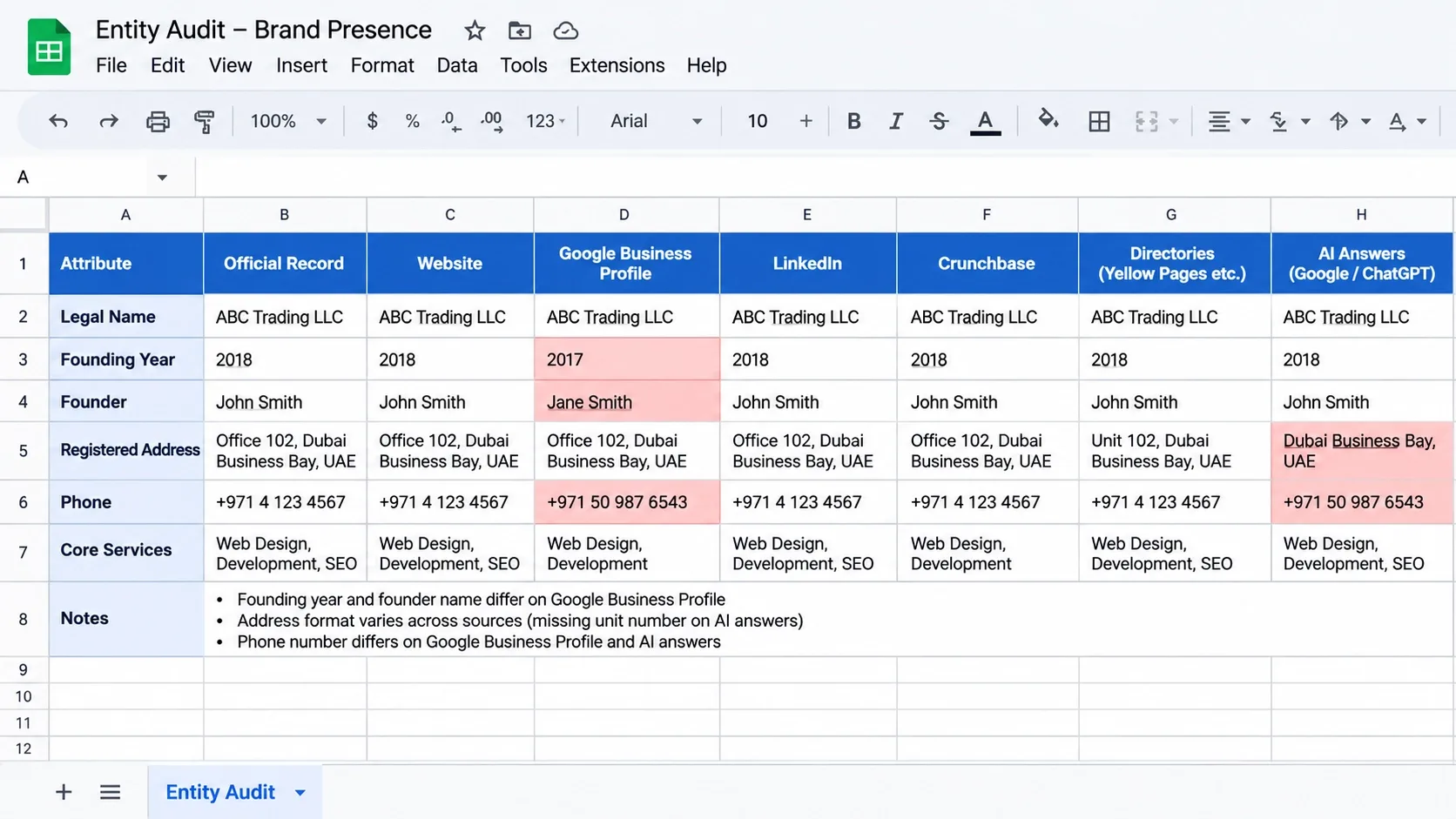
Run a discrepancy audit next. Build a sheet with one row per fact and one column per source:
- Facts to check: legal name, brand name, founding year, founders and executives, headquarters address, phone, core products or services, logo.
- Sources to check: your website, Google Business Profile, LinkedIn, Crunchbase, industry directories, press coverage, Wikidata, and what ChatGPT, Perplexity and Gemini say when asked.
Every cell that disagrees is a problem to fix at the source, not to explain away.
Fix them in order of influence. Start with the sources you fully control and that machines trust most: your own site, Google Business Profile and LinkedIn. Then move to Crunchbase and the major directories in your industry. Old press articles are the slowest to change, so for those, publish a clear correction on your own site and make sure every newer source states the right fact.
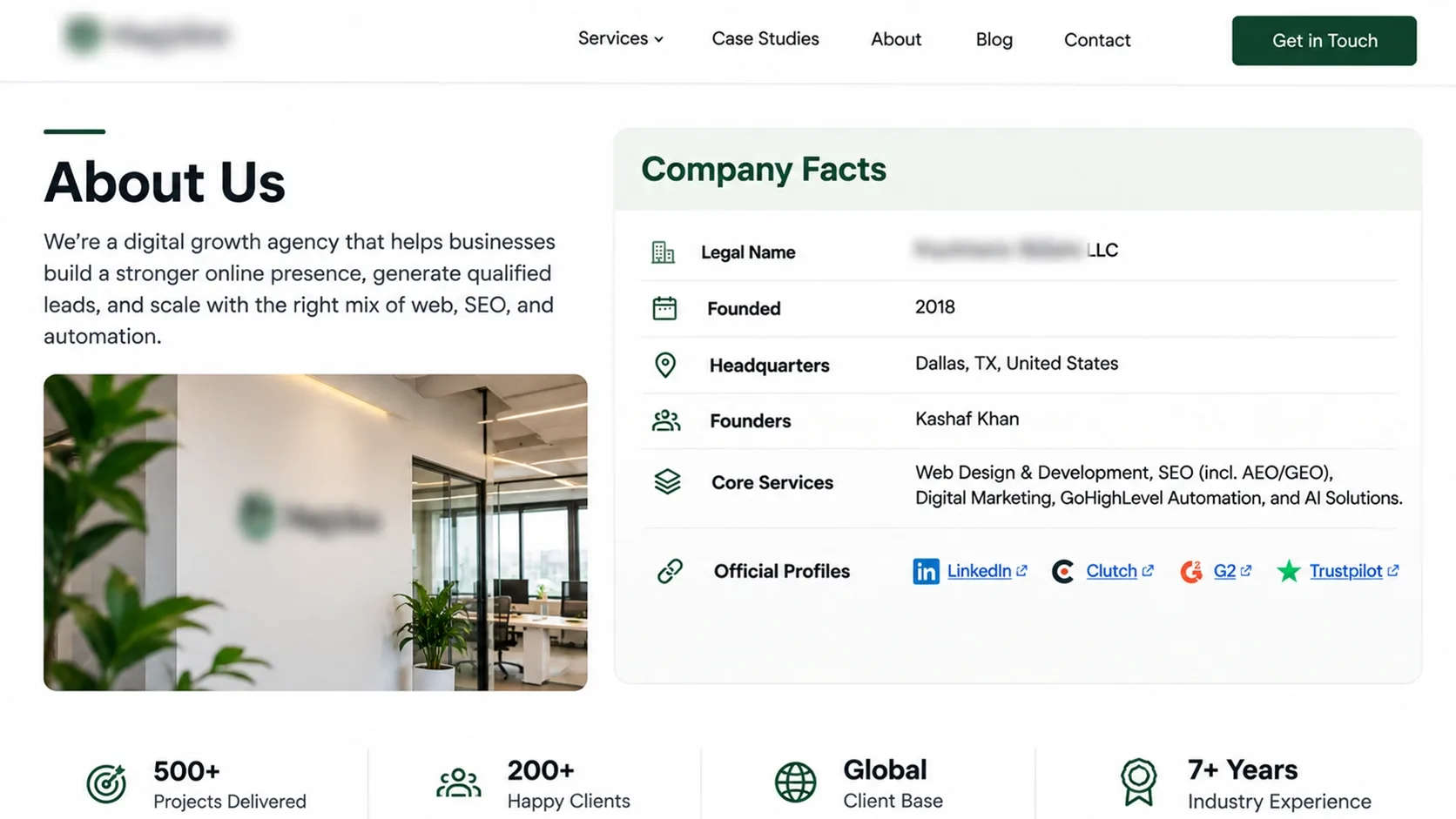
Build the About page as the answer key. Keep the brand story if you like, but give the facts their own block near the top, written as plain statements: "Example Brand is a logistics software company founded in..." style sentences, one fact per line, with no ambiguity for a crawler to resolve.
Google's own Organization structured data documentation, last updated in September 2026, recommends putting this information on your home page or on a single page that describes your organization. I use the About page for the full fact sheet and keep the homepage markup lighter but consistent.
The execution rule. No marketing fluff in the fact block. "Industry-leading innovators since day one" tells a machine nothing. "Founded in 2018 in Dallas, Texas by Jane Doe" tells it three things.
2. Deploying Organization and Person JSON-LD (The Semantic Layer)
The objective. Translate the canonical facts into one data layer every page shares.
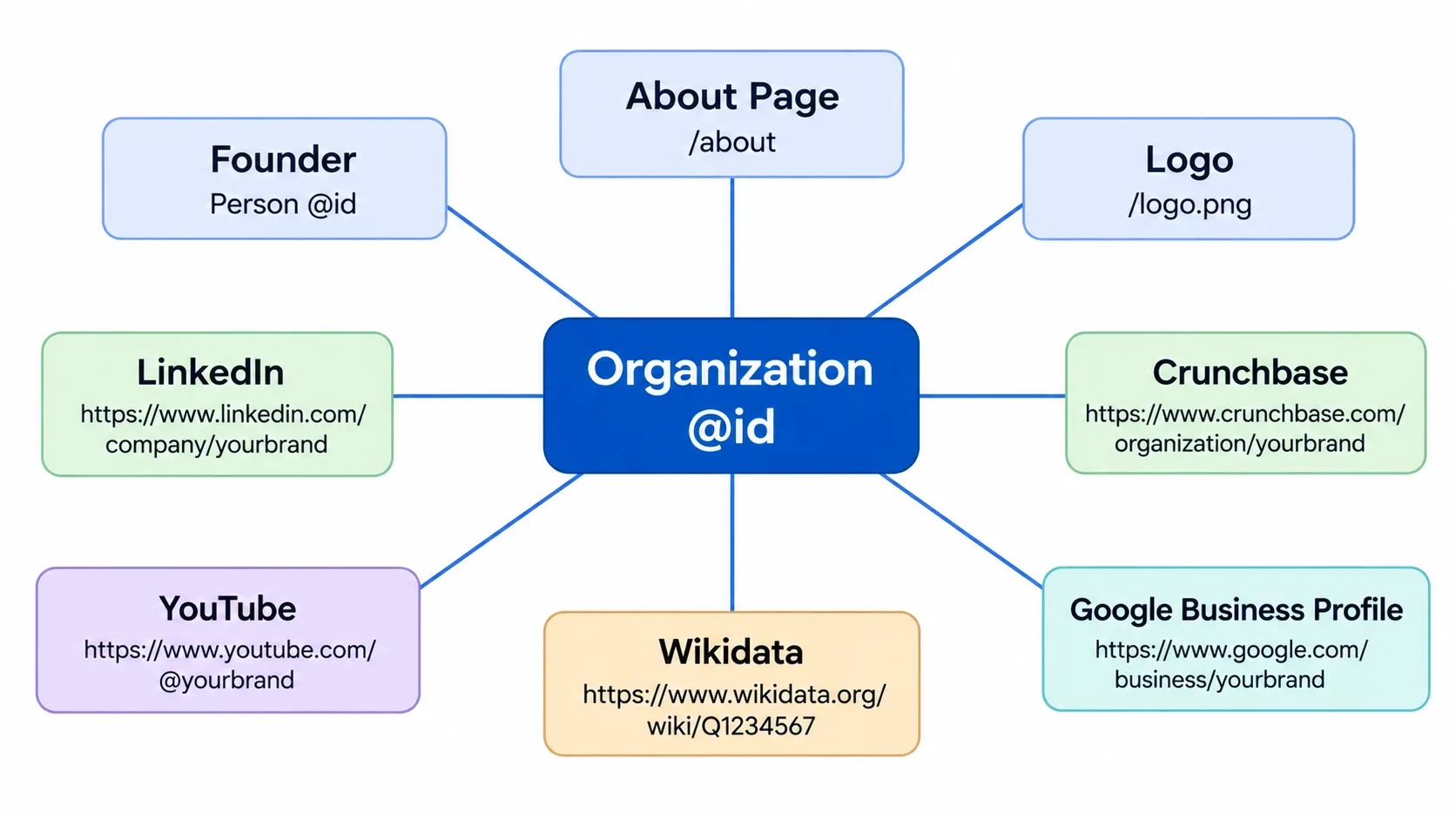
The technical workflow. The piece most sites get wrong is @id. In JSON-LD, @id is a node identifier: a stable URL-shaped name for a thing. Give your organization one, such as https://www.example.com/#organization, and reuse that exact value everywhere. Your blog posts, product pages and author pages then reference the same node instead of declaring a new organization each time.
This is the base structure I deploy on the About page, simplified:
|
{ "@context": "https://schema.org", "@graph": [ { "@type": "Organization", "@id": "https://www.example.com/#organization", "name": "Example Brand", "legalName": "Example Brand LLC", "url": "https://www.example.com/", "logo": "https://www.example.com/logo.png", "foundingDate": "2018", "address": { "@type": "PostalAddress", "addressLocality": "Dallas", "addressRegion": "TX", "addressCountry": "US" }, "founder": { "@id": "https://www.example.com/about/jane-doe/#person" }, "sameAs": [ "https://www.linkedin.com/company/example-brand", "https://www.crunchbase.com/organization/example-brand", "https://www.youtube.com/@examplebrand", "https://www.wikidata.org/wiki/Q00000000" ] }, { "@type": "Person", "@id": "https://www.example.com/about/jane-doe/#person", "name": "Jane Doe", "jobTitle": "Founder and CEO", "worksFor": { "@id": "https://www.example.com/#organization" }, "sameAs": ["https://www.linkedin.com/in/janedoe"] } ] } |
The sameAs array is where you tell machines that your LinkedIn page, your Crunchbase profile, your YouTube channel and your Wikidata item all describe one entity. Only list profiles you control or that clearly describe you. A sameAs link to a random directory listing with an old address does more harm than good.
Place the full Organization block in the <head> of the About page, and output a shorter version sitewide that carries the same @id. Then hunt down the conflicts. The ones I find on almost every audit:
- Duplicate organizations: the SEO plugin, the theme and a reviews widget each output their own Organization block with different names or logos.
- Wrong type: a single-location clinic marked as a generic Organization when LocalBusiness or a more specific subtype fits, or the reverse for a remote software company.
- Stale values: an old phone number or address hardcoded into a template years ago and never updated.
On product pages, point the product's brand or manufacturer at the same organization @id. I showed how that connection works for stores in my guide on structuring product schema for AI Overviews and ChatGPT citations, and my WooCommerce SEO checklist covers where duplicate schema from plugins and themes usually creeps in.
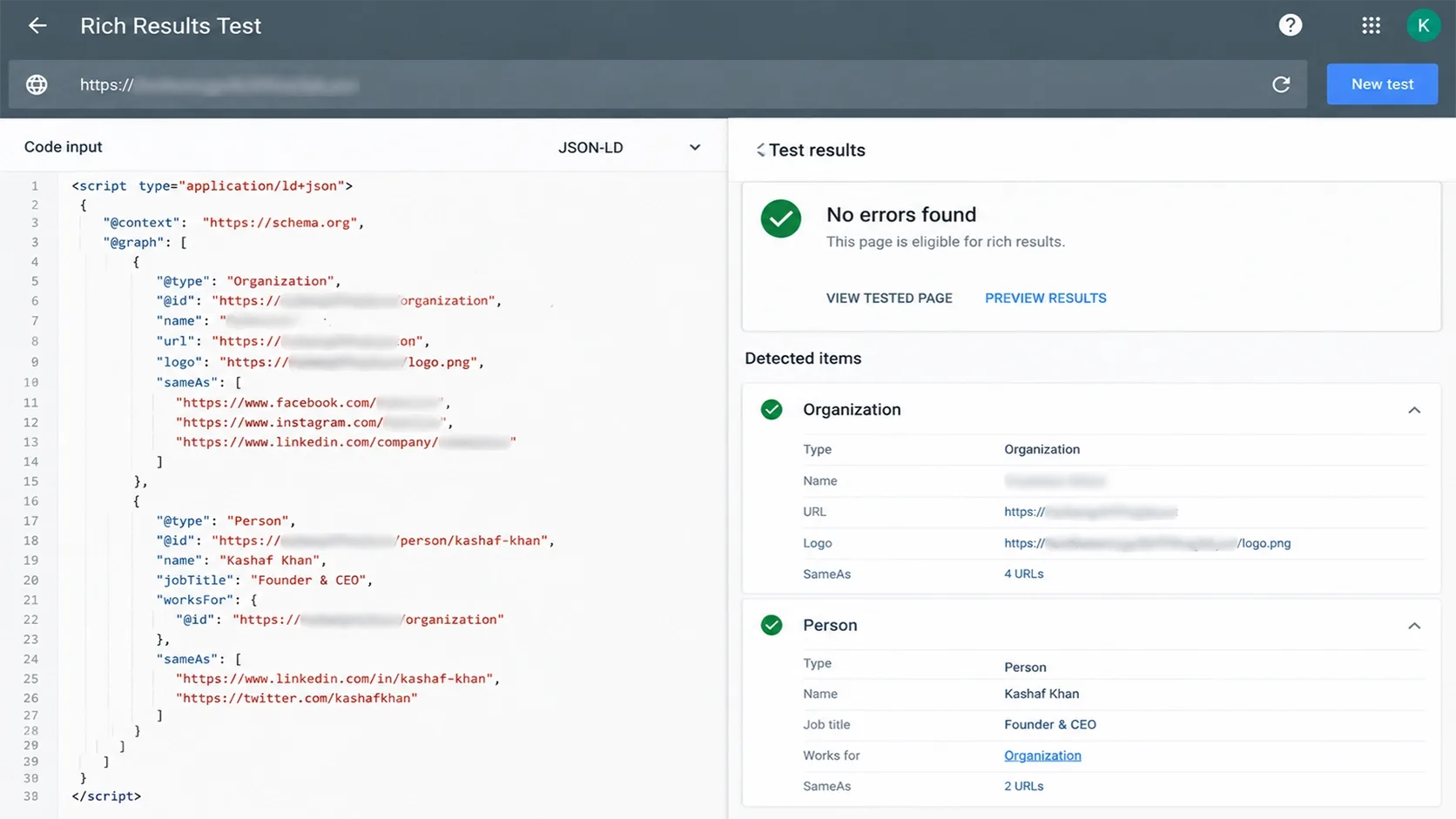
The execution rule. Keep strict parity. The JSON-LD must match the visible page, and every subdomain must describe the organization the same way. If the shop subdomain says "Example Brand Inc." and the blog says "Example Brand LLC," you've created two entities and asked Google to pick one.
3. Entity Mention Velocity and Digital PR
The objective. Teach search engines and AI models what category your brand belongs to.
The technical workflow. Language models learn associations from co-occurrence. When your brand keeps appearing in the same sentences and lists as the established names in your space, the model starts treating you as part of that set. Google hasn't published how it weighs unlinked mentions against links, but for AI answers, the mention itself carries the association whether or not there's a link attached.
The PR goal changes as a result. A link is still nice. A mention in the right context is the actual target.
- Comparison and listicle pieces: "best [category] tools" articles on respected industry sites, where your name sits next to the known leaders.
- Podcasts and webinars: show notes and transcripts put your brand and your founder next to category terms, and they get indexed.
- Industry directories and associations: the ones real buyers use, with the same name, description and category on every listing.
- Original data: a small survey or benchmark from your own customers earns citations from writers who need a number.
Before pitching anyone, I lock down three things. A one-paragraph brand boilerplate that every partner, directory and journalist gets word for word. Two or three category phrases you want to be known for, such as "WooCommerce development agency" rather than a vague "digital solutions provider." And a target list of 20 to 30 publications, podcasts and directories that your buyers actually read, ranked by relevance rather than domain metrics.
Pitch steadily from there. A few strong mentions every month look natural and keep reinforcing the association. A burst of 40 placements in one week, followed by silence, looks like a campaign and teaches the models very little.
Teaching content helps too, because it gives other sites a reason to name you. I explained why in my post on the role of educational content in building brand authority.
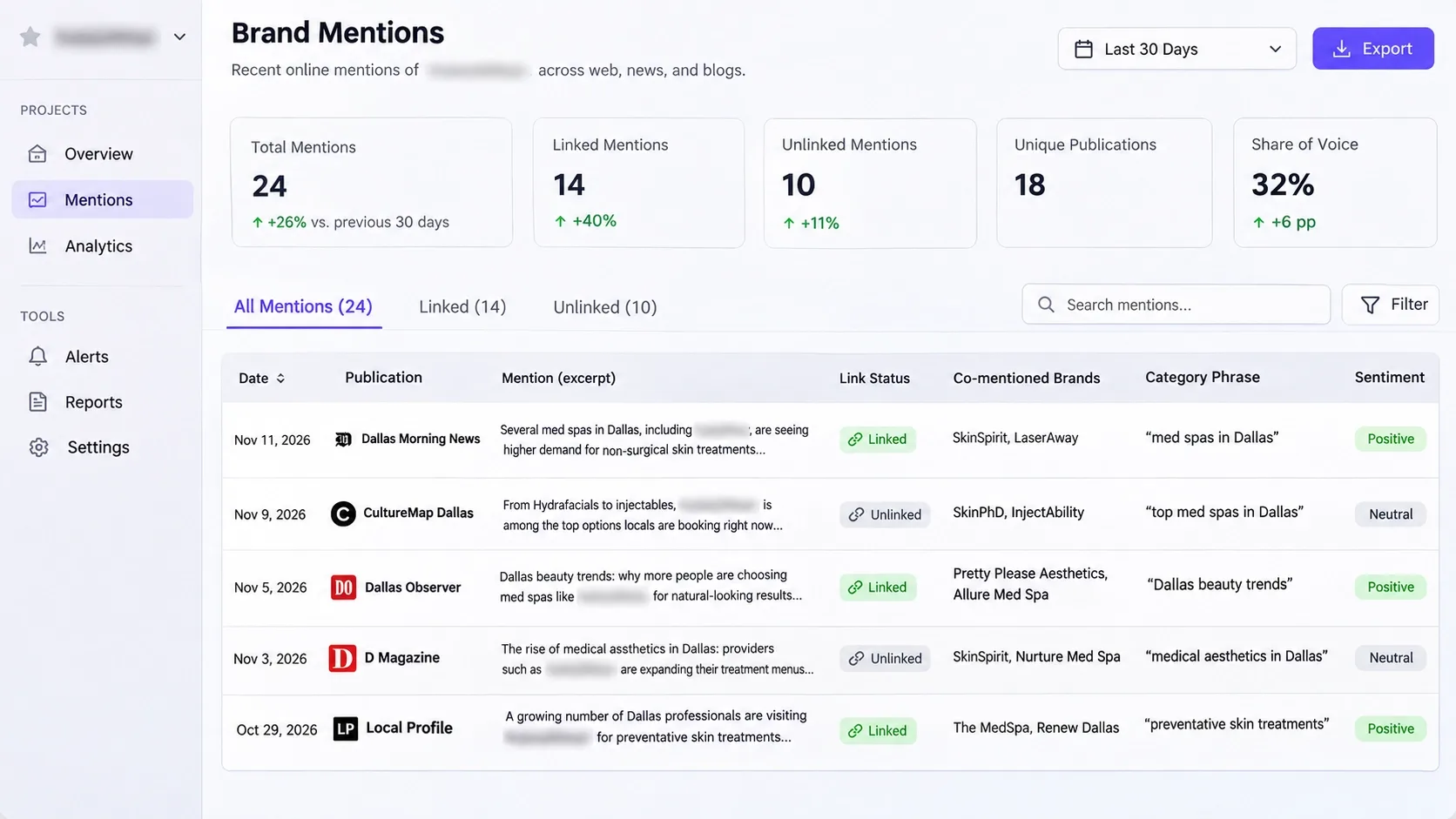
The execution rule. Consistency beats volume. Ten relevant mentions on trusted topical sites, using the same brand name and the same category language, are worth more than fifty generic press releases on sites nobody reads.
4. E-E-A-T and Author Entity Reconciliation
The objective. Prove real, qualified people stand behind the brand.
The technical workflow. Give every regular author a proper bio page, not a two-line box. Include their role, real experience, credentials where relevant, a photo, and links to their LinkedIn, talks, interviews and articles on other sites.
A strong author page answers four questions fast: who is this person, what have they actually done, why should I trust them on this topic, and where else can I verify them? If a reader can't answer all four in 30 seconds, neither can a machine.
Mark that page up with Person schema, give the person a stable @id, and connect it both ways: the Person's worksFor points to the organization @id, and the Organization lists them as founder or employee. Every article's author property then references that same Person @id.
The sameAs array on the Person node carries their outside footprint. A conference talk, a guest column and a podcast appearance all become evidence that this author exists beyond your website, and that evidence rubs off on the brand they work for.
Trust signals in the design matter as much as the markup. Minhaj, our Head of Development, covers how credentials and bios get built into page templates in his guide to healthcare website design that builds patient trust, and the same patterns apply far outside healthcare.
The execution rule. Anonymous content is a liability in AI search. An "Admin" byline gives machines nothing to verify, so it does nothing for your credibility, and in health, finance or legal topics it actively works against you.
5. Claiming and Correcting the Knowledge Graph
The objective. Control the facts in your knowledge panel and in the AI answers that draw on it.
The technical workflow. You can't apply for a knowledge panel. Google shows one when it's confident enough about an entity, and that confidence comes from consistent facts across your site, your schema and independent sources. Wikipedia helps, but it isn't required. Many companies and people have panels without one.
Wikidata is often the more realistic path, but only when the entity meets Wikidata's notability policy. That means being clearly identifiable with serious, public references. Creating a promotional item that gets deleted wastes time and can leave a messy edit history.
Once a panel appears, get verified. Google's guide on submitting verified feedback for a knowledge panel explains the process: verify your identity with a Google account, search for your entity, click "Suggest edits" at the top of the panel, choose the fact to change, and include public URLs that support the correction. Submit each suggestion separately. Google says verified feedback is usually reviewed within a few days.
Always link to your canonical About page in those requests, plus at least one independent source that states the same fact.
Rebrands need extra care. Keep the old name visible on the About page as a former name, add it to your schema with alternateName, and update every major profile on the same day. That gives search engines a clear bridge from the old entity to the new one instead of two half-trusted brands.
For local businesses, the Google Business Profile is part of the same picture. Name, address, phone, categories and hours there must match the About page and the schema exactly, and our local SEO audits start with that match.
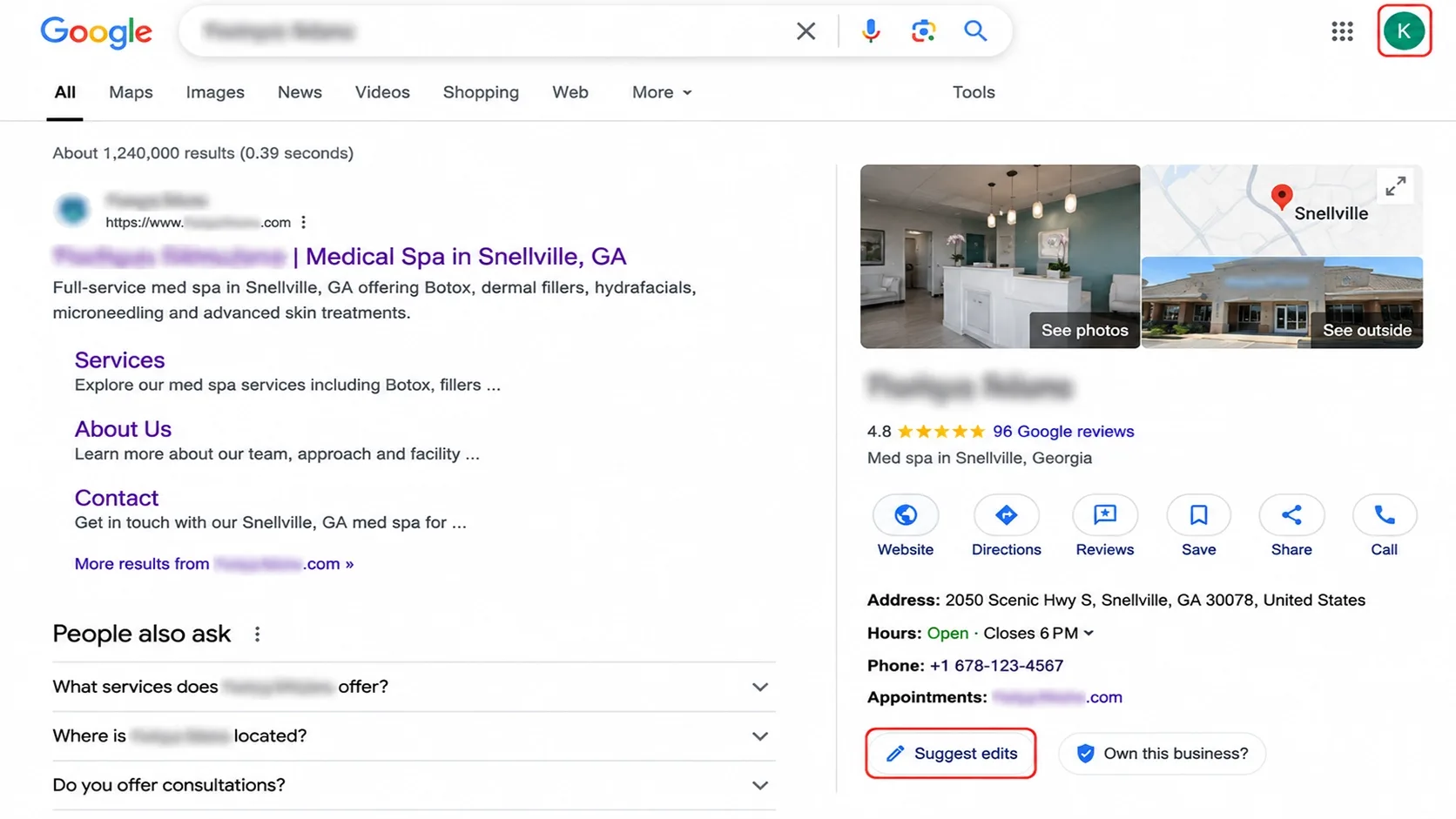
The execution rule. You can't force a panel overnight. In my experience, it shows up after 6 to 12 months of consistent facts, clean schema and steady third-party mentions, and sometimes longer for a new brand.
Measuring Share of Model Presence (Tracking AI Visibility)
Rank tracking tells you where a page sits for a string. It can't tell you whether ChatGPT recommends you, describes you correctly or forgets you exist.
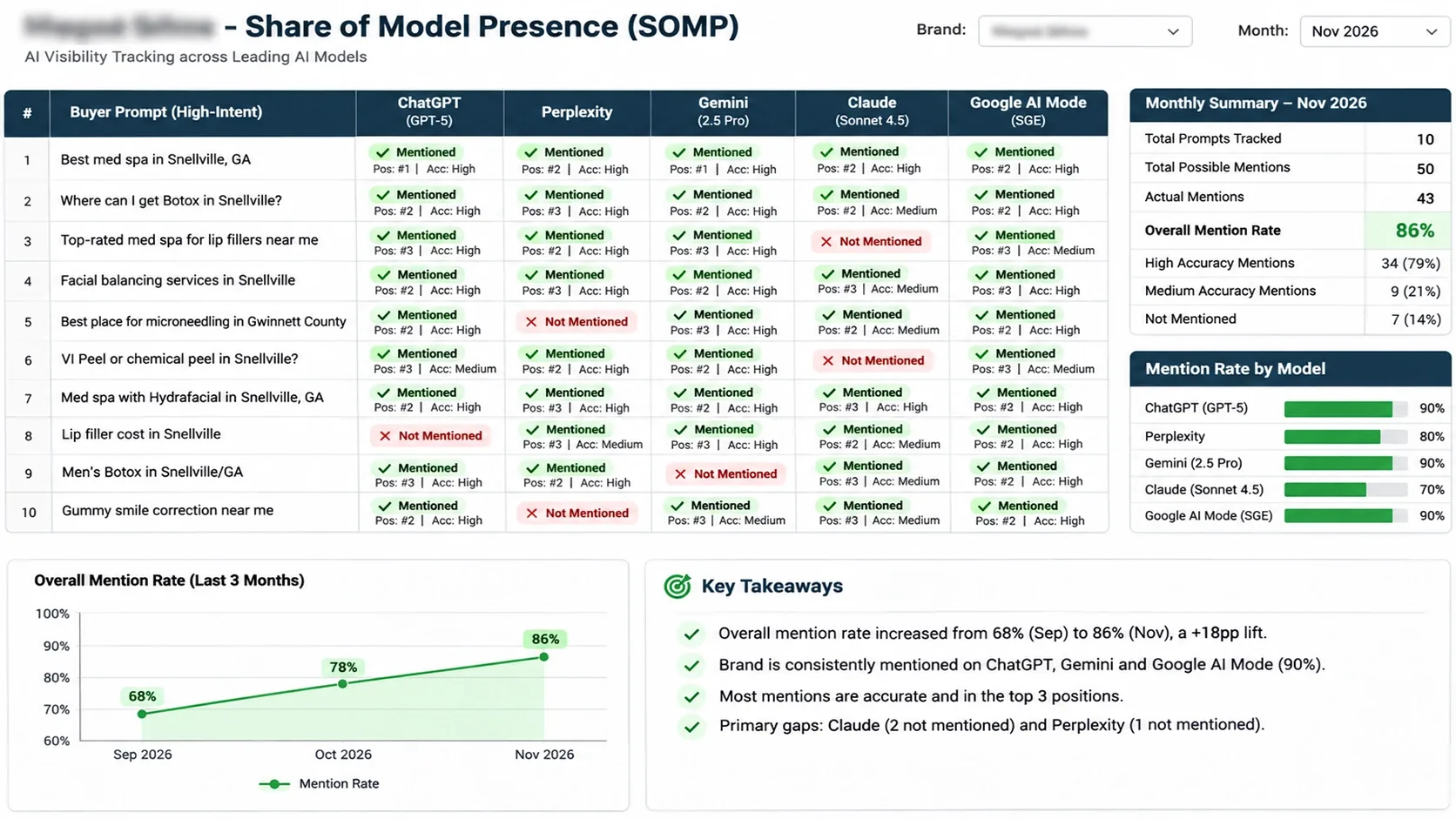
I track a different number instead: Share of Model Presence. It's the share of relevant AI answers that mention your brand, and whether those mentions are accurate.
This is the audit I run each month:
- Build a fixed prompt set: 20 to 40 questions real buyers ask, such as "Who are the top providers of [service] in [city]?", "What is [brand] known for?" and "[Brand] vs [competitor]."
- Run it across tools: ChatGPT, Perplexity, Gemini, Claude, and Google's AI Mode, in a clean session each time.
- Score each answer: mentioned or not, position in the list, facts correct or wrong, and which sources were cited.
- Track the trend, not single answers: AI responses vary from run to run, so the monthly rate matters more than any one reply.
Accuracy matters as much as presence. A brand mentioned in 60% of answers with the wrong founder or the wrong city has a bigger problem than one mentioned in 30% with every fact right, because every wrong answer repeats the error to a buyer.
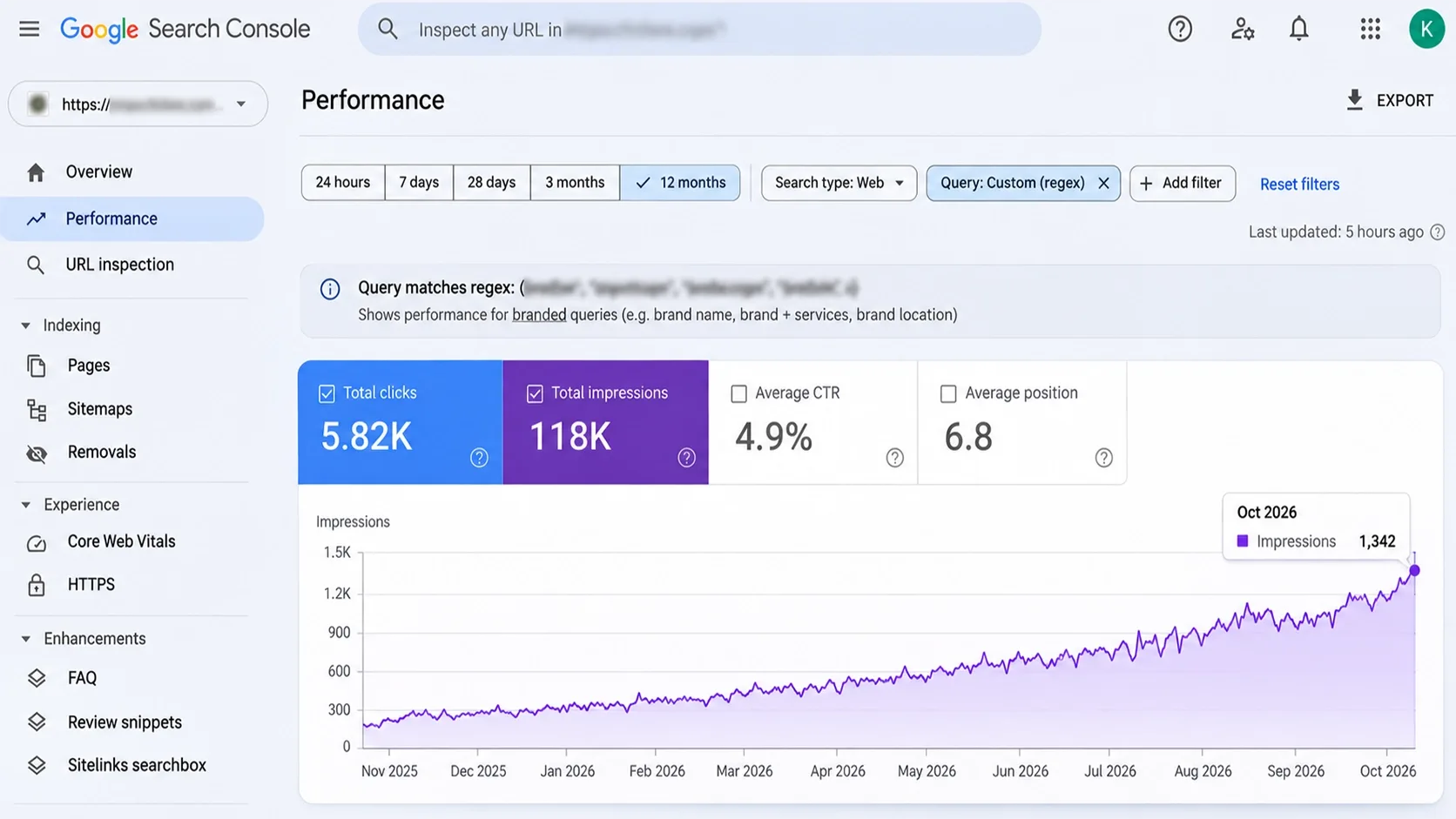
Search Console fills in the Google side. Filter queries with a regex that matches your brand and its common misspellings, then watch branded impressions over time. Rising branded demand is one of the clearest signs that your entity is getting stronger. My post on which weekly SEO metrics to measure shows how I fit this into a weekly routine.
Re-run your Knowledge Graph Search API query every quarter too. Check whether the entity exists, whether the type and description are right, and whether the resultScore moves. Treat that score as a rough signal only, since Google doesn't document what it measures and labels the API unsuitable for production-critical use.
When the AI answers get your facts wrong, fix the source pages they cite. Often that's an old blog post of your own with outdated details, and refreshing it with real information gain does more than any outreach. I covered that process in my guide to fixing content decay, and the citation side in my guide to getting your website cited by AI search engines.
FAQs
Do I need a Wikipedia page to establish an entity for my brand?
No. Consistent facts, clean Organization schema with accurate sameAs links and mentions on trusted sites can earn a knowledge panel without Wikipedia.
What is the difference between keyword SEO and entity SEO?
Keyword SEO matches pages to search phrases. Entity SEO makes sure search engines and AI models know exactly who your brand is, what it does and how it connects to people, products and places.
How long does it take Google to generate a Knowledge Panel for a new business?
Usually 6 to 12 months of consistent signals, sometimes longer. There's no form to request one.
How do I fix incorrect facts about my brand in ChatGPT or Perplexity?
Fix the facts at the source: your About page, schema, profiles and any pages the AI tool cites. Then add fresh, consistent third-party mentions and re-test with the same prompts each month.
What is the role of an @id node in JSON-LD schema?
It gives an entity one stable identifier. Every page can then reference the same organization or person instead of creating duplicates.
Can a small local business build a recognizable entity?
Yes. Size matters less than clarity: the same name, address and phone everywhere, clean schema and a strong Google Business Profile go a long way.
Does updating my Google Business Profile help with entity SEO?
Yes. It's one of Google's main sources of local business facts, so it should match your website and schema exactly.

Written by
Kashaf
Kashaf is a veteran SEO specialist with deep expertise in AI SEO, generative engine optimization, ORM, web strategy, and marketing automation. With a Master's in Computer Science, he blends search strategy with technical insight into websites, automation workflows, and AI-driven platforms, helping brands dominate traditional search while adapting to the future of AI-powered discovery.