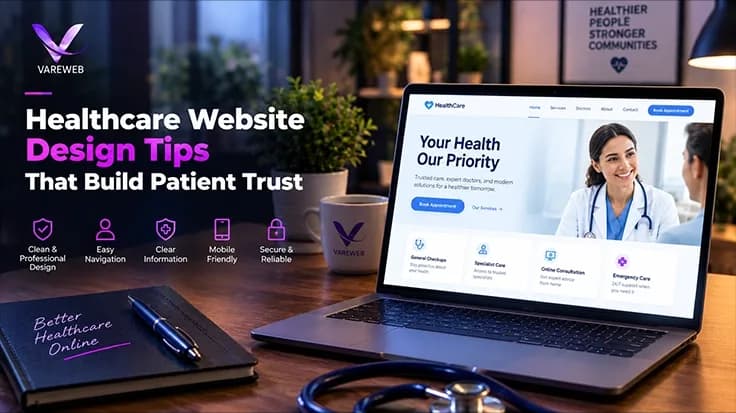
Quick Answer: Healthcare web design is not just calming color palettes - out-of-the-box templates often fail strict YMYL guidelines, lack real accessibility compliance, and load too slowly for patients searching urgently on a phone. Building a healthcare site that ranks and converts isn't about bolting on a generic "Book Now" widget. It's about engineering HIPAA-aware data layers, showcasing E-E-A-T through structured physician profiles, meeting WCAG standards in practice rather than on paper, and structuring JSON-LD schema so Google and AI engines can instantly verify medical authority.
A patient searching for urgent care at midnight doesn't read a mission statement. They scan a phone screen for a number, a location, and some visible sign that whoever answers actually knows what they're doing - and they form that judgment in the time it takes a hero image to load, well before they reach a single word of actual content. A practice can employ genuinely excellent physicians and still lose that patient in the first four seconds, because the site architecture behind those physicians was never asked to carry the weight it's actually carrying.
Here's a number worth sitting with before anything else: Gallup and the West Health-Gallup Center's own April 2026 research found that 25% of Americans have used an AI tool for health information, with 59% of them researching specifically before a doctor's visit. That's a quarter of the country forming a first impression of a condition, a treatment, or a provider before a human is ever involved - and if your site's data isn't structured well enough for that AI tool to read accurately, a competing practice's is shaping that first impression instead. Overcoming generic template constraints is exactly why our healthcare web development strategies focus on clean, purpose-built engineering rather than an off-the-shelf theme with a stock photo swapped in.
A Patient Forms Their First Impression Before Reading a Single Word
A quarter of Americans now use AI tools to research health information before ever seeing a doctor - if your site's data isn't structured for that moment, a competing practice's is shaping that first impression instead. Vareweb builds healthcare sites engineered for both the human glance and the machine read.
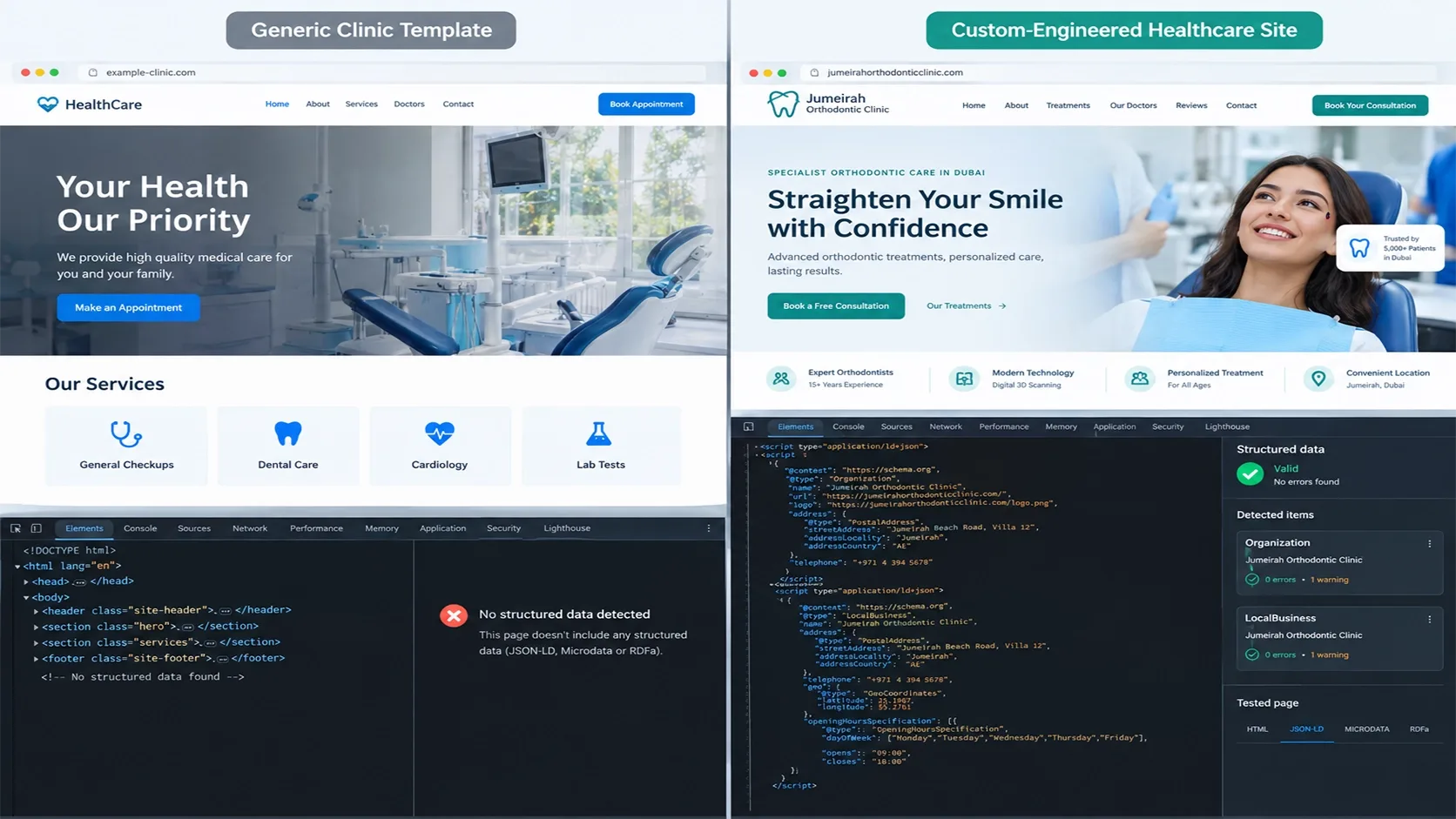
Quick Comparison: Standard Medical Templates vs. Search-Engineered Healthcare Architecture
| # | Area | Standard clinic website | Search & AI-engineered healthcare |
|---|---|---|---|
| 01 | Physician profiles | Combined bios on one "About Us" page | Dedicated URL per physician, credentials, schema |
| 02 | Schema markup | Basic LocalBusiness markup only | Nested MedicalEntity, Physician, MedicalWebPage |
| 03 | Patient portal crawling | Login-gated URLs left open to crawlers | Blocked via robots.txt and rel="nofollow" |
| 04 | Mobile LCP | Oversized hero images slow urgent searches | AVIF/WebP, fetch priority, fast server response |
| 05 | Accessibility | Styled divs, missing ARIA labels | Semantic HTML5, genuine WCAG compliance |
| 06 | Booking & telehealth scripts | Render-blocking widgets and iframes | Facade-loaded, deferred non-critical JS |
| 07 | Location pages | Copy-pasted text across every branch | Unique hyper-local content, distinct reviews |
| 08 | Medical disclaimers | Dense legal text sitting above the fold | Empathetic UX first, disclaimers near the footer |
| 09 | AI discovery (llms.txt) | No llms.txt, unmanaged crawler access | Machine-readable summary of specialties, policies |
| 10 | Symptom-to-treatment linking | Blog isolated from service pages | Contextual hub linking symptoms to treatments |
| 11 | Patient reviews | Locked inside third-party iframes | Pulled via API into the DOM with AggregateRating |
| 12 | Security signals | Basic SSL and little else | HSTS, secure cookies, strict CSP |
| 13 | On-site search | Exact-match only, fails on medical terms | Semantic search understanding patient phrasing |
| 14 | FAQ content | Missing or entirely unstructured | FAQPage schema answering high-anxiety questions |
The Technical Guide: Healthcare Website Design Tips That Build Patient Trust
Fourteen strategies, each addressing specific way standard medical templates quietly work against trust, rankings, or both.
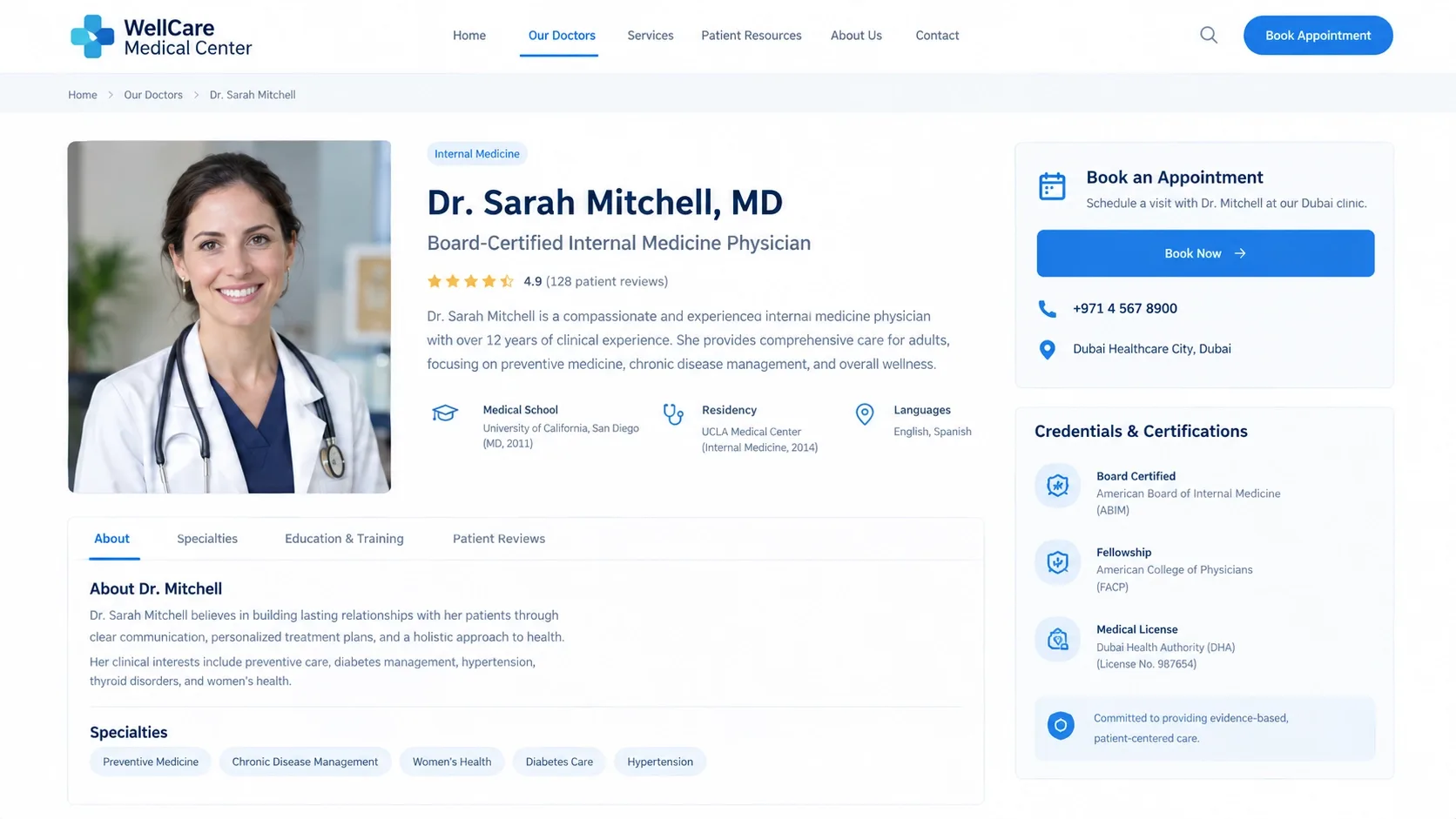
1. Engineer Dedicated Physician Profile Pages for E-E-A-T
Combining an entire care team on a single "About Us" page is one of the fastest ways a healthcare site fails Google's YMYL quality standards. A shared page can't carry individual academic credentials, board certifications, or publication history with the depth a quality rater - human or algorithmic - expects to see before trusting medical content.
Each physician needs an individual URL: full credentials, board certifications, links to published research where they exist, and Person or Physician schema tying the page directly to the practice's broader MedicalOrganization markup. We've restructured messy team pages into exactly this format more than once, and the pattern holds every time - individual authority pages consistently outperform a shared roster page on both trust signals and rankings. The same specificity principle carries into how we approach an About page that actually builds trust more broadly.
2. Implement Nested MedicalEntity and Physician JSON-LD Schema
Most healthcare sites lean on basic LocalBusiness markup and stop there, which tells a search engine almost nothing about what actually happens inside the building. JSON-LD now runs on 55.5% of the web, and healthcare is precisely the category where the richer schema types matter most, because the facts being verified are medical, not commercial.
Layer in MedicalSpecialty, MedicalCondition, and MedicalWebPage schema so search engines - and AI answer engines drawing on the same structured data - understand exactly which conditions a practice treats, which specialties it covers, and which insurance it accepts, without inferring any of it from unstructured paragraph text. We cover the broader template-level mechanics of this in How Schema Markup and Web Design Work Together.
3. Isolate Patient Portals to Protect Crawl Budget
Clinics routinely link heavily to external patient portals - MyChart and similar systems - and just as routinely leave crawlers free to wander into login-gated parameters that were never meant to be indexed in the first place, burning crawl budget on pages Google can't actually read past the login wall anyway.
Use robots.txt to disallow portal subdirectories outright, and apply rel="nofollow" to outbound portal links from content pages, so the crawl budget that should be finding your service pages and physician profiles isn't wasted chasing a login screen it will never get past.
When a practice asks us why a handful of service pages never seem to get re-crawled after an update, patient portal leakage is one of the first things we check - a crawler that keeps hitting dead-end login walls learns, over time, to visit the domain less often altogether.
A Crawler That Keeps Hitting Login Walls Learns to Visit Less Often
Patient portal leakage is one of the first things we check when a practice's service pages stop getting re-crawled. Vareweb isolates what shouldn't be indexed so crawl budget goes toward the pages that actually need to rank.
4. Optimize Mobile Core Web Vitals for Urgent Searches
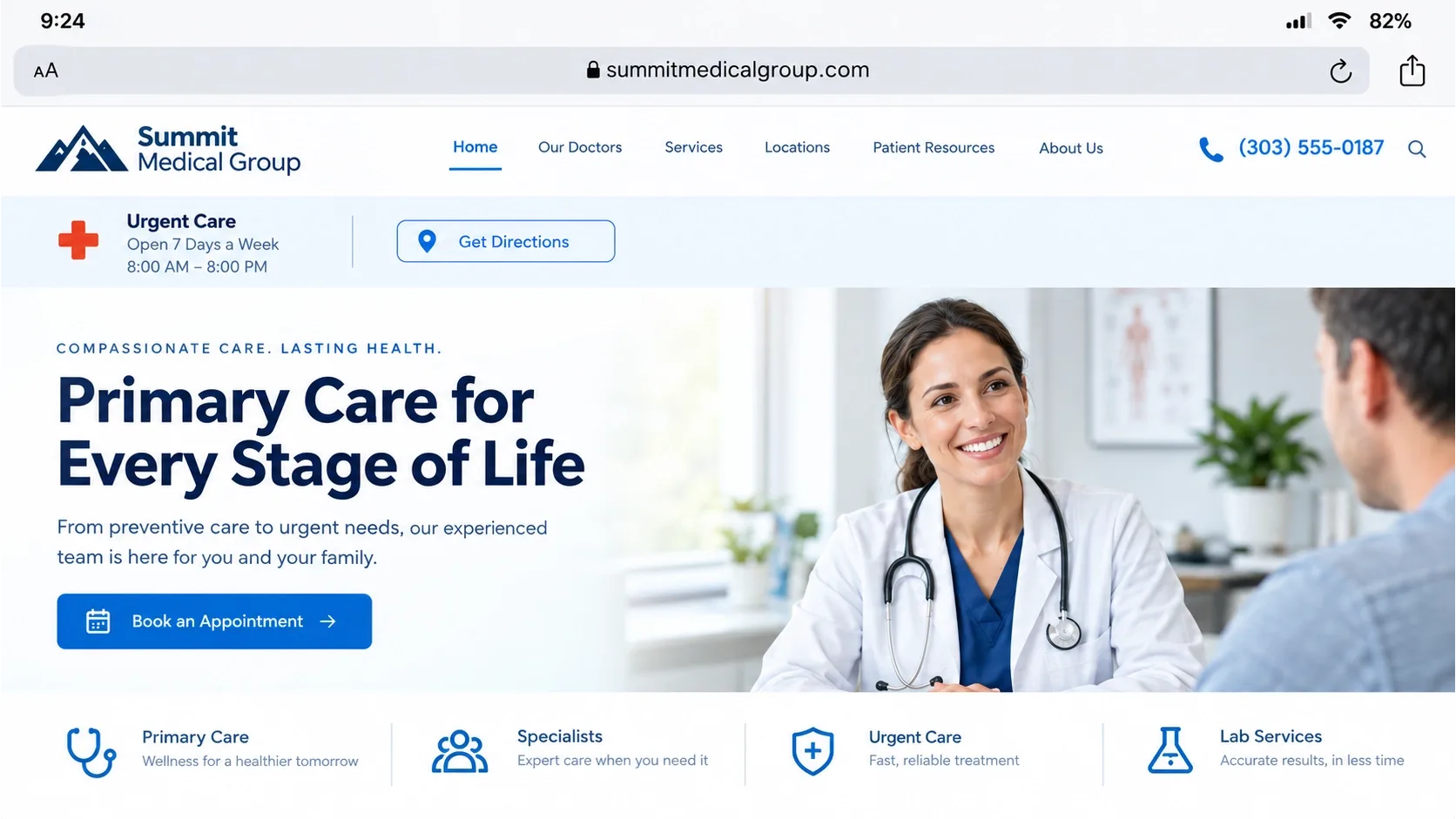
Patients searching for medical help are frequently anxious, frequently on a mobile connection, and frequently in a hurry - the worst possible moment for a four-second hero image of a hospital lobby to stand between them and the phone number they're looking for. Mobile now accounts for roughly half of all web traffic globally, and urgent healthcare search skews even further toward it.
Implement AVIF or WebP formats, set explicit fetch priority on the actual LCP candidate, and get server response time down before touching anything else - a slow time-to-first-byte undermines every other optimization layered on top of it. We go deeper on the underlying levers in How Important Is Page Speed for SEO in 2026?.
5. Design for WCAG Compliance and Accessibility
Healthcare sites have to work for everyone, including elderly patients and patients with visual or motor impairments - not as a legal afterthought, but as a genuine access requirement for the population most likely to need care in the first place. This is also, increasingly, a legal exposure question: UsableNet's own August 2026 lawsuit tracker recorded 432 new ADA web accessibility lawsuits in that single month, with healthcare named specifically among the fastest-growing targeted industries.
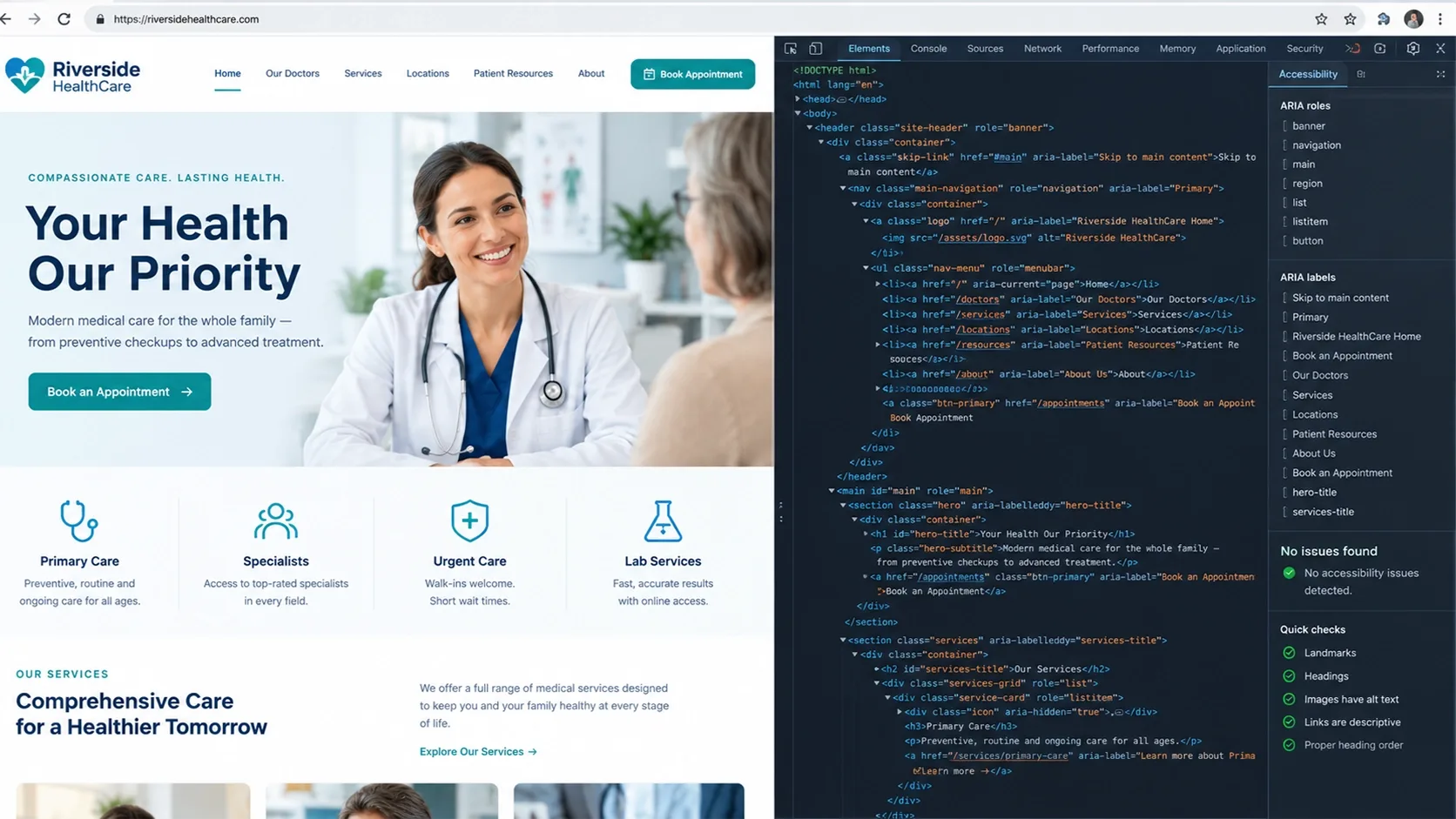
Replace styled <div> tags with genuine semantic HTML5 - nav, main, section - and apply strict ARIA labeling rather than relying on an overlay widget bolted on after launch; the same tracker found a meaningful share of sued sites were already running a third-party accessibility widget at the time of the lawsuit. Real semantic structure builds trust with patients and satisfies the same accessibility signals search engines increasingly weigh. We cover the implementation details in Web Accessibility: Designing for All Users.
6. Audit and Defer Third-Party Booking Scripts
Heavy telehealth widgets, live chat plugins, and appointment-booking iframes are frequent, severe sources of JavaScript execution delay, and they tend to load on every page regardless of whether a given visitor has any intention of booking that session.
Build a static facade for the booking widget that loads the real, heavy script only once a patient actually clicks to schedule, and defer every non-critical script that isn't needed for the first meaningful interaction. This protects Interaction to Next Paint specifically - the metric that punishes exactly this kind of unmanaged third-party script stacking, and the same pattern we cover in more general terms in 11 Best UI/UX Design Tips for Good Core Web Vitals.
A Booking Widget Loading on Every Page Is Costing You Interactions
Most visitors never click "schedule" on the page they land on - but the heavy script loads for all of them anyway. Vareweb builds static facades that defer the real script until a patient actually clicks.
7. Structure Location Pages for Multi-Clinic Dominance
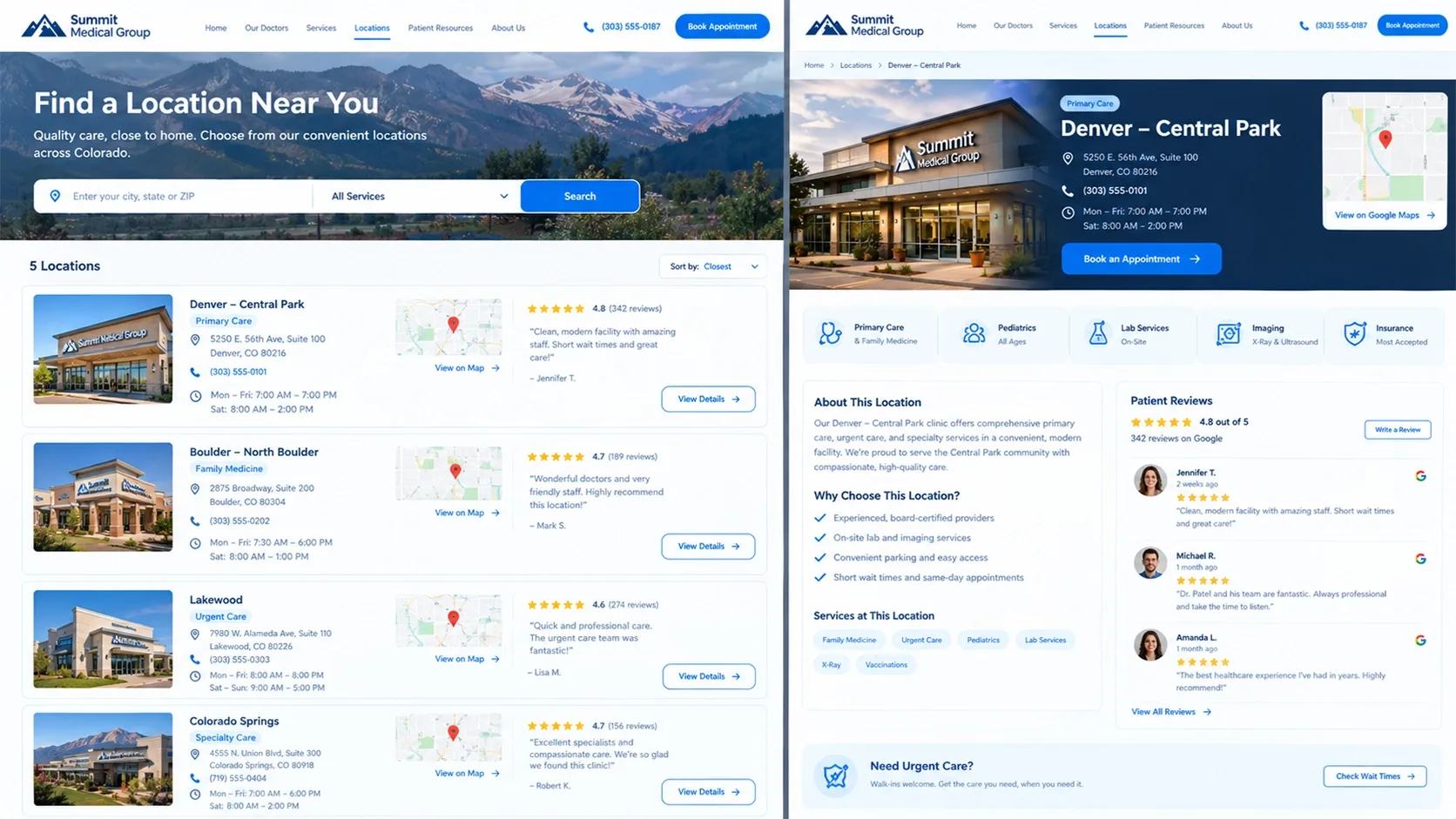
Multi-location practices default to copy-pasting the same service description across ten branch pages, which Google reads as exactly the duplicate content it is - and which tells a patient nothing about what actually makes the branch three miles from them different from the one across town.
Build genuinely unique, hyper-local architecture per branch: distinct provider rosters, location-specific patient reviews, real driving directions, and localized schema tied to that specific address rather than the organization as a whole. Each location page should read like it was written for that neighborhood, because it was.
Auditing multi-location clinic sites, we see the same shortcut over and over - a corporate team writes one strong page, then finds-and-replaces the city name across every branch. Patients notice immediately when a page clearly wasn't written for their specific location, and so does Google.
8. Move Dense Medical Disclaimers Below the Core Patient UX
Legal disclaimers are non-negotiable, but placing a wall of regulatory text above the fold destroys mobile UX at exactly the moment a worried patient needs a clear, calm answer, not a paragraph of liability language standing between them and it.
Code a layout that leads with clear, empathetic symptom and treatment information, and keeps the heavy disclaimer text organized cleanly near the footer where it remains fully accessible and fully compliant without being the first thing a patient has to scroll past. Compliance and reassurance don't have to compete for the same pixels.
Compliance and Reassurance Shouldn't Compete for the Same Pixels
A worried patient needs a clear answer before a paragraph of liability language. Vareweb designs the layout so disclaimers stay fully compliant without being the first thing anyone has to scroll past.
9. Implement an llms.txt File for Healthcare AI Discovery
AI health assistants increasingly answer questions about treatments, hours, and accepted insurance by drawing on structured summaries rather than crawling a full page the way a human reads it - which makes the Gallup finding above directly actionable: a real share of patients are already forming a first impression this way.
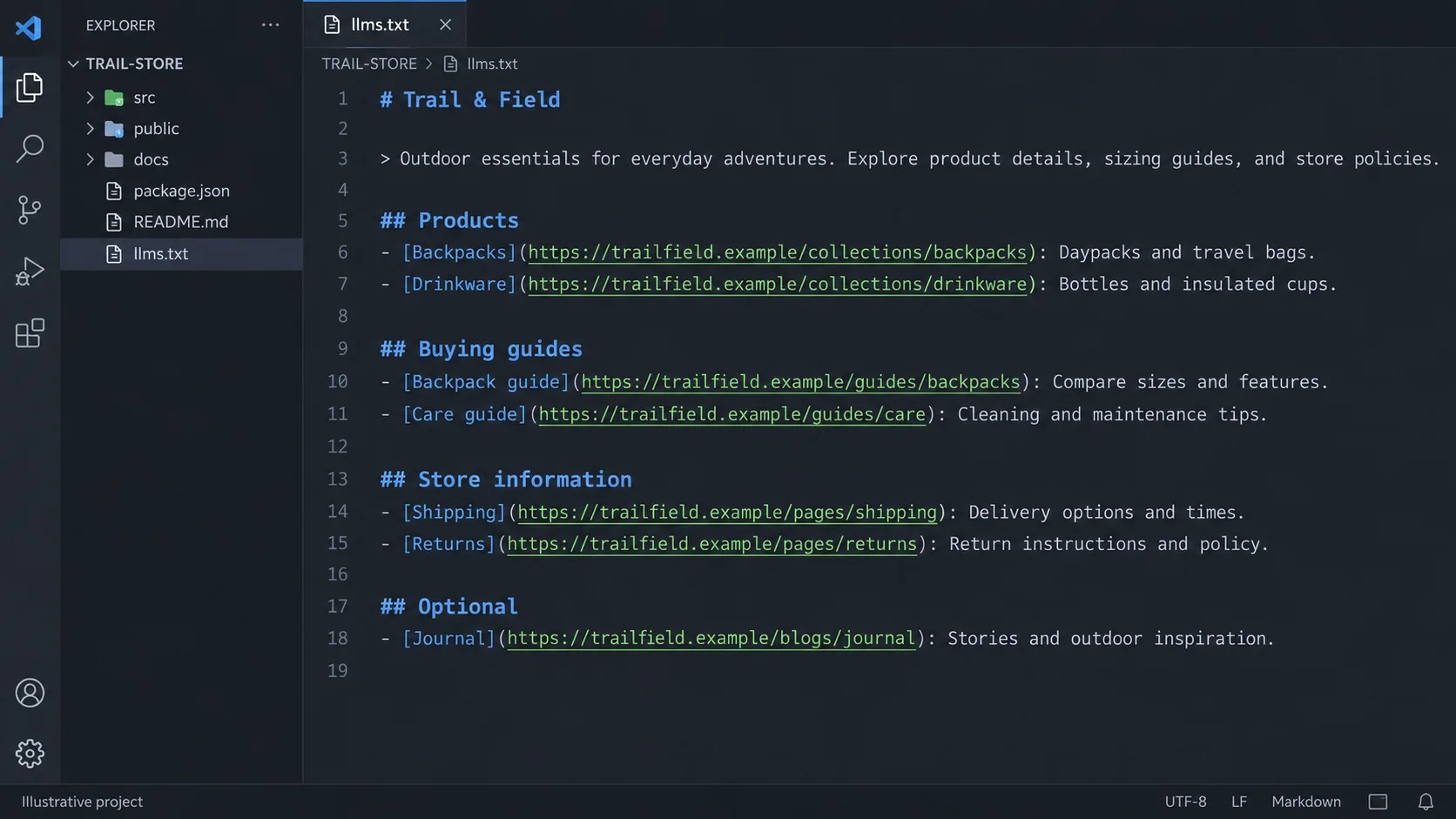
Create an llms.txt file at the site root giving AI agents a clean, machine-readable summary of specialties, accepted insurance, and emergency protocols in plain Markdown. We go deeper on the broader access question in Tips to Build AI-Agent-Friendly Websites and the citation mechanics specifically in How to Get Your Website Cited by AI Search Engines.
Treat this file as living documentation, not a one-time launch task - a summary that still lists a physician who left the practice eight months ago, or insurance the clinic stopped accepting, does real damage to the exact trust an AI citation was supposed to build.
10. Build a Symptom-to-Treatment Internal Linking Flywheel
Healthcare blogs sit isolated from service pages by default far too often - a genuinely helpful article on "why does my knee hurt" gets published, ranks reasonably well, and never sends a single reader toward the knee replacement service page it should be funneling traffic to.
Architect content hubs that deliberately map informational symptom searches to the specific commercial treatment page they should lead toward, using contextual, descriptive anchor text placed mid-article rather than a single generic link at the bottom. A patient reading about knee pain should find the orthopedic consultation page naturally, in the sentence where it's actually relevant.
A Great Symptom Article That Never Links to the Treatment Page Is a Missed Booking
Architecting content hubs that connect informational searches to the commercial page they should lead toward is exactly the kind of structural work most practice sites skip. Vareweb builds that flywheel in from the start.
11. Leverage Real Patient Reviews via First-Party Data
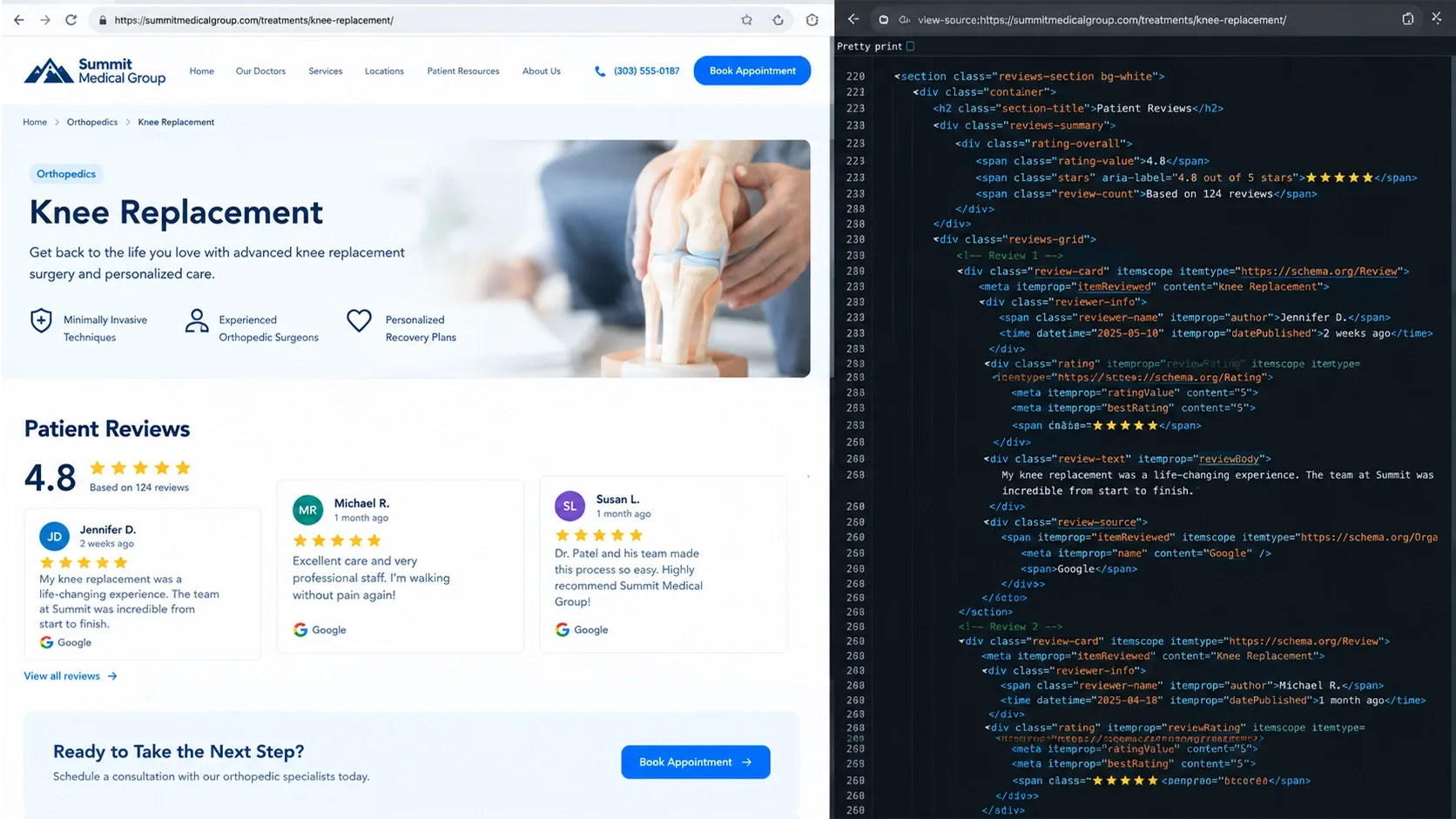
Third-party review widgets - Healthgrades, ZocDoc, and similar platforms - frequently render inside an iframe, which means the review content sitting right there on the page is functionally invisible to Google, however many stars a visitor can see.
Pull reviews via API and render them directly in the HTML DOM, paired with AggregateRating schema, so those review stars have a genuine chance of surfacing in the SERP itself rather than staying locked inside a widget no crawler can read. Visible, verifiable social proof does real work here - we cover the broader mechanics in 12 Reasons Why Social Proof Is Important for Your Brand.
12. Enforce Strict HTTPS, SSL, and Security Headers
Patient trust starts with visible security, and while HIPAA compliance is mostly a data-storage and data-handling question rather than a front-end one, the front-end still has to visibly demonstrate that same seriousness - a browser security warning undoes a beautifully designed physician page in a single glance.
Implement HSTS, secure cookie flags, and a genuinely strict Content Security Policy rather than the bare-minimum SSL certificate most templates ship with by default. This is the same visible-trust logic behind what trust badges actually signal and why they matter - security headers are trust signals a browser enforces automatically, badges are trust signals a visitor has to notice.
13. Upgrade On-Site Search for Medical Terminology
Standard site search fails the moment a patient misspells a complex medical term or searches in plain language instead of clinical vocabulary - typing "heart doctor" and getting zero results because the site's own content says "cardiology" is a genuinely common, genuinely avoidable failure.
Integrate AI-driven semantic search so a patient's plain-language query reliably connects to the correct specialty hub, regardless of whether they used the clinical term or the everyday one. This single fix consistently lowers bounce rate for exactly the highest-intent visitors - the ones who searched because they need something specific, right now.
Ready for a Site That Earns Patient Trust and Ranks for It?
Vareweb builds healthcare sites around E-E-A-T, accessibility, security, and the technical SEO underneath all of it - so patients and search engines trust what they find at the same time. One team, accountable for the whole result.
14. Utilize FAQ Schema for High-Anxiety Patient Questions
Patients carry immediate, specific questions about recovery time, insurance coverage, and pain levels well before they're ready to book - questions that, left unanswered on the page itself, send them straight to a search bar or a competing practice's site instead.
Code localized FAQPage schema directly into treatment pages, answering the real questions a patient actually has at that stage of decision-making. Done well, this captures "People Also Ask" placements in the SERP and gives an anxious patient a direct, reassuring answer before they've even clicked through - sometimes that answer is what turns a search into a booking.
Write these answers the way a caring front-desk staff member would say them out loud, not the way a legal team would draft them. The clinical accuracy still has to hold up, but the tone is what a frightened patient actually remembers.
Frequently Asked Questions
Why is E-E-A-T more important for healthcare websites than other industries?
Healthcare sits squarely in Google's Your Money or Your Life category, where inaccurate information carries genuine real-world risk to a reader's health or finances. Google applies meaningfully stricter quality standards to YMYL content than it does to most other industries as a result.
How long does it take for a new clinic website to rank locally?
Three to six months of consistent technical and local SEO work is a realistic baseline for most markets, faster in less competitive specialties and slower in dense metro areas with many established practices already ranking.
Does HIPAA compliance directly affect our SEO rankings?
Not directly, but the two overlap in practice - a HIPAA-aware data architecture tends to produce the same clean, secure, well-structured front-end that search engines also reward, even though the compliance requirement itself is about data handling, not rankings.
How do we manage multiple location pages without creating duplicate content?
Build genuinely unique content per branch - distinct provider rosters, local reviews, and location-specific schema - rather than templating one description across every address with only the city name swapped.
What is the best way to integrate patient scheduling without slowing down the site?
Load a lightweight static facade for the booking widget by default, and defer the full, heavier booking script until a patient actually clicks to schedule an appointment, rather than loading it on every single page visit regardless of intent.
Can medical practices get featured in AI Overviews and ChatGPT?
Yes - through clean MedicalEntity and Physician schema, a genuine llms.txt file, and content that answers specific patient questions directly rather than burying the answer in generic marketing language an AI system has no reason to cite.
Should we use stock photography for our healthcare website?
Sparingly, and never for physicians or facilities - real photos of real providers and real locations build measurably more trust than stock imagery, which patients increasingly recognize and discount on sight.
How does WCAG accessibility impact patient trust and search visibility?
Directly on both counts - accessible markup serves patients with disabilities who are statistically more likely to need care, and the same semantic structure that satisfies WCAG is what search engines rely on to understand page content in the first place.

Written by
Minhaj
Minhaj Ahmed is an experienced web and software development professional specializing in web applications, mobile apps, SaaS platforms, and AI-powered solutions. As Head of Development at Vareweb, he brings a strong software engineering background to building scalable digital products and automation systems. He writes about web development, mobile apps, AI, software engineering, and emerging technologies.