
Quick Answer: Legitimate med spa SEO in competitive Texas markets like Dallas, Houston and Austin usually costs $1,500 to $5,000+ per month, depending on how many locations you run and how hard the local competition fights. Because med spas sit under Google's YMYL (Your Money or Your Life) standards, a $500/month package is a liability, and the real price comes from medically reviewed content, serious Google Business Profile work and local backlinks people actually trust.
When a med spa owner shows me a $500/month SEO proposal, I already know what's inside: a citation blast, four generic blog posts and a spreadsheet of links nobody would ever click.
The owner usually knows something is off too. They just don't know what a fair number looks like, because agencies rarely explain where the money goes.
The stakes are high because the demand is concentrated. The American Society of Plastic Surgeons' 2025 procedural statistics, released September 1, 2026, show neuromodulators and hyaluronic acid fillers made up 80% of all minimally invasive procedures in 2025. Every clinic in your zip code wants the same Botox and filler patients you want, and most of them are bidding for the same searches.
I audit med spa sites across Texas, and most of the ones I see were burned by a cheap retainer before they called anyone else. The fix almost always starts with the same conversation: what a fair retainer actually buys, and how the clinic will know it's working.
Quick Overview: Med Spa SEO Pricing in Texas
| Cost driver | Smaller market (Tyler, Midland, Waco) | Tier 1 metro (Dallas, Houston, Austin, San Antonio) | What a fair retainer includes |
|---|---|---|---|
| Typical monthly retainer | Around $1,500 to $2,500 | $3,000 to $5,000+, more for multiple locations | Named people, hours and a 90-day plan |
| Market density | Fewer clinics, easier Map Pack wins | Franchises and well-funded clinics on every corner | Grid-based rank tracking around each location |
| YMYL content | A few strong treatment pages | Deep pages per treatment, reviewed by a licensed provider | Medical review, real author names, accurate claims |
| Local links and PR | Chamber, local news, sponsorships | Texas lifestyle and health publications | Links you can open, read and approve |
| Technical and CRO | Fast gallery pages, working booking form | Same, plus testing on booking flows | Core Web Vitals fixes and form tracking |
| Pricing model | Retainer, or a one-time audit first | Monthly retainer with clear scope | You own every account; avoid pay-per-lead |
| ROI tracking | Booked consults from organic | Revenue per treatment and per location | CRM-matched bookings, not impressions |
| The $500 package | Not enough even here | No chance | Walk away |

The YMYL Reality: Why Medical Spas Cannot Survive on Cheap SEO
Google puts health topics in a stricter bucket. Its guidance on creating helpful, reliable, people-first content says its systems give more weight to content showing strong experience, expertise, authoritativeness and trustworthiness on topics that could affect a person's health, finances or safety.
A med spa sells needles, lasers, peels and prescription weight-loss programs. Every one of those pages falls in that bucket.
The bar for a page about laser resurfacing downtime is not "readable and keyword-rich." It's "would a physician sign off on this?" A $15/hour freelancer who has never seen a treatment chart can't clear that bar, and neither can a spun AI article on "the benefits of dermal fillers."
I've stopped clinic owners from paying for exactly that kind of post. Those drafts tend to promise "painless" results or skip contraindications entirely. A sentence like that can mislead a patient, and it exposes the clinic too.
Texas makes the compliance side sharper. House Bill 3749, known as Jenifer's Law, took effect on September 1, 2025, and tightened who can administer elective IV therapy in settings like med spas and IV lounges. Any IV hydration page written before that date needs a provider to review it against current rules, not an SEO writer guessing from an old competitor page.
This is why serious healthcare SEO costs more than SEO for a pizza shop. The writing takes longer, the review takes a licensed person's time, and one careless claim can undo months of trust.
Cheap SEO isn't a smaller version of good SEO. In medicine, it's a risk you pay for monthly.
The Breakdown: Med Spa SEO Cost In Texas and What Drives the Price
Four variables decide most of the number on your proposal. A fifth shows up later, once a clinic starts selling skincare. Many successful med spas eventually scale by selling medical-grade skincare to their patients online, and that store is a different build from a brochure site. It needs product schema, inventory that matches the treatment room and a checkout that doesn't slow the rest of the site, which is the point where clinics bring in eCommerce web development services instead of bolting a plugin onto the booking site.
1. Market Density: Tier 1 Texas Cities vs. Suburbs
The objective. Know exactly who you're competing with before you agree to a price.
The market reality. Ranking for "lip fillers Houston" or "CoolSculpting Dallas" puts you against clinics with seven-figure marketing budgets, national franchises and plastic surgery practices that have built links for a decade. Ranking for "Botox Tyler" usually puts you against a handful of local clinics, some of which still run a site from 2017.
Texas is also moving fast. The Census Bureau's Vintage 2025 city population estimates, released May 14, 2026, put the nation's five fastest-growing cities with 20,000+ residents all in Texas: Celina, Fulshear, Princeton, Melissa and Anna. Celina grew 24.6% in a single year to 64,427 people, Fort Worth added 19,512 residents, and Austin passed 1 million.
I split Texas into three tiers when I scope a med spa. The core metros, Dallas, Houston, Austin and San Antonio, and especially pockets like Uptown, River Oaks and West Lake Hills, are the most expensive to win. The fast-growing suburbs, Plano, Frisco, Katy, The Woodlands, Round Rock and New Braunfels, sit in the middle and change quickly. Smaller markets like Tyler, Midland, Lubbock and Waco are where a well-run clinic can still own the map with a modest budget.
Those suburbs are where new clinics open every quarter. A Frisco or Celina med spa that had the Map Pack to itself three years ago now shares it with four newcomers.
The Map Pack runs on three factors that Google spells out in its guide to improving your local ranking: relevance, distance and prominence. Distance is the one you can't buy. A clinic in Plano will struggle to show in the Map Pack for a searcher standing in Deep Ellum, no matter what the agency promises.
Relevance is where most clinics leave easy wins on the table. Audit your Google Business Profile categories first: "Medical spa" as the primary category, with secondary categories only for services you really offer. List each treatment as a service, add real photos of your rooms and team, and answer reviews within a day or two. I see Texas clinics with 300 reviews and a primary category of "Beauty salon," and they wonder why they don't show up for Botox.
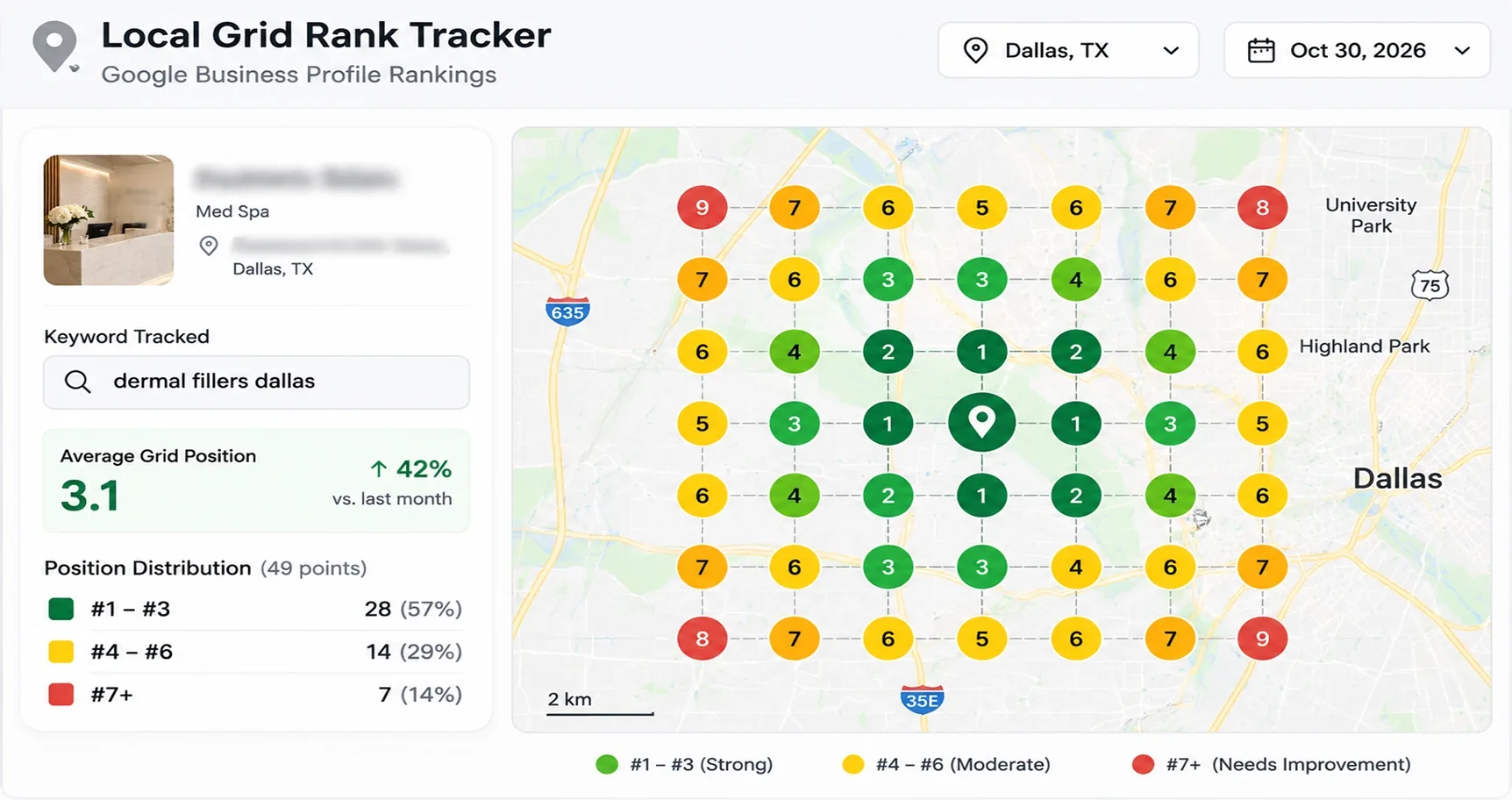
That's why I track rankings on a grid, not as a single number. A grid tool checks your position from dozens of points around the clinic, so you can see exactly where you win and where visibility drops off a few miles out. A single "you rank #2 for Botox Dallas" report hides all of that.
- Inner ring: you should own the Map Pack within a mile or two of the clinic. If you don't, start with the Google Business Profile.
- Outer ring: visibility here comes from prominence: reviews, links, local press and strong treatment pages.
- Beyond the map: organic city and treatment pages can rank across the metro even when the Map Pack won't.
How it impacts pricing. Dense metros need heavier link building, more content and constant Business Profile work, which pushes retainers into the $3,000 to $5,000+ range. A clinic in Tyler or Midland can often win the Map Pack for around $1,500 a month because the competition simply isn't there yet. Our local SEO scopes start from that grid data, not a fixed package.
2. E-E-A-T and YMYL Content Production
The objective. Publish treatment pages that are medically accurate, clearly reviewed and better than what's ranking now.
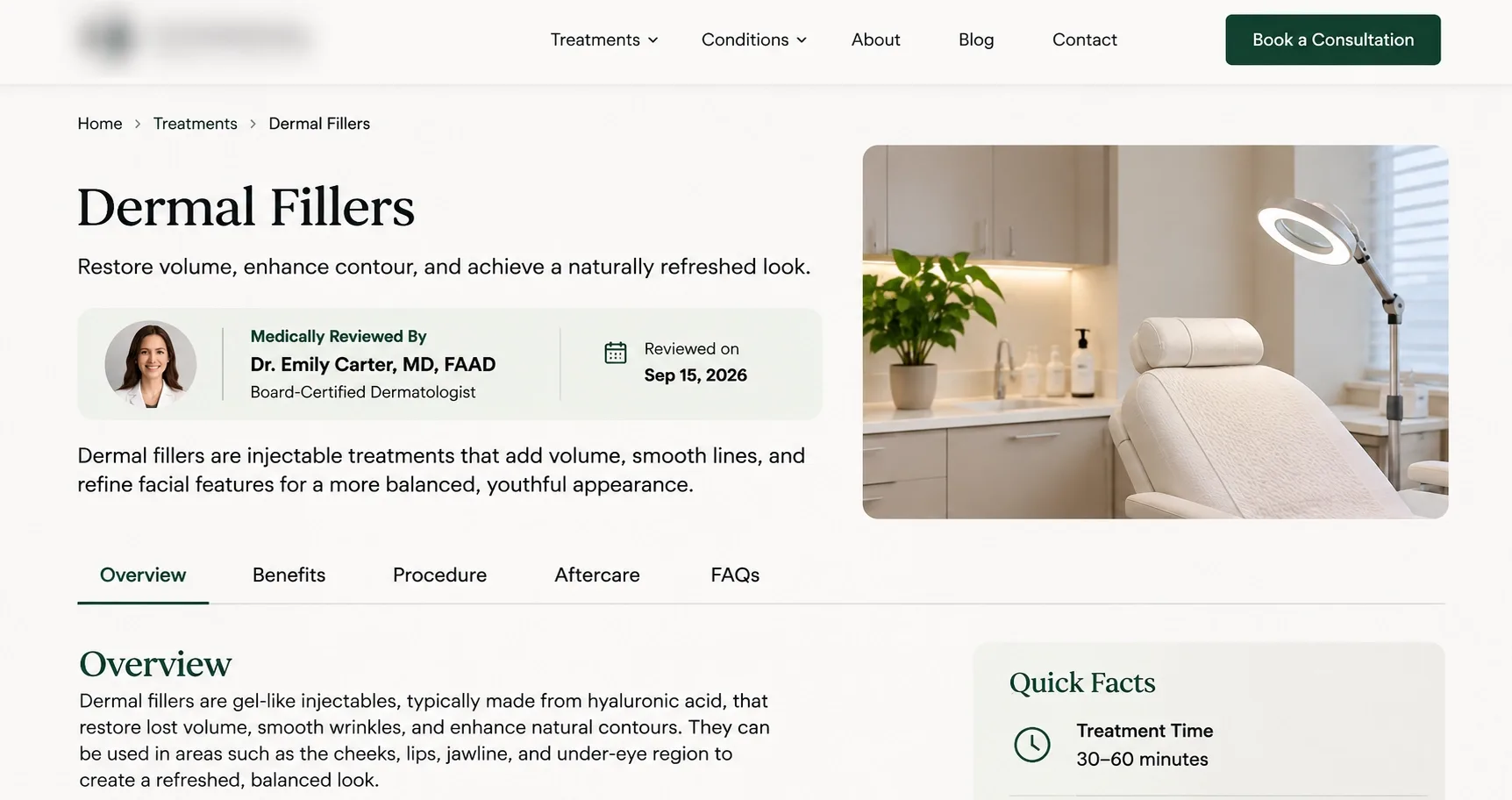
The market reality. A strong Botox page doesn't list "benefits" in bullets. It answers what a nervous first-time patient asks at the consultation: how many units, how long results last, what bruising looks like, who should avoid it and who actually injects at your clinic. A writer drafts it from your medical director's answers, and the medical director reviews it before it goes live.
Every page should show three things a cheap agency skips:
- A named author and medical reviewer with real credentials and a review date.
- Claims a provider would defend, with no "painless," "permanent" or "zero downtime" language unless it's true for every patient.
- Your own proof: before-and-after photos with consent, your provider's actual technique and your clinic's aftercare steps.
Schema helps machines read that page correctly. I use MedicalBusiness or a fitting subtype for the clinic, Person markup for injectors and physicians, and Service markup for treatments, all matching what visitors can see. Schema.org also has a MedicalWebPage type, and I use it as clean labeling, not as a ranking trick, because Google doesn't show a special result for it.
Structure matters as much as copy. Treatment pages behave like category pages on a store: one strong hub for "injectables" that links to Botox, Dysport, lip filler and cheek filler, each with its own page. I walk through that hub-and-spoke logic in my guide to optimizing category pages for SEO, and the same rules carry over to service pages.
AI tools are changing who reads these pages first. BrightLocal's 2026 research found nearly half of consumers now ask AI for business recommendations, making AI the third most used tool for finding local businesses. Clear, reviewed, well-structured treatment pages are what those tools quote, and I explained how to earn those mentions in my guide to getting your website cited by AI search engines.
How it impacts pricing. Clinical-grade content takes writer time, provider review time and careful markup. Expect content to be the largest line in a fair retainer, often a third or more of it.

3. Digital PR and Local Backlink Acquisition
The objective. Earn links and mentions that prove a real Texas clinic stands behind the site.
The market reality. I once opened a Dallas med spa's backlink profile and found almost nothing but low-quality directory links, hundreds of them, many on sites with no traffic at all. Google's systems mostly ignore links like that, so the clinic had paid every month for links that counted for nothing while competitors earned real ones.
The links that move a med spa look different:
- Local press: a feature in a city magazine or a Texas lifestyle publication about a new treatment or your medical director.
- Community ties: chamber of commerce listings, charity events, wedding and bridal guides, local sports sponsorships.
- Professional mentions: training academies, manufacturer provider locators and speaking slots at industry events.
- Clean citations: consistent name, address and phone on the directories people actually use, set up once and maintained.
One real story beats fifty directory links. A medical director quoted in a local article about summer skin damage earns a link, a branded search bump and a new patient or two in the same week.
How it impacts pricing. Real outreach means pitching editors, building relationships and waiting for publication dates. A fair agency puts a meaningful part of the retainer here and shows you every placement before and after it lands.

4. Technical Architecture and Conversion Optimization
The objective. Load fast on a phone and turn a visit into a booked consultation.
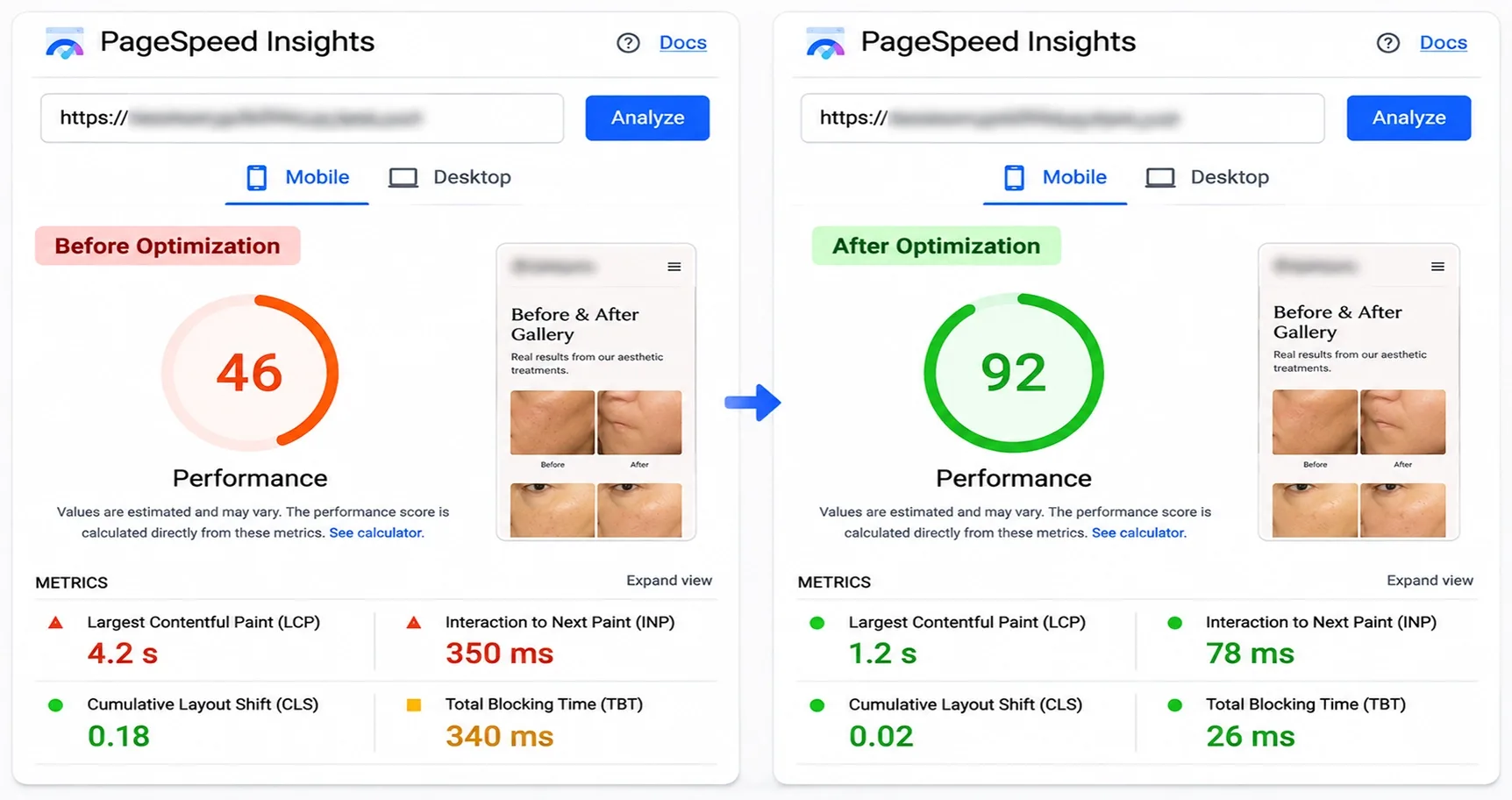
The market reality. Med spa sites carry some of the heaviest pages I audit. Before-and-after galleries with dozens of uncompressed images, hero videos, chat widgets and booking embeds stack up, and the gallery page, the one patients want most, loads last.
The fixes are technical: compress and resize images, lazy-load anything below the fold, give the gallery its own lightweight template and keep third-party scripts in check. I listed the design side of these fixes in my post on UI/UX tips for flawless Core Web Vitals.
Conversion is the other half. Patients book when they trust the clinic and can do it in three taps. Minhaj, our Head of Development, covers the trust details, from provider bios to visible credentials, in his guide to healthcare website design that builds patient trust.
The booking flow also has to report back. On a med spa rebuild for a Georgia clinic, the work that mattered most was wiring every inquiry form into the CRM with automated intake follow-up and appointment reminders, so no lead from search sat unanswered over a weekend.
How it impacts pricing. Ongoing audits, speed work and testing on booking forms take technical hours that $500 packages never include. Budget for them, or the traffic you pay for will leak out of a slow page.
Pricing Models: Retainer, Project or Pay-Per-Lead
The monthly number is only half the question. How you pay changes what the agency is motivated to do.
- Monthly retainer: the standard model for ongoing local SEO, and the one I recommend for most clinics. It works when the proposal names the people, the hours and the deliverables for each month.
- One-time audit or project: useful before you commit to a retainer, or when you need a site rebuild, a migration or a cleanup after a bad agency. You get a fixed scope and a written plan you can take anywhere.
- Hourly consulting: good for clinics with an in-house marketer who needs direction, not hands.
- Pay-per-lead: the model I trust least. Agencies paid per form fill tend to chase cheap, low-intent leads, and some keep the leads on their own sites, so you never own the asset.
Whatever the model, insist on owning every account: your domain, your Business Profile, your Analytics and Search Console. An agency that won't hand over admin access is telling you how the breakup will go.
The $500/Month Trap: Red Flags to Avoid When Hiring an Agency
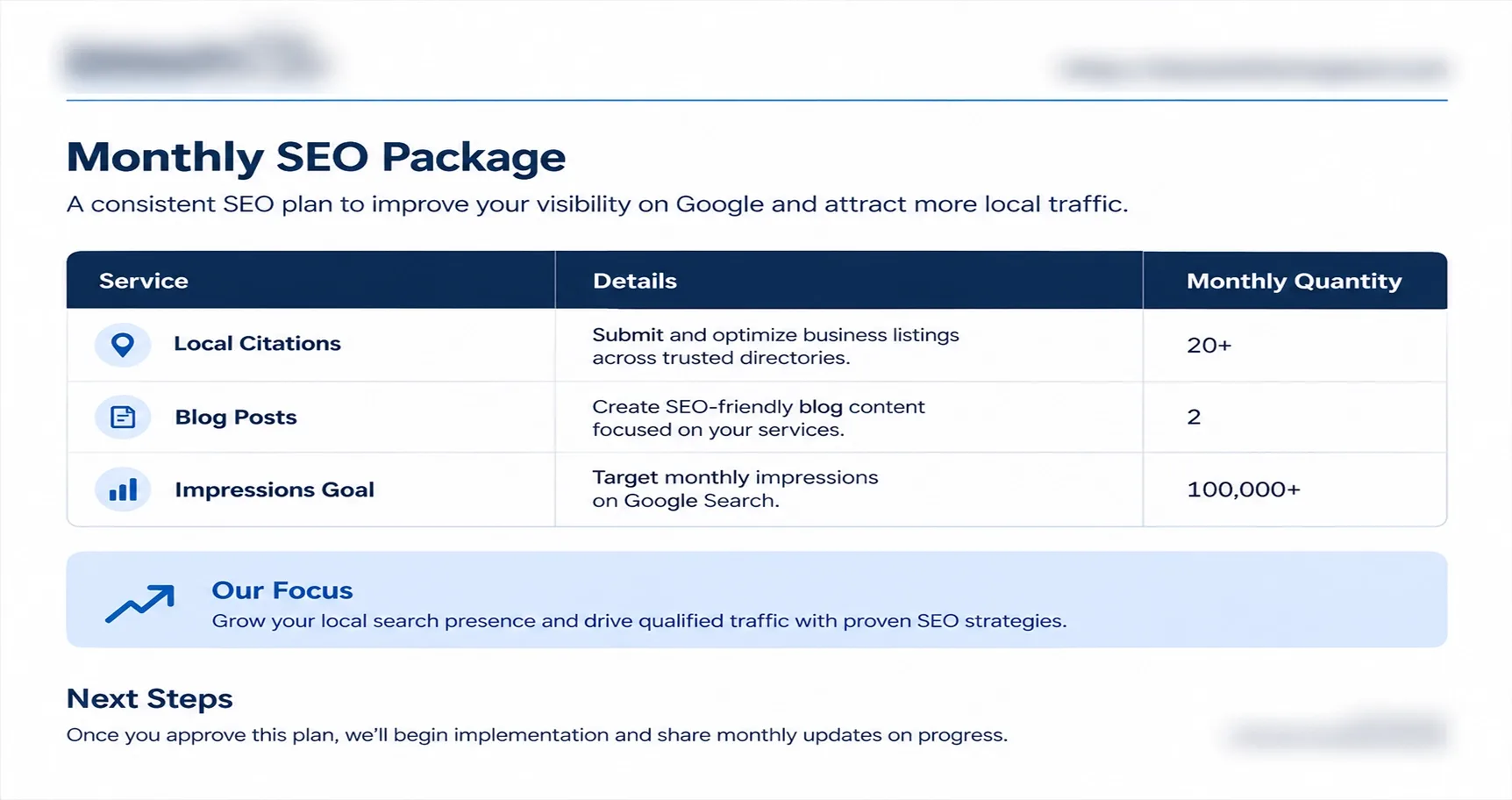
A $500 retainer pays for maybe five or six hours of real work a month. Here's what usually fills those hours.
- Automated citation blasts: the same listing pushed to hundreds of directories. You need the major ones right, and the rest add nothing your competitors don't already have.
- Generic AI blog posts: "5 benefits of Botox" written without a provider's input. They rank for nothing, and in a YMYL category they can carry claims no clinician would sign.
- Vanity reports: impressions, keyword counts and a traffic chart pointing up. No booked consultations, no revenue, no patient source.
- Locked accounts: the agency owns your Google Business Profile or Analytics, so leaving means starting over.
Those generic posts don't just sit there harmlessly. They pile up, compete with your real treatment pages and slowly lose whatever traffic they had. I wrote about how to find and fix that kind of slide in my guide on content decay and declining posts.
I've also rescued clinic sites that needed a near-complete rebuild because a previous agency created one thin "Botox in [city]" page for every nearby town. None of those pages had a real address, provider or patient story behind them, and the whole set pulled the site down.
Ask every agency the same questions: who writes the content, who medically reviews it, which links will you build, and how will you show me booked consultations? If the answers stay vague, so will the results. I put the full vetting checklist in my guide on how to choose an SEO company.
A cheap retainer isn't a discount. It's the most expensive line on the budget, because it buys months you can't get back.
How to Calculate Your Med Spa SEO ROI
SEO is worth paying for only if the math works for your clinic. The math is simple once the tracking is right.
Start with patient acquisition cost (PAC): your monthly SEO spend divided by new patients who came from organic search and booked. Then work out lifetime value (LTV): what an average patient spends with you over the time they stay. Injectables patients often return every three to four months, so their value builds fast.
A worked example makes this concrete. Say you spend $3,000 a month, and organic search brings 15 new booked patients. Your PAC is $200. If an average injectables patient spends $600 a visit and comes back three times a year, that patient is worth $1,800 in year one before any add-on treatments or skincare. Spending $200 to win $1,800 is a trade most clinic owners would take every month.
Plug in your own numbers. If the PAC sits above the first-year value after six months of solid work, something in the plan needs to change.
The tracking has to be honest for any of this to mean anything:
- Separate the sources: tag Google Business Profile links with UTM parameters, so Map Pack calls and bookings don't blur into "direct" traffic.
- Track calls and forms: use call tracking and form tracking tied to your booking system or CRM.
- Match to revenue: count a lead only when it becomes a booked and attended consultation, then record what that patient spent.
- Follow up fast: a lead that waits overnight often books elsewhere. I explained why in my post on why automated follow-up matters more in 2026.
I review a short set of numbers every week so problems show up early. My post on which weekly SEO metrics to measure lists the checks I use with clients.
FAQs
How long does it take to see ROI from med spa SEO in Texas?
Expect Map Pack movement in about 4 to 6 months and up to 12 months for competitive organic terms in Dallas, Houston or Austin. Smaller markets usually move faster.
Do I need a separate SEO budget for each clinic location?
Yes, in most cases. Each location needs its own Google Business Profile work, location page, reviews and local links, though content and technical work can be shared across locations.
Should I pause my Google Ads while investing in SEO?
No. Keep ads running while SEO builds, then reduce spend on terms where you rank well organically and track whether bookings hold.
How do I track whether SEO is driving patient bookings?
Tag your Business Profile links, track calls and forms, and connect them to your booking system or CRM. Count only booked and attended consultations from organic search.
Why do SEO agencies charge more for medical businesses?
Medical topics fall under Google's YMYL standards, so content needs expert input and provider review. That takes more time and skill than SEO for a standard local business.
Can I rank in Dallas if my clinic is in Plano or Frisco?
You can rank organic pages for Dallas searches, but the Dallas Map Pack is hard to win from a suburb because distance matters. Never use a fake Dallas address, as it breaks Google Business Profile rules.
What is the difference between Google Business Profile optimization and traditional SEO?
Business Profile optimization targets the Map Pack through your listing, categories, reviews and photos. Traditional SEO targets regular search results through your website's content, links and technical health.

Written by
Kashaf
Kashaf is a veteran SEO specialist with deep expertise in AI SEO, generative engine optimization, ORM, web strategy, and marketing automation. With a Master's in Computer Science, he blends search strategy with technical insight into websites, automation workflows, and AI-driven platforms, helping brands dominate traditional search while adapting to the future of AI-powered discovery.