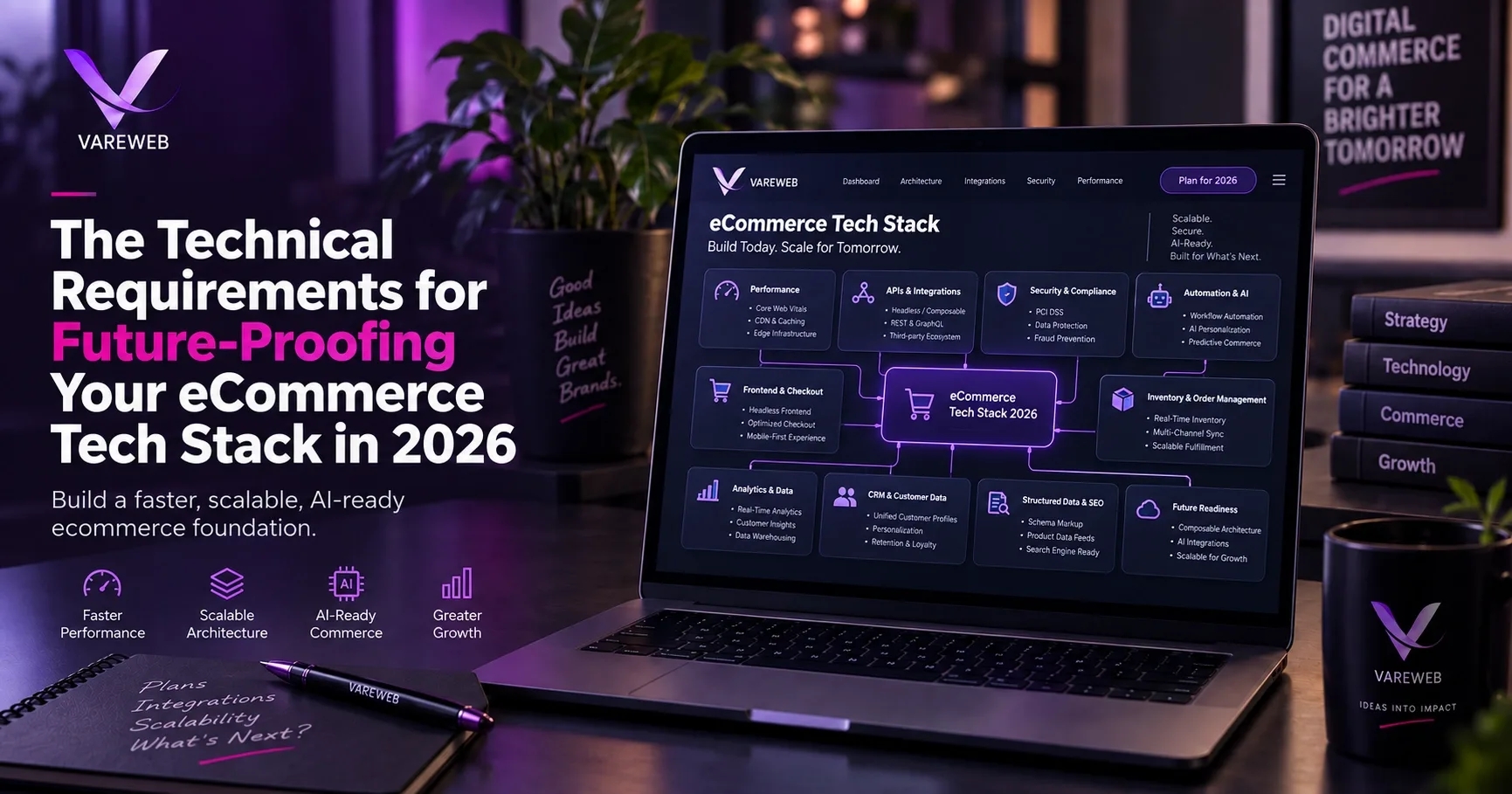
Quick Answer: Future-proofing an ecommerce tech stack is no longer just about choosing the most popular platform or the best-looking theme. It requires a resilient, flexible data architecture where product information, pricing, inventory, and business logic are structured cleanly and can move reliably between systems. The goal is to make commerce data easy for human shoppers, search engines, AI Answer Engines, and connected applications to understand and access without one experience becoming dependent on or slowing down another.
In my technical audits, the stores surviving the shift to AI search all share one architectural trait: their data doesn't live inside their design. Everyone else is still treating data as an afterthought bolted onto a theme, and that gap is what's about to get expensive.
Here's a real number to sit with. Shopify's own App Store now lists 28,512 apps from 17,808 vendors, and the average store isn't running one or two of them - it's running a stack, each one injecting its own script, its own schema, its own opinion about how your product data should render. That's not a platform problem. That's an architecture problem, and it's exactly why our approach to eCommerce website development always prioritizes the data layer over visual gimmicks - the theme is replaceable. The data underneath it has to survive the replacement.
Is Your Data Layer an Asset, or a Liability Waiting to Compound?
The average store runs a stack of apps, each with its own opinion about how your product data should render - that's an architecture problem, not a platform problem. Vareweb prioritizes the data layer over visual gimmicks in every ecommerce build.
Quick Overview: The Four Pillars
| Pillar | What It Fixes | What Breaks Without It |
|---|---|---|
| Data Layer | Clean, consistent, machine-readable product information | AI systems have less reliable product data to interpret and may favor clearer sources |
| API-First Architecture | Decoupled systems that can scale and evolve independently | A tightly coupled monolith becomes harder to scale, maintain, and modify safely |
| AI-Readiness (AEO/GEO) | Structured, accessible information for AI and answer-engine systems | Product information becomes harder for ChatGPT, Perplexity, AI Overviews, and similar systems to interpret |
| Performance Engineering | Fast page delivery and responsive experiences at the edge | Slow experiences can increase shopper drop-off and make content less efficient for automated systems to access |
The Death of the "Theme-First" Build
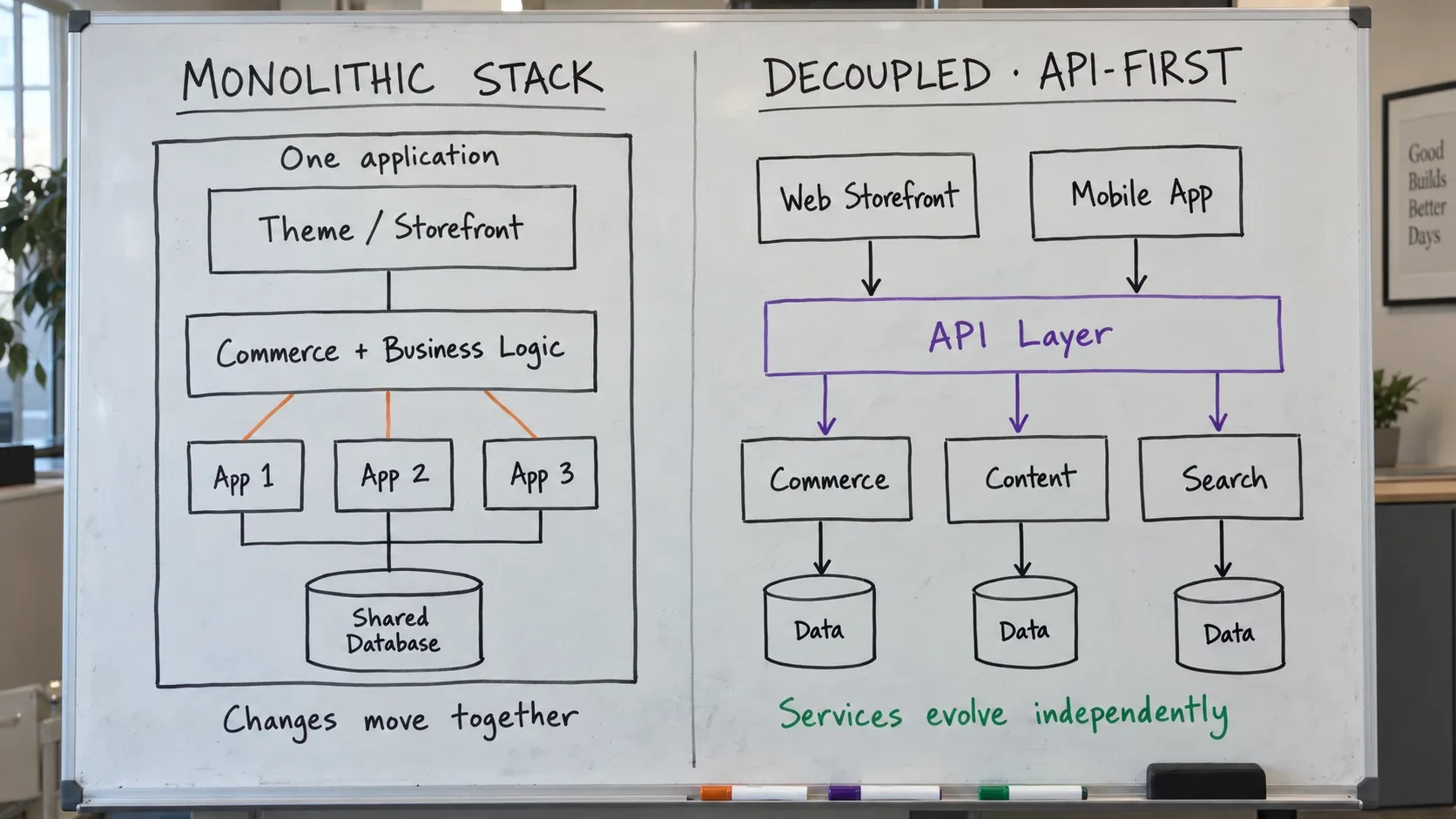
Buy a commercial theme, stack twenty apps on top of it, ship it. That's still how most stores get built, and it's a house of cards by design - every app adds its own DOM weight, its own render-blocking script, its own competing claim on how the page should behave. None of them were built to coordinate with each other. They were built to sell independently in an app store.
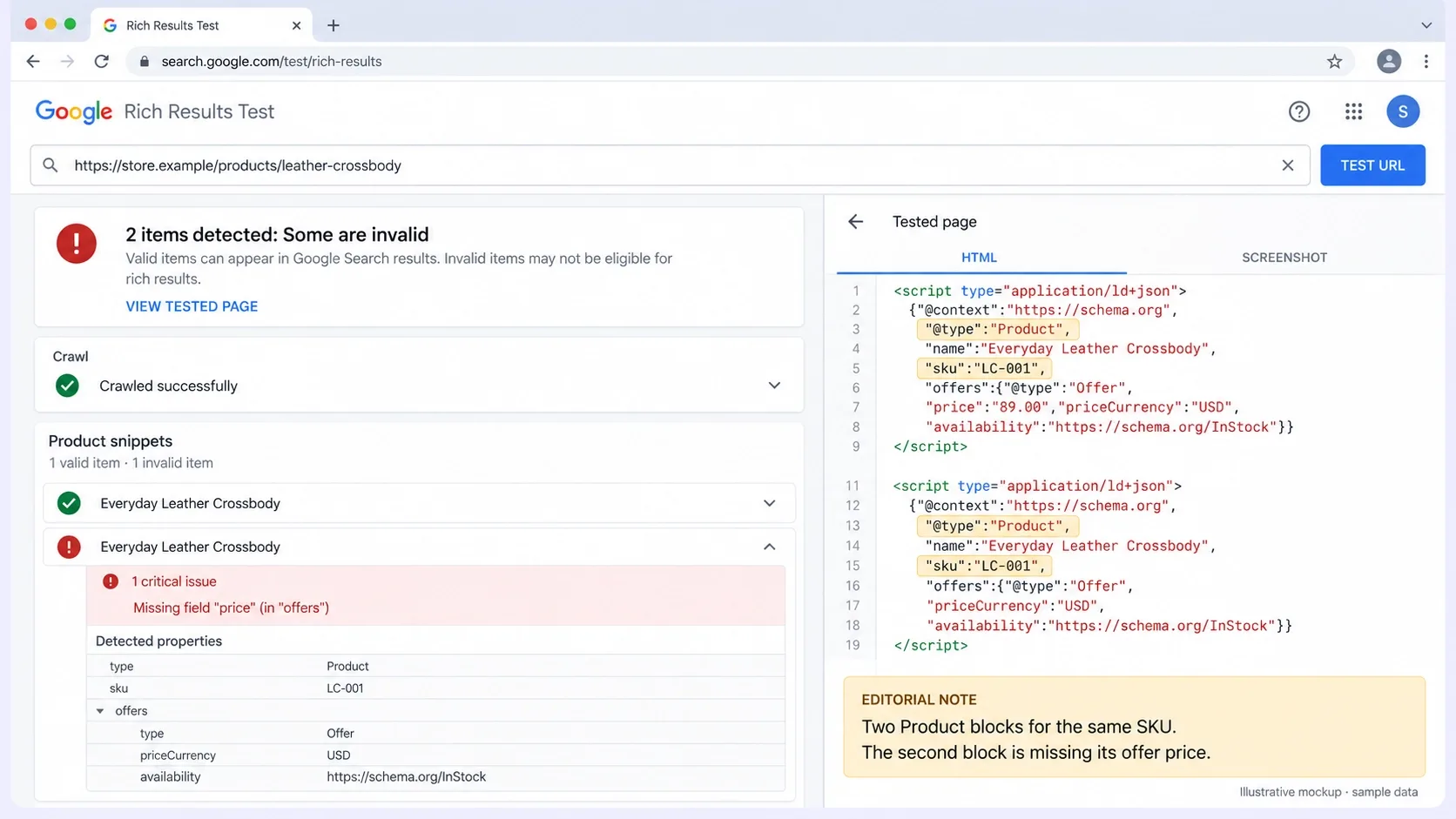
The damage compounds in two directions at once. Core Web Vitals degrade because nobody budgeted for twenty scripts fighting for the main thread. And structured data gets corrupted because two of those apps both output Product schema, neither one aware the other exists - a pattern I've documented in painful detail across Common Shopify SEO Issues and How to Fix Them and Common WooCommerce SEO Issues and How to Fix Them.
You cannot rely on a bloated 2018-era visual theme if you want modern AI to understand your catalog, and the reason is structural, not aesthetic. A theme was built to answer "how does this look on screen." It was never built to answer "what exact price and stock status does this SKU carry right now, in a format a machine can trust without rendering a browser." Those are two different engineering problems, and most stacks only ever solved the first one. The shift that actually matters isn't "make it look better." It's "make the data accessible" - visually, that might not even change what the customer sees.
Pillar 1: The Resilient Data Layer
Price, inventory, variants, specs - this information has to exist cleanly outside of visual formatting, not trapped inside a <div> that only makes sense once CSS has finished painting it. Think about it: a crawler that has to infer your price from a class name is one bad theme update away from getting it wrong.
Flawless nested JSON-LD - Product, Offer, AggregateRating - is the actual voice your store uses to talk to machines. I go deeper on the template-level implementation in How Schema Markup and Web Design Work Together. And here's the part that kills more stores than any other single mistake: relying on client-side JavaScript to render that critical data. If a crawler has to execute your JS to see the price, a meaningful share of AI crawlers simply won't bother. They move on. Server-rendered or pre-rendered data isn't a nice-to-have anymore - it's the baseline.
This same discipline is exactly what separates a data layer from a data swamp: one owner per field, one source of truth per fact, and a template layer that reads from that source instead of generating its own copy of it. Split price across three systems - the theme's cart logic, a discount app, and your schema block - and you don't have three chances to get it right. You have three chances to get it wrong in three different ways, on the same page, simultaneously. This is also where Ecommerce SEO stops being a content exercise and starts being an engineering one - the keyword research doesn't matter if the data underneath the page it's targeting can't be trusted.
Split Price Across Three Systems, and You Have Three Ways to Get It Wrong
One owner per field, one source of truth per fact - that's the discipline that turns a data layer into something trustworthy instead of a data swamp. This is where Ecommerce SEO stops being a content exercise and starts being an engineering one.
Pillar 2: API-First and Composable Architecture
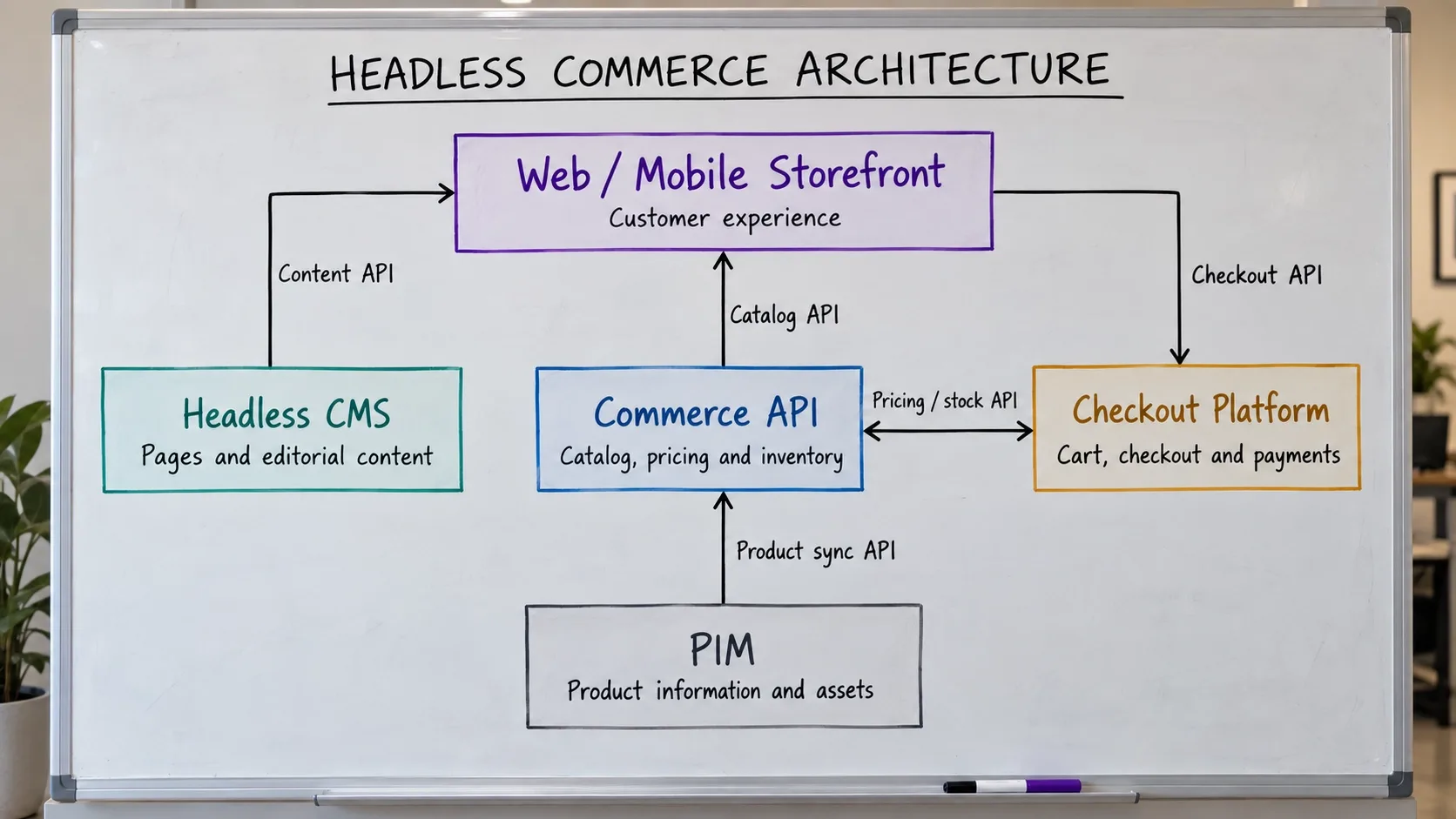
Not everyone needs headless. Everyone needs clean APIs. That distinction matters more than the architecture debate usually admits - a standard Shopify or WooCommerce setup with well-structured data can outperform a botched headless migration every time, and I've watched founders spend six figures chasing an architecture they didn't need yet.
Composable becomes worth the complexity once you're connecting genuinely best-in-class systems - Shopify for checkout, Contentful or Sanity for content, Akeneo for product information - through APIs instead of forcing everything through one platform's limitations. The organizations doing this well aren't doing it for aesthetics. MACH Alliance's 2026 Enterprise Technology Report, surveying 600 enterprise technology leaders, found 78% of companies with fully implemented composable architecture report clear AI ROI, against just 13% still in early planning stages. That's not a marginal edge. That's a six-times gap, and it's the architecture doing the work, not the AI model on top of it.
Here's the honest test before you commit to any of this: can you name the specific limitation your current platform is hitting, and can you name the specific system that solves it better? If the answer is a vague sense that headless sounds more modern, you're not ready for the migration - you're ready for a consultant's invoice. Composable architecture pays for itself when it removes a bottleneck you can point to. It becomes debt when it's adopted as a trend.
Pillar 3: AI-Readiness - AEO, GEO, and llms.txt
LLMs don't crawl the way Googlebot does. Googlebot renders, indexes, ranks. An LLM retrieving for a citation wants a fact it can trust immediately - it isn't going to piece one together from ambiguous markup if a competitor's page hands over the same fact cleanly.
llms.txt is the newest piece of this - a Markdown file at your root directory that gives AI agents a machine-readable summary of your catalog and policies without making them fight through JavaScript rendering first. Pair that with genuinely structured data and you've built what Generative Engine Optimization actually requires: not a trick, just a store an AI system can trust without double-checking. OpenAI's own Instant Checkout rollout makes this concrete - ChatGPT recommends products from a submitted feed, not a crawl of your page, and when the feed and the page disagree, the feed wins. I go deeper on getting cited specifically in How to Get Your Website Cited by AI Search Engines.
Notice what that pattern actually implies: Google Merchant Center, Bing Shopping, and OpenAI's product feed are three separate submissions, in three separate formats, and every one of them is only as good as the underlying product database feeding it. Architect that database once, cleanly, and every new AI surface that launches next year becomes a faster integration instead of another fire drill.
An LLM Won't Guess at Your Price. It'll Just Cite Someone Else's
Clean, structured data plus an llms.txt file is what actually earns AI trust - not a trick, just a store a model doesn't have to double-check. Vareweb builds that foundation as part of every ecommerce architecture, not a bolt-on after launch.
Pillar 4: Ruthless Performance Engineering
Sub-1.5-second load times aren't aspirational anymore - they're table stakes, and most stores aren't close. Current field data puts just 6.3% of active WooCommerce stores passing all three Core Web Vitals, measured in real Chrome user data, not a lab test on a fast connection. That's not a WooCommerce problem specifically. It's what happens to any stack that never treated performance as architecture.
Edge caching, removing render-blocking third-party scripts, and optimizing the critical rendering path - none of this is exotic. Lazy loading is a baseline now, not a competitive advantage; if that's still your headline performance win, you're behind, not ahead. I've written more on what actually moves these numbers in How Important Is Page Speed for SEO in 2026?.
How to Audit Your Current Stack's Shelf Life
Three things to check today, not next quarter:
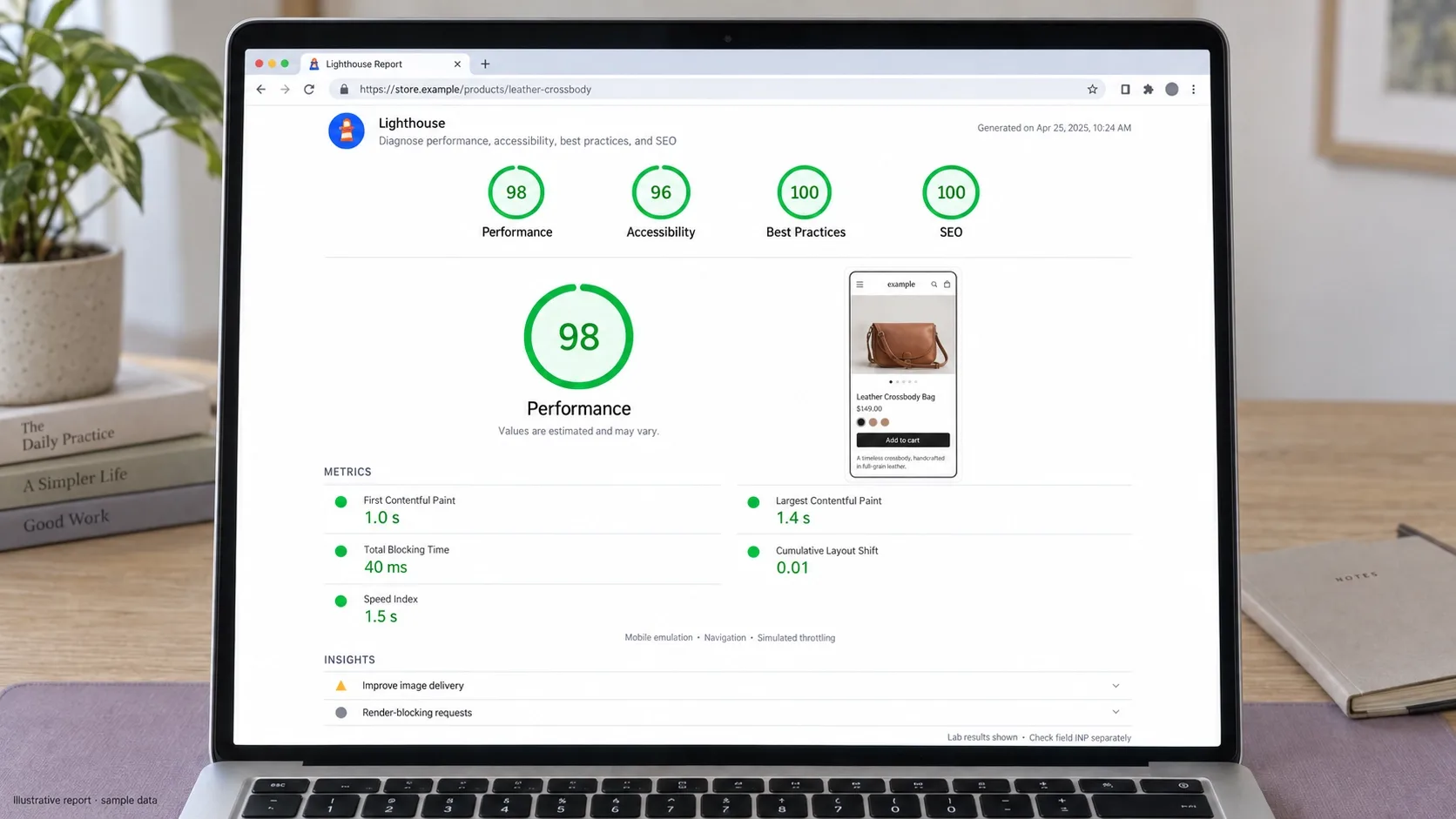
Run a Lighthouse report. Look specifically at JavaScript execution time - if it's choking the main thread, no amount of image compression downstream will fix what's happening upstream.
Run a Rich Results test on your top templates. Duplicate or conflicting schema from stacked apps shows up here fast, and it's usually the first sign nobody's owned your structured data in a while.
Count your third-party apps honestly. For each one, ask whether it's solving something that should have been hardcoded into the architecture from the start. Apps are rented decisions. Architecture is owned.
Technical Checklist
☐ Is critical product data present in raw HTML, or hidden behind client-side JS?
☐ Is JSON-LD schema perfectly nested and free of duplicates across the template?
☐ Are third-party integrations running through clean APIs rather than bloated front-end scripts?
☐ Do you have an llms.txt file guiding AI crawlers to your catalog and policies?
☐ Are your Core Web Vitals passing 2026 thresholds natively, without a caching band-aid?
☐ Have you audited for conflicting schema injected by stacked apps or plugins?
Ready to Build a Stack That Survives the Next Platform Shift?
Vareweb architects the data layer, APIs, and performance engineering underneath your store - so the next AI surface, integration, or theme change is a fast update, not a fire drill. One team, accountable for the whole result.
FAQs
Do I have to go headless to future-proof my store?
No. Composable architecture pays off once you're integrating genuinely best-in-class systems - if a standard platform with clean APIs and clean data covers your needs, headless just adds complexity you don't need yet.
What is a "data layer" in simple terms?
The layer where your product facts - price, stock, specs, variants - live independently of how they're styled. Change the theme, and the data layer shouldn't notice.
How do third-party apps ruin an eCommerce tech stack?
Individually, they rarely do. Stacked without coordination, they compete for the same DOM, duplicate the same schema, and slow the same page - death by twenty small cuts, not one big mistake.
How does AI search change the way we build eCommerce sites?
It shifts the audience for your data. You're no longer just designing for a human scrolling a page - you're structuring facts for a model that needs to trust them instantly, with no room to guess.
What is the lifespan of a standard eCommerce build today?
Roughly two to three years before the accumulated app bloat and schema drift start costing more in lost visibility than a proper data-layer rebuild would have cost upfront.
Is Core Web Vitals still worth chasing if my site converts fine already?
Yes - conversion today doesn't protect against the crawl and citation problems building underneath a slow site. Fix it before it shows up as a traffic problem, not after.
Should a small store worry about any of this, or is it enterprise-only?
The data-layer and schema fundamentals apply at any size. Full composable architecture is the enterprise-scale piece - a small store gets most of the benefit from clean APIs and clean data alone.

Written by
Kashaf
Kashaf is a veteran SEO specialist with deep expertise in AI SEO, generative engine optimization, ORM, web strategy, and marketing automation. With a Master's in Computer Science, he blends search strategy with technical insight into websites, automation workflows, and AI-driven platforms, helping brands dominate traditional search while adapting to the future of AI-powered discovery.