Quick Answer: Squarespace is often a strong fit for service businesses, portfolios, creators, and smaller stores that prioritize simple site management and polished presentation. Shopify is generally better suited to businesses where ecommerce is the core operation, particularly stores planning for larger catalogs, higher order volumes, advanced integrations, and long-term growth. The key difference is focus: Squarespace is a broader website-building platform with commerce capabilities, while Shopify is commerce-first infrastructure built around selling, managing, and scaling an online retail business.
In my experience migrating stores, the exact moment a brand outgrows Squarespace is rarely dramatic. Nothing crashes. The catalog just quietly hits 50 SKUs, checkout starts feeling rigid, and the founder can't figure out why Google stopped sending traffic to product pages that used to rank fine.
The scale gap between these two platforms is real and worth stating plainly. Squarespace runs 2.4% of all websites W3Techs tracks, as of this month. Shopify accounts for 31.7% of the e-commerce systems in the same dataset. That's not a popularity contest - it reflects two genuinely different products built for two different jobs. Here's the painful truth about 'easy' drag-and-drop themes: easy to start is not the same as built to scale, and that's exactly why our eCommerce web development services focus heavily on migrating brands to platforms that can actually carry the weight of what they're trying to build, not just what they're launching with.
Still Deciding, or Already Outgrowing Squarespace?
The moment a brand outgrows Squarespace is rarely dramatic - the catalog just quietly hits 50 SKUs and checkout starts feeling rigid. Vareweb helps you make that call with a real technical assessment, not a platform sales pitch.
Quick Overview: Where Each Platform Actually Stands
| Factor | Squarespace | Shopify |
|---|---|---|
| Core Design | Website builder with integrated commerce capabilities | Dedicated commerce-first infrastructure |
| Best For | Smaller stores, service businesses, portfolios, and creators | Scaling retail brands, DTC businesses, and wholesale operations |
| Pricing & Fees | $16–$99/month (annual billing), with 0–2% transaction fees depending on plan | $29–$299/month (annual billing), plus Shopify Plus; payment processing fees vary by plan |
| Product Catalog | Better suited to smaller and less complex product catalogs | Designed for large catalogs and more complex commerce operations |
| AI / Schema Readiness | More limited control over advanced structured-data customization | Greater flexibility for custom JSON-LD and structured commerce data |
| Core Web Vitals | Less granular control over underlying templates and performance optimization | More opportunities for theme-level performance optimization, depending on implementation |
| Checkout | Streamlined built-in checkout with fewer advanced customization options | Shop Pay and broader checkout customization and extensibility options |
| Apps & API Access | Smaller extension ecosystem with more limited integration flexibility | Extensive app ecosystem with APIs for custom integrations and workflows |
| POS & Omnichannel | Suitable for lighter or occasional in-person selling | Native POS ecosystem built for integrated online and in-person selling |
| International Selling | Basic international commerce and localization capabilities | Shopify Markets with broader international selling and localization tools |
Squarespace vs Shopify: The Technical Differences That Actually Matter
Every comparison list eventually gets to pricing tables and template counts. Those matter, but they're downstream of a handful of structural differences worth understanding first - so that's where this starts.
1. Core Architecture: Visual Builder vs. Commerce Infrastructure
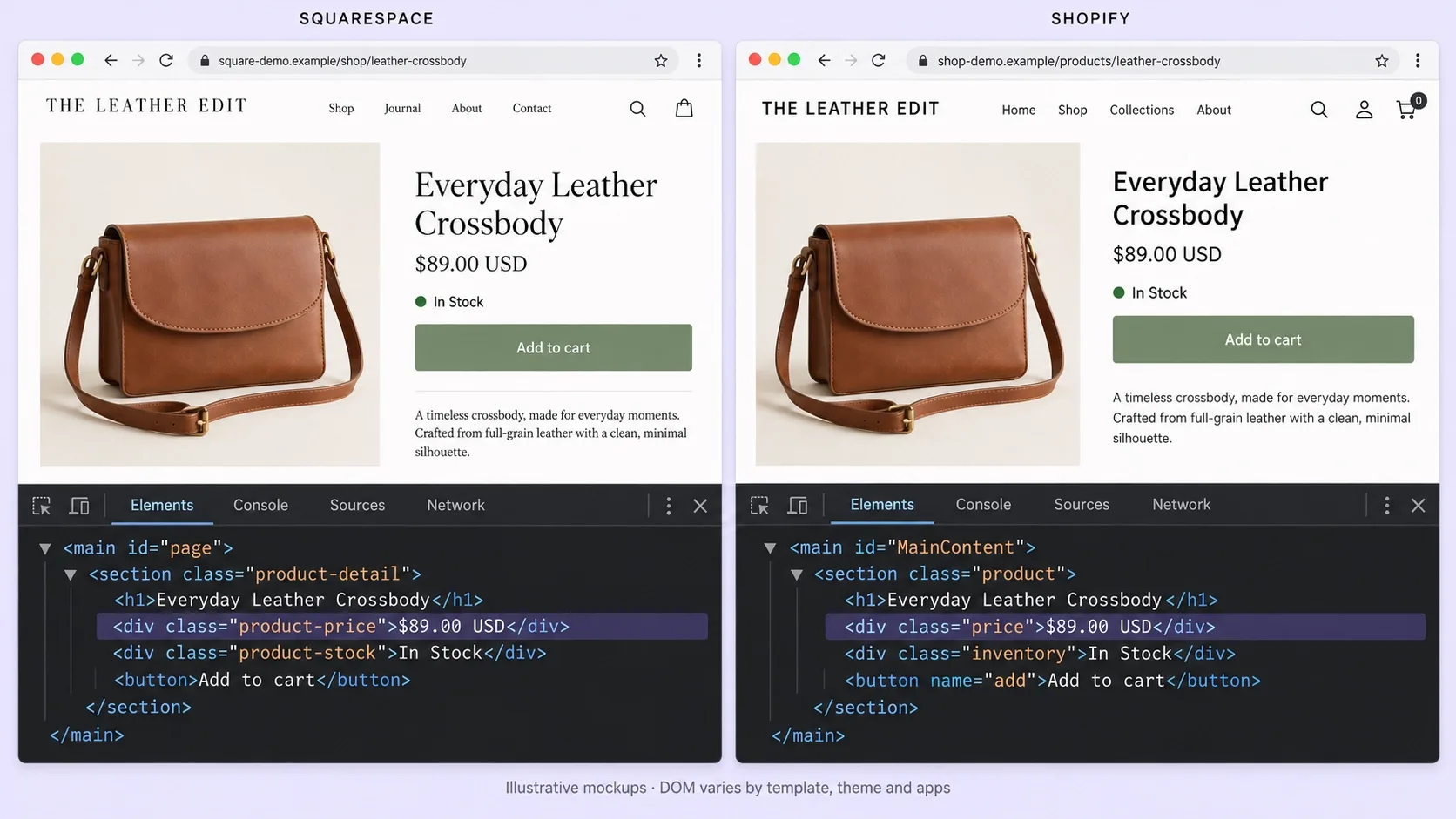
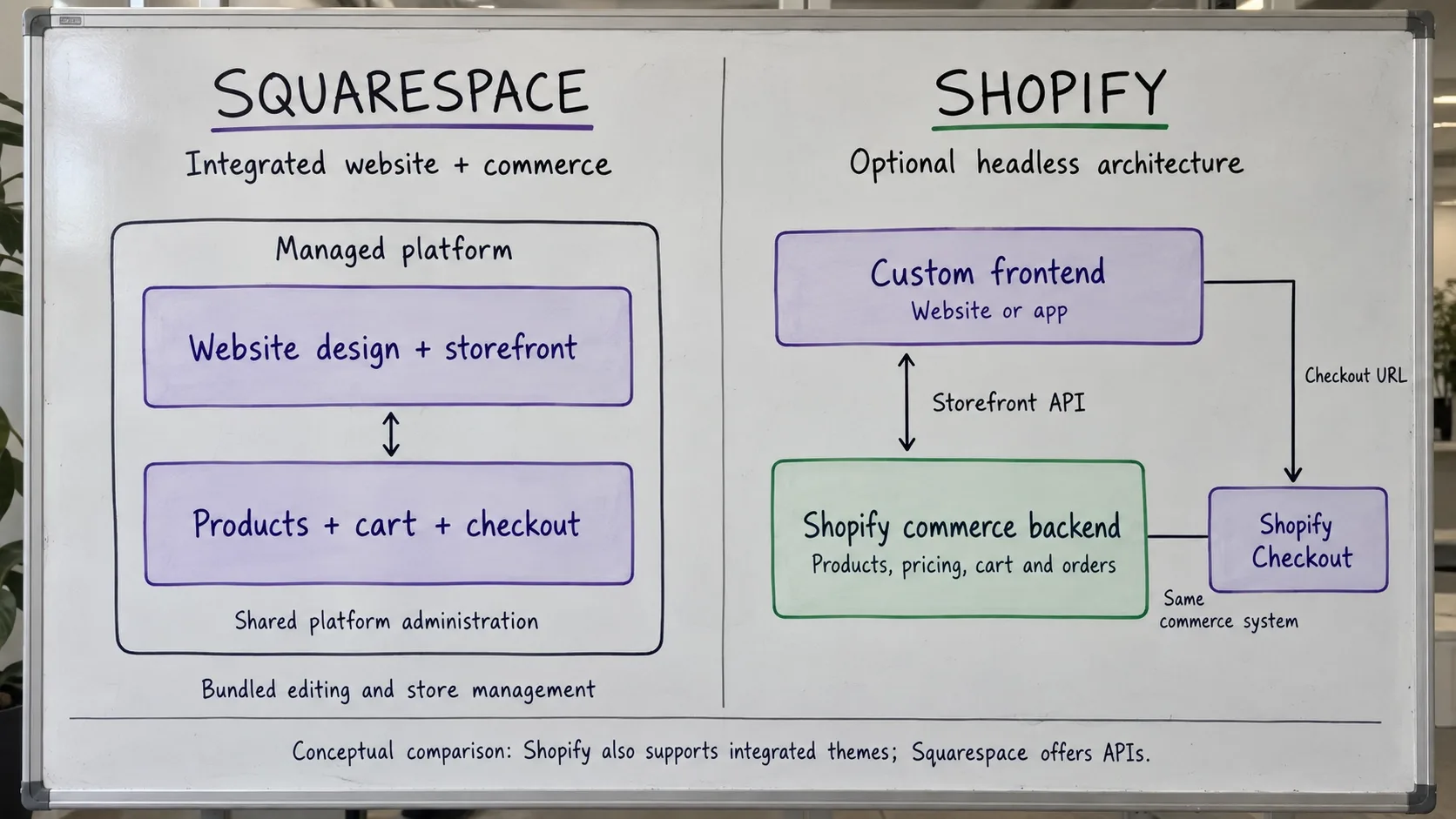
Squarespace is a monolithic, closed-source visual builder, and it's heavily reliant on JavaScript to render its drag-and-drop elements. That's not a criticism of the design tool - it's genuinely good at what it was built for. The problem shows up the moment commerce stops being a side feature and becomes the actual business.
Shopify separates the commerce backend from the front end, especially once you move into custom Liquid builds or headless Hydrogen setups. That separation is the whole point: your checkout logic, inventory, and pricing rules don't live inside the same rigid container as your fonts and hero banners. Think about it - one platform was designed to answer "how do I make a beautiful page," and the other was designed to answer "how do I process ten thousand orders without the page falling over." Those are different engineering problems, and no amount of visual polish closes that gap.
You cannot rely on a closed visual builder if you want custom checkout logic - and that's not a hypothetical limitation, it's a wall you hit directly the first time a client asks for a subscription flow, a wholesale pricing tier, or a currency-specific tax rule that Squarespace's settings panel simply has no field for. On Shopify, that's a Liquid customization or an app. On Squarespace, that's a feature request nobody's promising to build.
2. Pricing, Fees, and What the Sticker Price Doesn't Show
Squarespace's current pricing runs four tiers on annual billing: Basic at roughly $16/month with a 2% transaction fee on physical goods, Core at roughly $23/month which removes that fee on physical and service sales, Plus at roughly $39/month which drops the digital-product fee to 1% and adds abandoned-cart recovery, and Advanced at $99/month with the lowest processing rates and unlimited video storage.
Shopify's pricing starts higher and scales further: Basic runs $29/month on annual billing ($39 month-to-month) with a 2.9% + 30¢ online card rate through Shopify Payments, Grow runs $79/month annual ($105 monthly) at 2.7% + 30¢, and Advanced runs $299/month annual ($399 monthly) at 2.5% + 30¢. Shopify Plus starts around $2,300/month on a three-year term for enterprise-scale operations. Skip Shopify Payments in favor of a third-party gateway and every tier adds an extra 0.5-2% fee on top - a detail that quietly changes the math for merchants who assumed the sticker price was the whole story.
Here's the catch nobody puts in the pricing table: Squarespace's lower monthly cost is a cost to build inside, not a cost to grow inside. The moment you need an app Squarespace's ecosystem doesn't have, you're either living without the feature or paying a developer to hack around a platform that wasn't built to be hacked around. Shopify's higher baseline buys you an app and API ecosystem deep enough that most needs already have a solved answer, often a free one - and at real volume, Shopify's lower per-transaction rate on its higher tiers usually erases the monthly price gap entirely.
The Sticker Price Isn't the Whole Story
Squarespace's lower monthly cost is a cost to build inside, not a cost to grow inside - and at real volume, Shopify's lower per-transaction rate usually erases the gap entirely. Vareweb runs the actual math for your specific catalog and order volume before you commit either way.
3. Product Catalog and Variant Limits
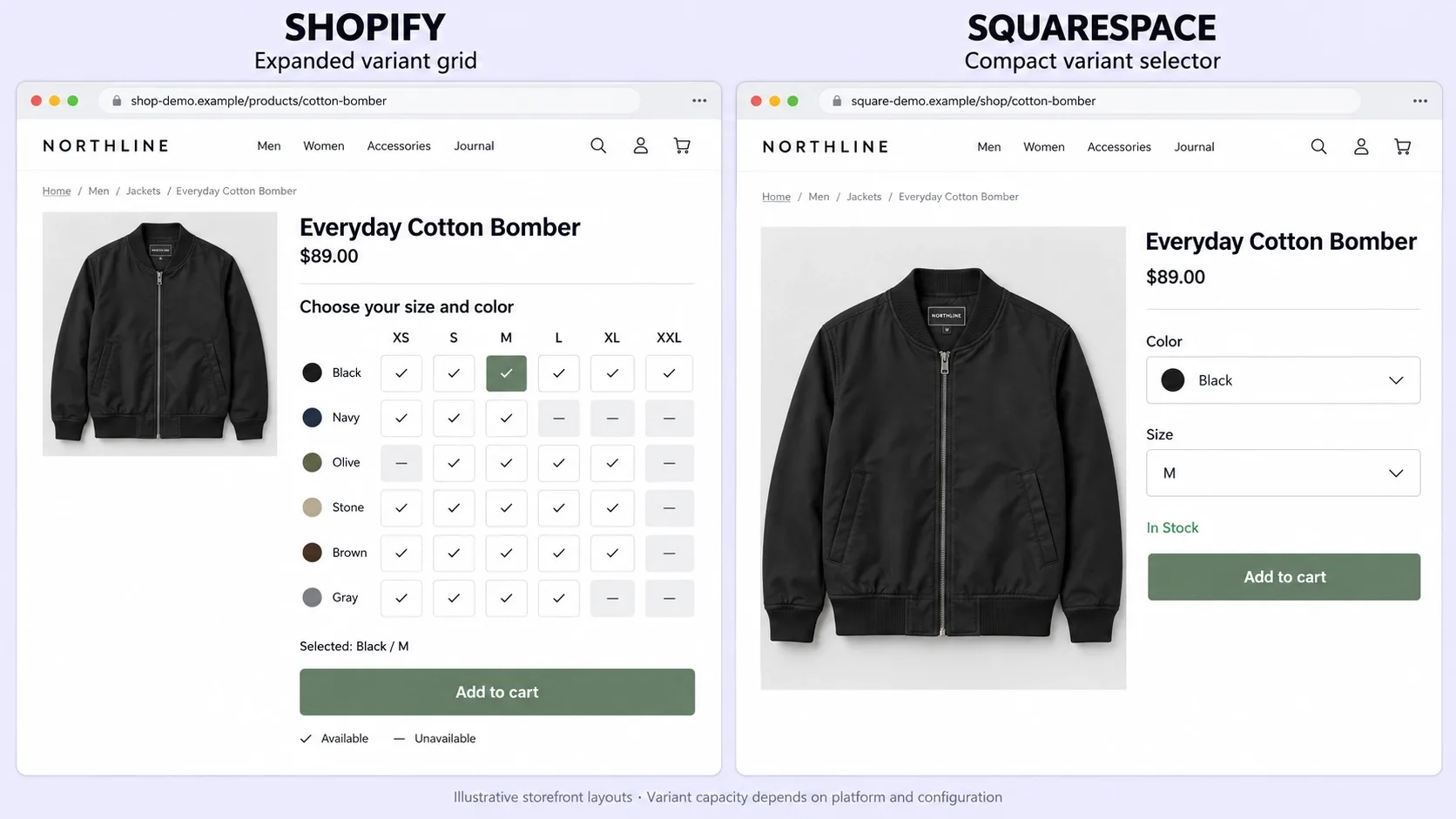
This is the constraint that catches growing merchants off guard, because it's invisible until you hit it. Shopify supports effectively unlimited products with generous variant allowances per item, scaling further on Plus. Squarespace caps total products and variant combinations at levels that are genuinely fine for a boutique catalog and genuinely limiting for anyone running real apparel-style size-and-color variance across a few hundred SKUs.
Inventory logic follows the same pattern. Shopify handles multi-location stock, transfers between warehouses, and granular per-variant tracking natively. Squarespace is built around a simpler, single-location mental model - which is exactly right for a solo maker shipping from one studio, and exactly wrong for a brand that just signed its second 3PL contract.
4. AI Readiness And Technical SEO
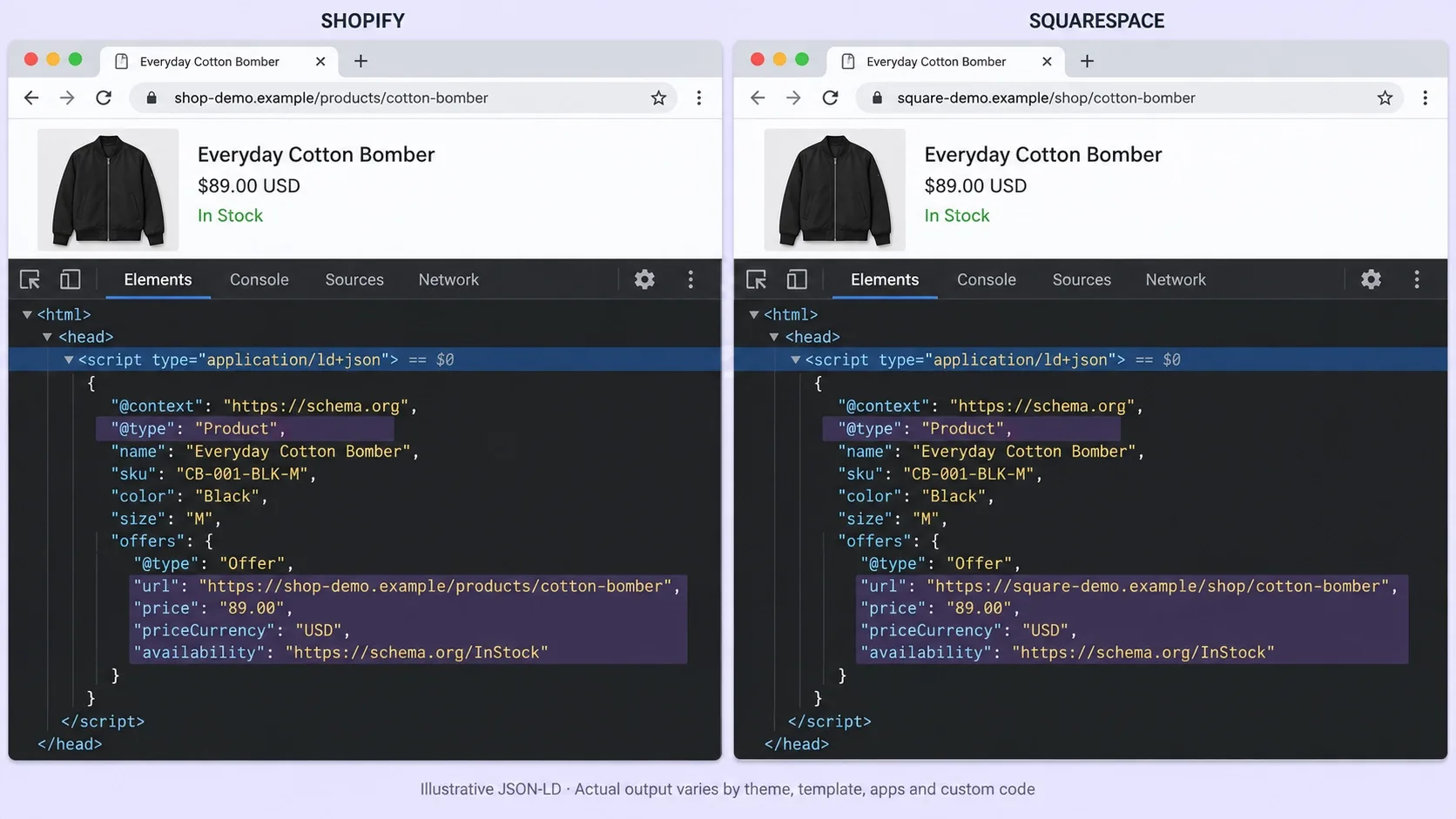
This is where the gap stops being theoretical. Answer Engine Optimization - getting cited by ChatGPT, Perplexity, and Google's AI Overviews - depends on flawless, dynamic JSON-LD: Product, Offer, AggregateRating, all matching what's actually rendered on the page. Shopify's ecosystem, whether through Liquid templates or custom apps, allows for that injection to happen dynamically and correctly at scale. I go deeper on the implementation specifics in How Schema Markup and Web Design Work Together.
Squarespace's rigid, closed code limits how far you can push schema customization, and it traps a meaningful share of product data inside heavy DOM elements that weren't built with a machine reader in mind. You can't inject the same level of nested, dynamic structured data a growing catalog needs, because the platform simply wasn't architected to expose that layer to you. None of this makes Squarespace bad at what it does. It makes it the wrong tool once AI visibility becomes a real revenue channel rather than a nice-to-have.
The same architectural gap that limits schema also limits ongoing technical SEO maintenance more broadly - a stacked-app Shopify store can develop its own version of this problem too, which is exactly the failure pattern I've documented in Common Shopify SEO Issues and How to Fix Them. The difference is that Shopify at least gives you the access to fix it. Squarespace often doesn't give you the door to walk through in the first place.
5. Performance And Core Web Vitals: The DOM Weight Problem
Drag-and-drop builders generate DOM bloat and unused CSS and JavaScript almost by design - every visual flexibility feature Squarespace offers costs something in markup weight, whether or not a given page actually uses it. That bloat destroys mobile load time (LCP) and interactivity (INP) in ways that are genuinely hard to reverse from inside a closed system.
Shopify's modern Liquid architecture - or Hydrogen and React for a headless build - can be stripped down to pass strict 2026 Core Web Vitals thresholds natively, because you actually control what ships to the browser. I've written more on what specifically moves these numbers in How Important Is Page Speed for SEO in 2026?. Now the painful part for Squarespace merchants: you can optimize images and trim copy all day, but you can't touch the platform's own rendering layer. The ceiling is fixed. On Shopify, the ceiling is a build decision.
6. Checkout Architecture And Conversion Optimization
This is a massive, measurable conversion driver, not a minor UX detail. Shopify's one-page checkout, combined with Shop Pay's saved-wallet experience, is genuinely one of the highest-leverage features on the platform. Shopify's own published data shows Shop Pay checkouts completing at 1.72x the rate of standard checkout, with an even larger gap on mobile - and Plus merchants get Checkout Extensibility on top of that, letting them customize upsell and downsell logic directly inside the flow.
Squarespace's checkout, by contrast, is rigid and largely un-customizable. There's no equivalent to Shop Pay's saved-wallet acceleration, and no native framework for the kind of upsell or downsell logic that meaningfully lifts average order value. I cover the broader mechanics of what actually reduces checkout drop-off in How to Reduce Cart Abandonment in 2026, and a fair share of it simply isn't available to build on Squarespace at all, regardless of how good your implementation is.
Shop Pay Alone Converts 1.72x Standard Checkout
That's not a minor UX detail - it's one of the highest-leverage conversion features on either platform, and it simply doesn't exist on Squarespace. Vareweb builds and optimizes Shopify checkout flows around exactly this kind of measurable lift.
7. Apps, API Extensibility & Third-Party Integrations
Here's the question that actually separates a hobby store from a scaling retail business: what happens when you need an ERP, a dedicated PIM, or advanced warehouse routing logic connected to your storefront? Shopify's GraphQL and REST APIs let it act as a genuine central nervous system for a retail operation, exchanging data with whatever specialized systems the business actually needs. This is exactly the layer where Ecommerce SEO and technical architecture stop being separate conversations - a feed that syncs correctly through an API is also a feed an AI shopping agent can trust.
The scale gap in the app ecosystems themselves tells the same story from a different angle. Shopify's App Store lists 28,512 apps from 17,808 vendors, covering nearly any integration a merchant could need. Squarespace's extensions marketplace holds a small fraction of that - functional for the basics, thin the moment a request gets specific. Squarespace remains a walled garden by comparison: it's not that integrations are impossible, it's that you're working within boundaries the platform decided on your behalf, rather than architecture you control.
8. POS And Omnichannel Selling
Shopify's point-of-sale system connects in-person and online inventory in one dashboard - a real consideration the moment a brand adds a market stall, a pop-up, or a physical retail location alongside its online store. Squarespace's in-person selling tools exist but stay noticeably lighter, built for occasional use rather than a genuine omnichannel operation running both channels at volume.

9. International And Multi-Currency Selling
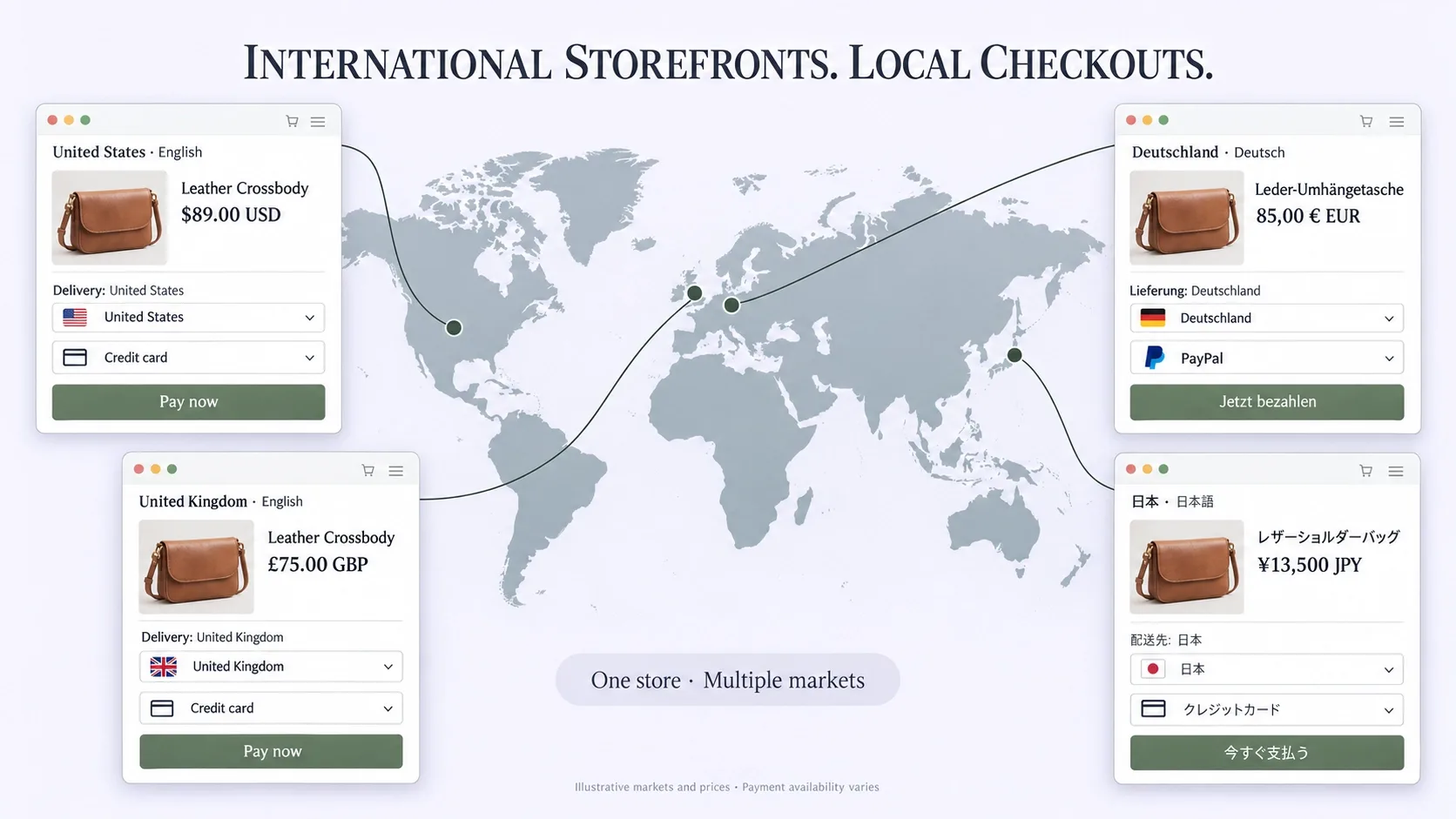
Shopify Markets gives merchants localized pricing, multi-currency checkout, and region-specific domains or subdomains without bolting on a third-party app for the core functionality. Squarespace supports selling internationally too, but the multi-currency and localization tooling sits well behind Shopify's - fine for a brand shipping occasionally abroad, a real constraint for one building international as a core channel from day one.
When Squarespace Is Actually the Better Choice
Restaurants, local services, photographers, and any brand where commerce is a secondary income stream under roughly $50K a year. If you're selling five products alongside a service business, or booking appointments with the occasional retail add-on, Squarespace's design quality and simplicity genuinely outperform the overhead of running Shopify. Don't let anyone talk you into commerce infrastructure you don't need yet.
When Shopify Is the Mandatory Choice
Pure DTC brands, dropshippers, B2B wholesale operations, and any brand scaling past 20 to 50 SKUs with real growth ambitions. Once product variants, inventory complexity, and multi-channel selling enter the picture, Squarespace's constraints stop being a minor inconvenience and start capping revenue directly.
The Migration Tipping Point
You cannot rely on a closed visual builder if you want custom checkout logic, dynamic tax handling across states, or genuinely scalable structured data - and the tipping point usually isn't one dramatic event. It's a combination: catalog complexity crossing 50 SKUs, shipping or tax logic that needs real conditional rules, or organic traffic that's plateaued because product pages can't carry the schema depth AI search now expects. If two of those three sound familiar, you're already past the point where migration is optional. Our Shopify Development Services team handles this exact transition regularly, and the technical debt only compounds the longer it's deferred.
Two of Three Sound Familiar? You're Ready to Migrate.
Vareweb's Shopify Development team handles Squarespace-to-Shopify migrations regularly - clean data mapping, redirects that protect your existing SEO equity, and a build that's actually ready for the catalog you're growing into. One team, accountable for the whole result.
FAQs
Is Squarespace bad for eCommerce SEO?
Not bad, but limited. It handles SEO fundamentals - sitemaps, clean URLs, meta tags - reasonably well, but its rigid schema support and heavier DOM weight cap how far you can push technical and AI-search optimization compared to Shopify.
Which platform is actually faster on mobile?
Shopify, once properly built - a stripped Liquid theme or a headless build can hit strict Core Web Vitals thresholds. Squarespace's fixed rendering layer puts a ceiling on mobile performance that no amount of content optimization removes.
Can I use Shop Pay on Squarespace?
No. Shop Pay is native to Shopify's checkout infrastructure and isn't available as an integration on Squarespace's commerce system.
How hard is it to migrate product data from Squarespace to Shopify?
Straightforward for a small catalog, more involved past a few hundred SKUs with variants - product data, images, and order history all need clean mapping, and redirects matter as much as the data migration itself to protect existing SEO equity.
Is Shopify more expensive than Squarespace when you factor in apps?
Often comparable at small scale, and worth it past that point - Squarespace's lower sticker price doesn't include the revenue ceiling its architecture imposes once a catalog and traffic actually grow.
Does Squarespace charge transaction fees on every plan?
Only on Basic, and only on physical goods at 2%. Core and above remove that fee on physical and service sales entirely, though digital products still carry a smaller fee that only disappears on the higher tiers.
What happens when my catalog outgrows Squarespace's product limits?
Nothing breaks overnight, but new products stop being addable once you hit the cap, and heavy variant use eats into that ceiling faster than most merchants expect. At that point the choice is trimming the catalog or migrating - there's no in-between tier Squarespace offers to buy more headroom.
Can I sell internationally on Squarespace, or do I need Shopify for that?
You can sell internationally on either, but Shopify Markets gives you localized pricing, multi-currency checkout, and region-specific storefronts natively. Squarespace's international tools work for occasional cross-border sales, not for a brand building multiple country markets as a core strategy.

Written by
Kashaf
Kashaf is a veteran SEO specialist with deep expertise in AI SEO, generative engine optimization, ORM, web strategy, and marketing automation. With a Master's in Computer Science, he blends search strategy with technical insight into websites, automation workflows, and AI-driven platforms, helping brands dominate traditional search while adapting to the future of AI-powered discovery.