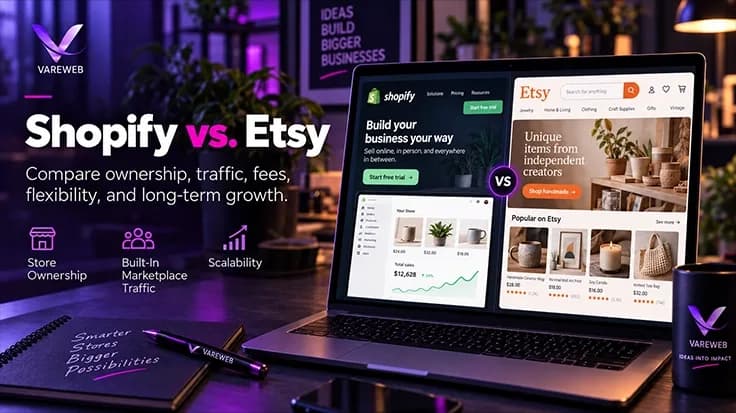
Quick Answer: Etsy and Shopify serve different stages and goals of an ecommerce business. Etsy provides access to an established marketplace and existing buyer traffic, making it useful for testing products, validating demand, and starting with relatively low upfront commitment. Shopify gives sellers greater control over their brand, customer experience, marketing, data, and store economics, making it better suited to building an independent ecommerce operation over the long term. For many sellers, the decision isn't simply Etsy vs Shopify - it comes down to whether the priority is marketplace discovery today or greater ownership and control as the business grows.
In my experience working with scaling brands, the biggest shock founders face when moving off marketplaces isn't the technical migration. It's realizing how much of their business they never actually owned in the first place - the customer relationship, the checkout experience, even the right to contact a buyer directly. Etsy isn't a competitor to Shopify. Etsy is a discovery channel. Shopify is your actual business engine.
Here's the number that should anchor this whole comparison: Etsy's own Q2 2026 shareholder letter reported a marketplace take rate of 25.9%, up 130 basis points year over year - meaning that, on average, a quarter of every dollar an Etsy seller generates never reaches them at all. That's not a criticism of Etsy's business model. It's simply the mathematical reality of renting distribution instead of owning it, and it's exactly the kind of unit-economics gap we help brands close when we build eCommerce web development services around owned platforms where sellers keep 100% of their customer data and control their own margin structure.
You Don't Own a Business Until You Own the Customer
A quarter of every Etsy dollar never reaches the seller, and that's before accounting for what you can't do with the relationship even when it does. Vareweb builds ecommerce infrastructure around platforms sellers actually own - where the customer data, the checkout, and the margin structure all belong to the business, not the marketplace.
Quick Overview: Etsy vs Shopify, Factor by Factor
| Factor | Etsy | Shopify |
|---|---|---|
| Ownership Model | Marketplace presence operated within Etsy's platform | Independent branded storefront with greater ownership and control |
| Account Risk | Subject to marketplace policies, account reviews, flags, and potential suspension | Operates under Shopify's merchant terms without dependence on marketplace seller status |
| Effective Fees (Illustrative) | Around 10% baseline in some scenarios, potentially higher when Offsite Ads and other applicable fees are included | Monthly platform subscription plus payment processing and any applicable transaction or app fees |
| Customer Data | More restricted customer access and retargeting options within marketplace rules | Greater control over customer email, SMS, analytics, pixels, and first-party marketing data |
| Traffic Source | Built-in marketplace search and Etsy's existing buyer audience | Traffic generated through SEO, paid advertising, social media, email, and other acquisition channels |
| Customization | Standardized marketplace structure with limited storefront customization | Extensive theme, Liquid, headless, and storefront customization options |
| Payment & Checkout | Checkout operates through Etsy's marketplace payment infrastructure | Multiple payment options, including Shopify Payments and accelerated checkout through Shop Pay |
| Shipping & Fulfillment | Integrated shipping tools and labels within Etsy's marketplace framework | Broader carrier, fulfillment, warehouse, and third-party logistics integration options |
| Reviews & Social Proof | Native marketplace review system tied directly to Etsy purchases | Typically handled through apps or integrations, with greater control over how reviews are displayed |
| Exit Valuation | Business value can be affected by dependence on a third-party marketplace | An independent store can support a more diversified business asset when traffic and revenue are spread across owned channels |
Shopify vs Etsy: What Are The Differences
1. The Structural Shift: Rented Marketplace vs. Owned Infrastructure
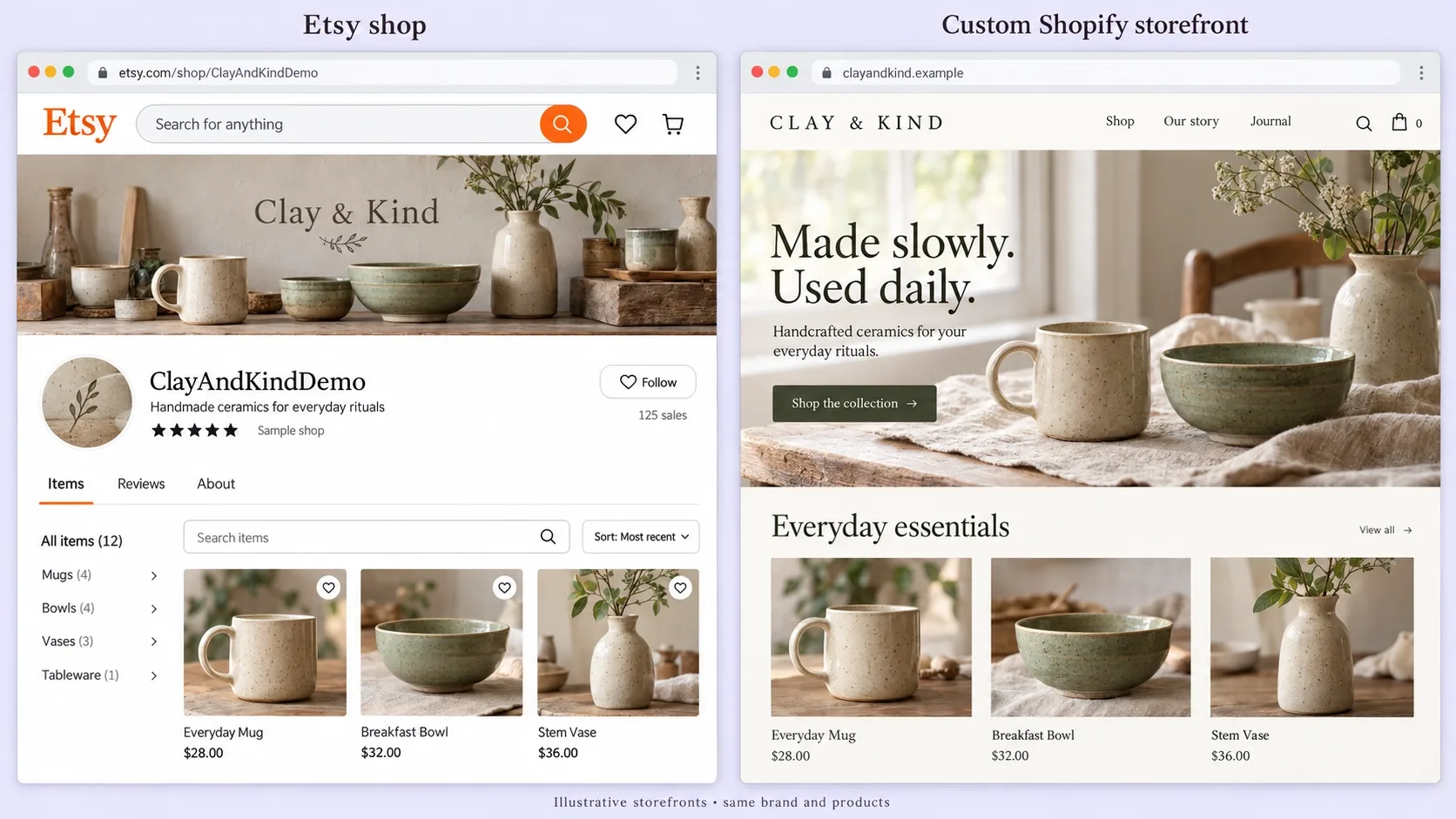
On Etsy, the buyer belongs to Etsy. Someone tells a friend "I bought this on Etsy," not "I bought this from [Brand]." The platform owns the search relationship, the checkout, the post-purchase messaging, and a meaningful share of the emotional credit for a good buying experience - all of it accrues to Etsy's brand, not yours.
On Shopify, the domain, the customer relationship, the checkout experience, and the brand memory belong entirely to you. A repeat customer remembers your name, finds you through a bookmark or a Google search for your brand specifically, and builds a relationship with a business rather than a listing inside someone else's catalog. That distinction sounds abstract until you try to sell the business - a buyer values a brand people actively seek out completely differently from a shop that only exists inside someone else's search results.
There's a quieter version of this shift too, one that shows up in day-to-day operations rather than a single dramatic moment. On Etsy, a policy update, a search algorithm change, or a new fee tier gets decided in a boardroom you have no visibility into, and you find out about it the same day it takes effect - alongside every other seller on the platform. On Shopify, the platform itself can still change, but the store built on top of it is yours to adapt. You control the timeline for a redesign, a pricing change, or a new checkout flow, rather than reacting to a policy update that landed in your inbox this morning with a compliance deadline attached.
A Policy Change You Have No Visibility Into Can Land in Your Inbox Tomorrow
The store you build on Shopify is yours to adapt on your own timeline - no boardroom decision you weren't in the room for, no compliance deadline attached to someone else's schedule change. Vareweb builds that independence in from the start.
2. Account Risk And Platform Governance
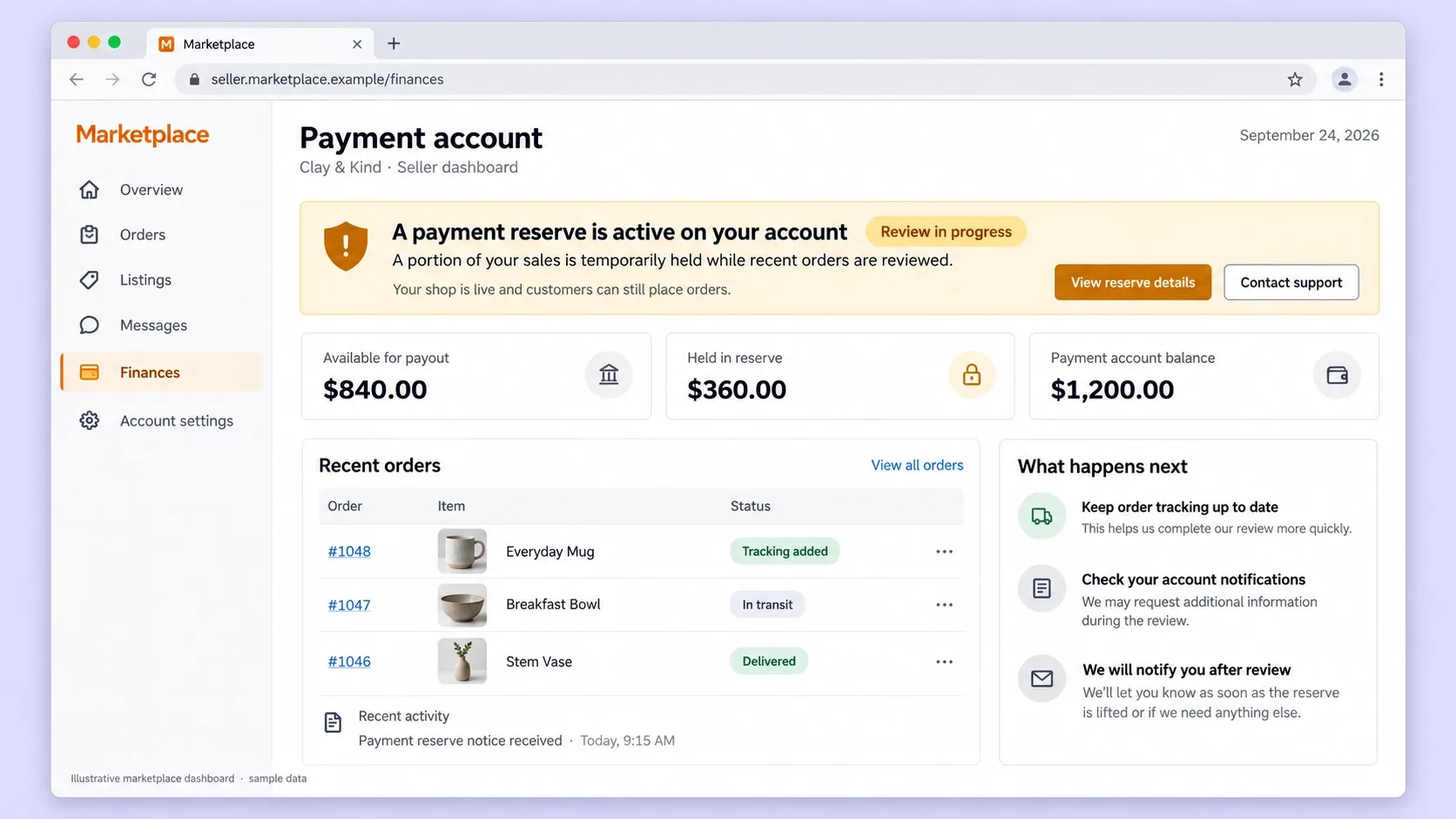
This is the section most sellers underestimate until it happens to them. Marketplace-scale platforms run automated policy enforcement across millions of listings - flagging suspected IP violations, unusual order patterns, or account behavior that trips a fraud model, often with no human reviewing the specific case before funds get held or a shop gets suspended.
I've seen successful sellers lose access to their main income overnight because an automated system flagged something a human would have cleared in thirty seconds - a reserve held against pending payouts, a listing pulled pending review, an account frozen while an appeal works through a queue with no published timeline. None of this makes Etsy poorly run. It's the unavoidable cost of operating at the scale a marketplace with 5.6 million active sellers has to operate at - automated enforcement is the only way governance scales to that many shops.
On a Shopify store running on your own domain, you operate under standard merchant processing terms. There's no marketplace algorithm that can suspend your entire storefront based on a pattern match against millions of other unrelated sellers. Payment processors have their own risk models, but they're evaluating your business specifically, not flagging you as a side effect of policing a marketplace forty times your size.
3. The Mathematical Fee Breakdown: What $50 Actually Becomes
Theory is easy to argue with. Numbers aren't. Etsy's own published fee schedule charges a $0.20 listing fee, a 6.5% transaction fee on the full order including shipping, and payment processing of roughly 3% plus $0.25 per transaction. Run a $50 sale through that stack: $0.20 plus $3.25 plus $1.75 comes to $5.20 in mandatory fees - a 10.4% effective rate before a single ad dollar enters the picture.
Now add Offsite Ads, which becomes mandatory rather than optional once a shop crosses $10,000 in trailing annual sales. At 12% on an ad-attributed order, that same $50 sale loses another $6 - pushing total fees to roughly $11.20, or a 22.4% effective rate. Shops still under that threshold pay 15% instead of 12% on Offsite Ads if they haven't opted out, pushing the effective rate closer to 26% on ad-attributed orders.
Shopify's Basic plan runs $29/month on annual billing, plus 2.9% and $0.30 per transaction through Shopify Payments. The same $50 sale costs $1.75 in transaction fees - full stop, no listing fee, no mandatory ad tax. At 100 sales a month, that's $175 in transaction fees plus the $29 platform fee, totaling $204 against $5,000 in revenue - a 4.08% effective rate. At 1,000 sales a month, the transaction fees scale to $1,750 while the flat $29 barely moves the needle, landing at roughly 3.56% effective. Here is the math that most new sellers completely miss: Shopify's effective rate drops as volume climbs, because the fixed monthly fee gets diluted across more orders. Etsy's effective rate climbs as volume climbs, because more of that volume gets attributed to mandatory Offsite Ads once you cross the threshold. The two platforms are moving in opposite directions on the exact metric that matters most as a business scales.
Etsy's Effective Rate Climbs as You Scale. Shopify's Drops.
That's not a marginal difference - it's two platforms moving in opposite directions on the exact metric that matters most as a business grows. Vareweb builds the Shopify infrastructure that lets that math actually work in your favor.
A Real Product: What $150 Actually Becomes
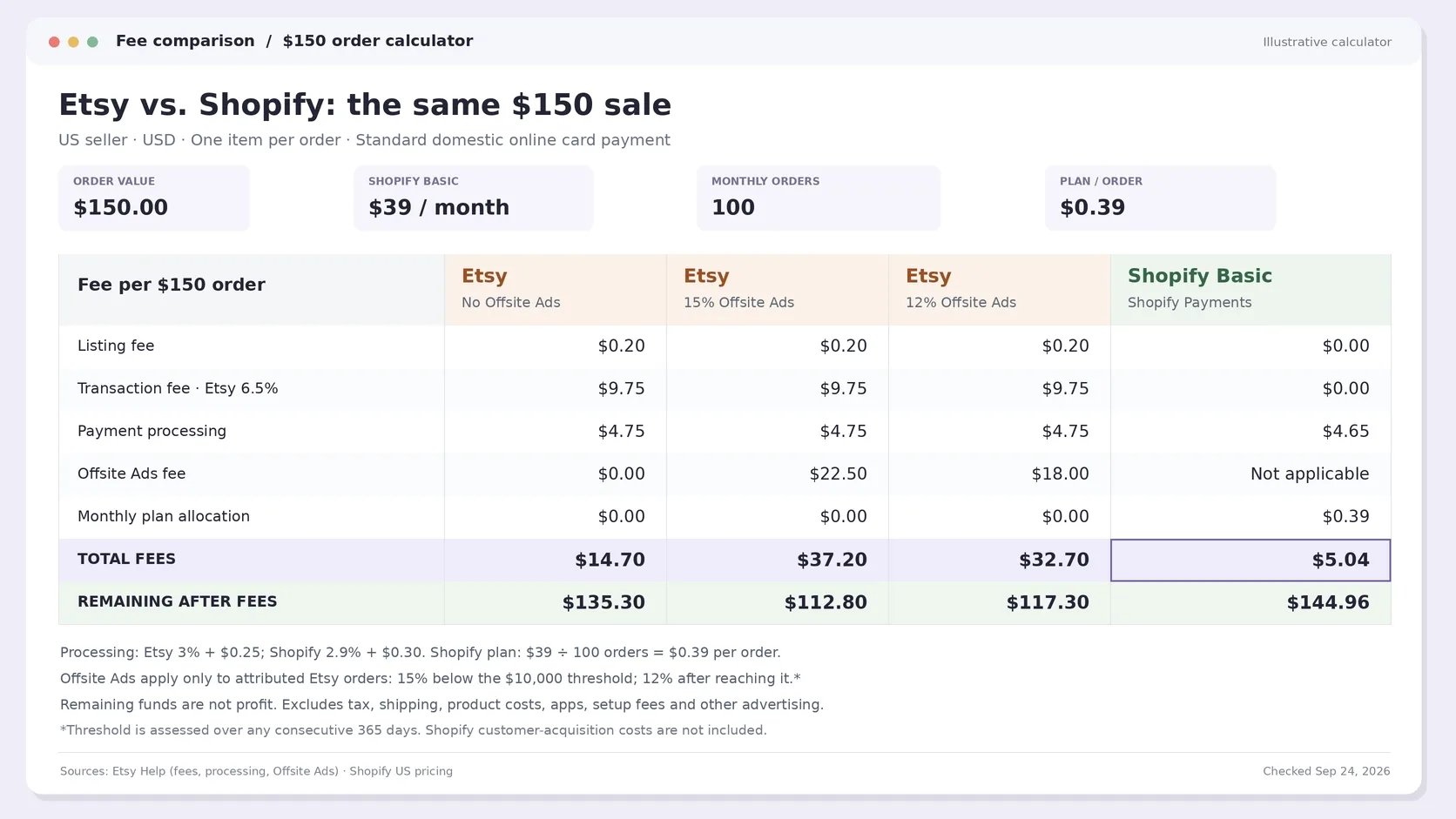
Percentages are easy to skim past. Let's make it concrete with a single $150 sale, run through both fee stacks exactly as published.
On Etsy, standard sale, no ads: $0.20 listing fee, plus 6.5% transaction fee ($9.75), plus 3% + $0.25 payment processing ($4.75). Total fees: $14.70. You keep $135.30 - a 9.8% effective rate.
On Etsy, same sale, Offsite-Ads-attributed: Add the mandatory 12% fee once you're over the $10,000 annual threshold - another $18.00 gone. Total fees: $32.70. You keep $117.30 - a 21.8% effective rate, nearly double the standard rate on the exact same product.
On Shopify, Basic plan, Shopify Payments: 2.9% + $0.30 comes to $4.65 in transaction fees. Amortize the $29 monthly platform fee across a realistic 20 sales that month and each sale absorbs another $1.45. Total cost per sale: $6.10. You keep $143.90 - a 4.07% effective rate.
Line the three up side by side: $135.30 on a clean Etsy sale, $117.30 once Offsite Ads enter the picture, $143.90 on Shopify. That's $8.60 more in your pocket per sale even in Etsy's best-case scenario, and $26.60 more per sale against the ad-attributed one - on a single $150 product. Multiply either gap across a real month of sales volume and it stops being a rounding error.
4. Customer Data Ownership And The Marketing Flywheel
Etsy restricts what a seller can see and do with buyer contact information specifically to protect the marketplace's own retargeting and repeat-purchase economics - a buyer's email stays largely inaccessible, and directing customers off-platform for future purchases violates seller policy. That's a completely rational business decision for Etsy to make. It's also a structural ceiling on how much a seller can ever build a direct relationship with their own customers.
On an owned Shopify store, that ceiling doesn't exist. You build a real email and SMS list in a tool like Klaviyo, deploy the Meta Pixel and Conversions API for accurate retargeting, track full-funnel behavior in GA4, and run post-purchase upsell sequences that lift lifetime value directly rather than hoping the marketplace's own algorithm resurfaces you to a past buyer. I go deeper on what this tracking stack should actually capture in What Is Web Analytics - the short version is that data ownership isn't a nice-to-have feature. It's the entire mechanism that turns a single sale into a repeat customer relationship instead of a one-time transaction you have to re-earn through the marketplace every time.
Think through what this actually compounds into over a year. A brand with its own email list can run a welcome flow, an abandoned-cart sequence, a post-purchase upsell, and a winback campaign for lapsed customers - four distinct revenue streams built entirely on data Etsy never lets a seller collect in the first place. Each one individually looks small. Stacked together across a full customer lifecycle, they're often the difference between a store that only ever sells to new traffic and one where repeat customers make up a real, growing share of monthly revenue.
Four Revenue Streams Etsy Never Lets You Build
A welcome flow, an abandoned-cart sequence, a post-purchase upsell, a winback campaign - all of it depends on owning the customer data Etsy structurally restricts. Vareweb builds the tracking and email infrastructure that makes each one possible.
5. Driving Traffic: Etsy Search vs. Owning Your Own SEO and Paid Ads
Etsy search is genuinely powerful and genuinely out of your control. Ranking depends on an algorithm you can't see, competes against millions of other listings, and - because Etsy sells ad placement on your own product pages - can put a direct competitor's listing right next to yours at the exact moment a buyer is deciding. You're renting visibility inside a system actively monetizing the attention you're trying to capture.
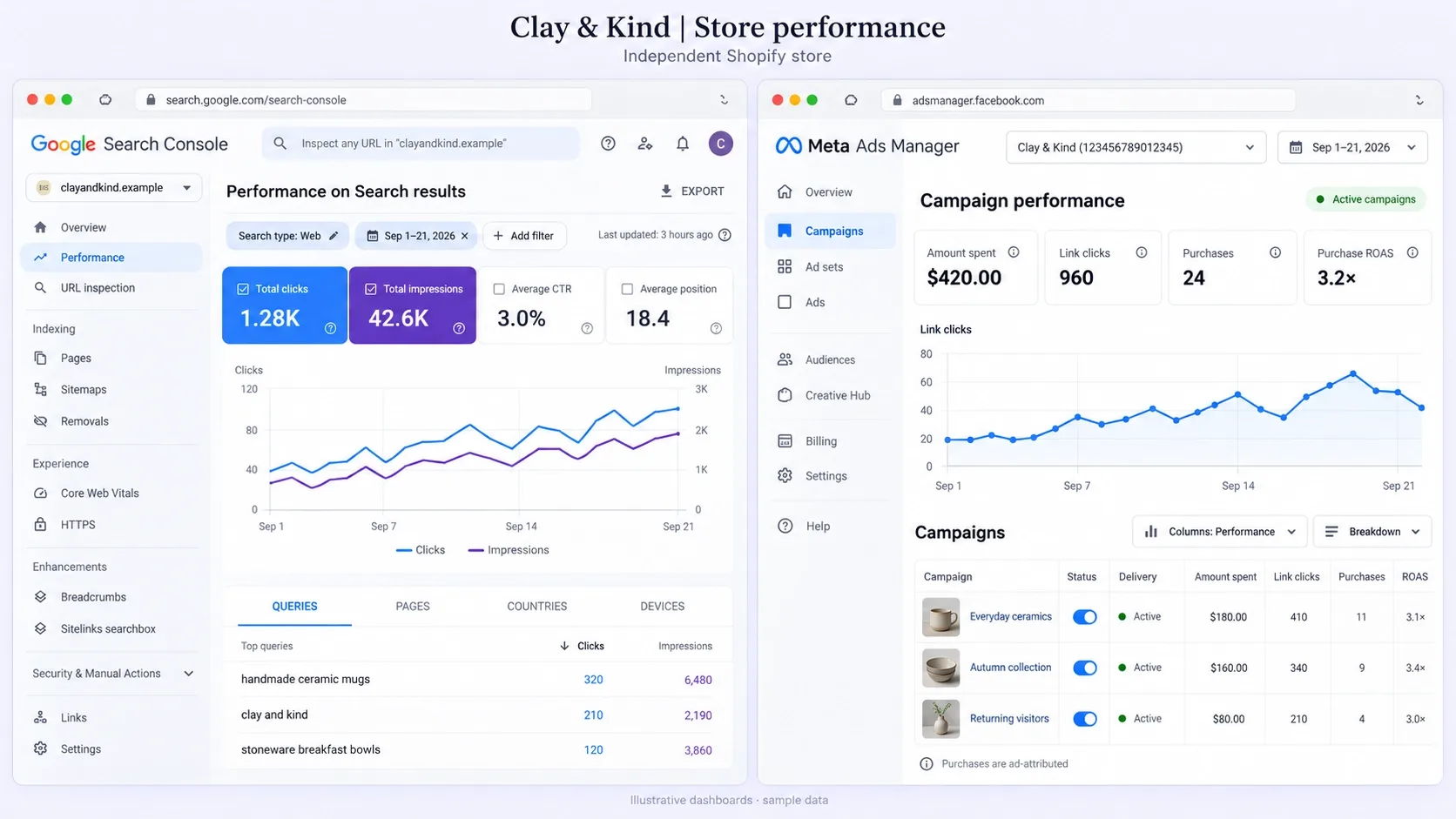
Managing your own acquisition stack looks different, and it's genuinely more work upfront. Google Shopping ads, Meta and Instagram campaigns, and organic content SEO all take deliberate setup - but every dollar and every hour you put into them compounds toward an asset you own, rather than renting visibility you lose the moment you stop paying or the algorithm shifts. This is precisely the discipline Ecommerce SEO work is built around for brands making this exact transition. I cover the technical side of building pages that actually earn organic visibility in How to Get Your Website Cited by AI Search Engines and How Schema Markup and Web Design Work Together - and it's worth being honest that this is real, ongoing work. Nobody hands you Etsy's built-in buyer traffic for free the day you launch. You earn it, deliberately, over months.
5. Customization, Tech Stack, and Conversion Rate Optimization
Etsy's template is uniform by design - every shop shares the same layout, the same checkout flow, the same core shopping experience, because consistency is part of what makes the marketplace trustworthy to a buyer browsing thousands of independent sellers. That consistency is also a hard ceiling on differentiation. You cannot build a bundle builder, a custom quiz-based product finder, or checkout logic tailored to your specific catalog.
Shopify's open architecture - Liquid theming, or a fully custom React storefront on Hydrogen - removes that ceiling entirely. Shopify Development Services built around a specific catalog can integrate custom ERPs and CRMs, build genuinely differentiated checkout logic, and optimize Core Web Vitals specifically for the mobile shoppers who make up most modern traffic - none of which is available inside Etsy's shared template, at any price. I cover the checkout-specific conversion levers in more depth in How to Reduce Cart Abandonment in 2026, and a meaningful share of that guidance simply has no equivalent inside Etsy's fixed flow.
6. Payment Processing And Checkout Options
Etsy runs every transaction through Etsy Payments - a single, bundled processor with no alternative and no ability to offer a saved-wallet, one-click checkout experience. It's simple, and simplicity is a real feature for a first-time seller who doesn't want to think about payment infrastructure at all.
Shopify gives you a choice of gateways, and specifically Shop Pay - a saved-wallet checkout that remembers a buyer's information across every Shop Pay-enabled store they've ever purchased from. Shopify's own published data shows Shop Pay checkouts completing at 1.72x the rate of standard checkout, with the gap widest on mobile, where typing out a full address and card number is the single biggest source of checkout abandonment. That's not a marginal UX nicety. It's a checkout completion advantage Etsy's uniform payment flow has no equivalent for.
Shop Pay Converts 1.72x Standard Checkout - Etsy Has No Equivalent
That's not a UX nicety, it's a measurable checkout-completion advantage a bundled, one-processor marketplace flow simply can't offer. Vareweb builds and optimizes Shopify checkout around exactly this kind of lift.
7. Shipping, Fulfillment And Logistics Tools
Etsy bundles discounted shipping labels directly into the seller dashboard, pulled from its own carrier relationships, and for a small or new seller that convenience genuinely removes a real operational headache - no separate account, no separate tool, print a label and move on.
Shopify doesn't bundle one carrier relationship. It opens the door to all of them - any carrier, any third-party logistics provider, any custom rate table your business actually needs, integrated through apps or direct API connections. That's more setup work upfront. It's also the only path to genuinely custom shipping logic: free-shipping thresholds, weight-based tiers, regional carrier selection, or a 3PL handling fulfillment entirely while inventory stays synced automatically. A seller shipping fifty orders a month rarely needs that flexibility yet. A seller shipping five thousand orders a month cannot operate without it.
9. Reviews, Social Proof And Built-In Trust Signals
Etsy reviews are native, automatic, and effectively permanent - every completed sale can generate a review that displays directly on the listing, and the credibility of an established Etsy shop rating is real, immediately visible social proof a brand-new domain simply doesn't have on day one.
On Shopify, reviews require a deliberate choice - an app, a display format, a collection strategy - but that extra setup buys genuine control: you decide how reviews display, which ones get featured on which product pages, and how review data feeds into your structured data and schema markup for search visibility. Etsy's built-in trust is faster to earn. Shopify's version is slower to build and entirely yours to shape once it exists.
10. Brand Equity And Exit Valuation: What Are You Actually Building?
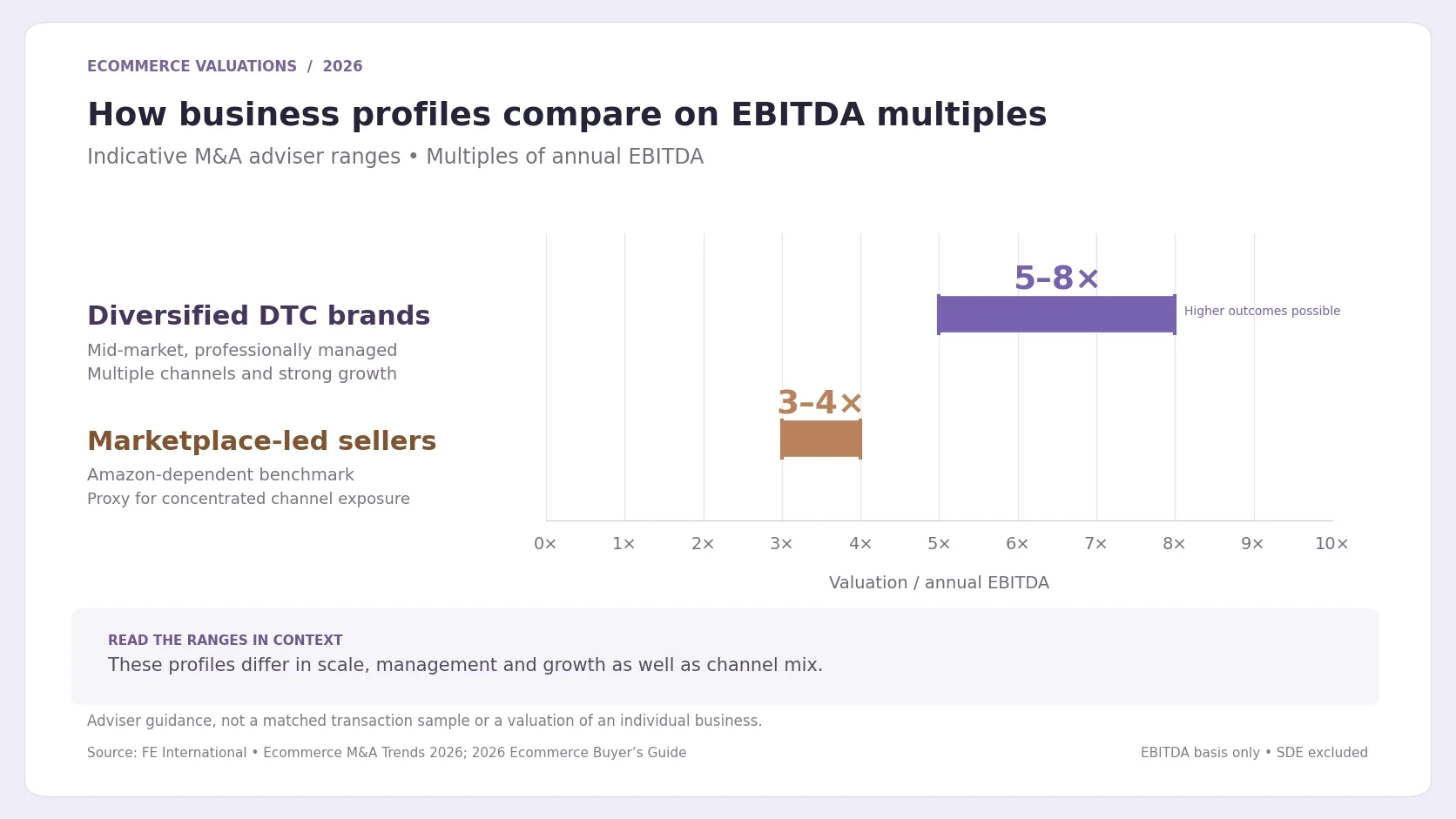
This is the question most sellers never ask until someone else asks it for them - a potential acquirer, a partner, their own future self deciding whether to sell. FE International's 2026 valuation data, drawn from over 1,500 completed transactions, puts mid-market DTC brands at 4x to 8x adjusted EBITDA - and channel diversification, an owned audience, and platform independence are consistently the factors that push a business toward the top of that range rather than the bottom.
An Etsy shop, however profitable, is structurally harder to value at a premium multiple, because its earnings depend on continued access to a platform the seller doesn't control and can't transfer cleanly to a buyer. A standalone Shopify brand with its own domain, its own customer list, and its own acquisition channels represents something genuinely different to an acquirer: a transferable asset, not a rented storefront. What Trust Badges Mean and Why They Are Important and a real, human About page both sound like small details next to a valuation multiple - they're actually part of the same story a buyer is evaluating: is this a brand people trust and return to, or a listing that happens to convert today
The Hybrid Model: Using Both Platforms Strategically
The smartest version of this isn't a binary choice. Plenty of brands launch on Etsy specifically to validate product-market fit - cheap to test, built-in buyer traffic, minimal upfront investment before you know if a product actually sells. Once repeat demand is proven, the same sellers build a Shopify presence and use tasteful package inserts, a QR code, or simply consistent branding to introduce existing buyers to their owned storefront over time, without violating Etsy's policies against directly soliciting off-platform purchases inside a transaction itself.
Ready to Build the Store You Actually Own?
Vareweb helps brands make this exact transition - migrating from Etsy to a Shopify store built around SEO, conversion, and the customer data ownership that turns one-time sales into a real, valuable business. One team, accountable for the whole result.
Etsy becomes a discovery and validation channel running in parallel, not a channel you have to abandon the day you launch your own store. The businesses that navigate this best treat the two platforms as sequential tools solving different problems, not as competitors fighting for the same role in the business.

FAQs
Is it harder to get sales on Shopify compared to Etsy?
Initially, yes - Etsy hands you built-in buyer traffic from day one, while Shopify requires you to build your own acquisition through SEO and paid ads. That upfront traffic gap is exactly what you're trading for full ownership of the customer relationship long-term.
Can I connect my Etsy shop to my Shopify store?
Yes, through official sales-channel integrations that sync inventory and orders across both platforms, which is exactly how the hybrid model above works in practice without manually managing two separate catalogs.
Does Etsy charge fees if a customer comes from my own link?
Standard listing and transaction fees still apply regardless of traffic source. Offsite Ads fees specifically only apply when the sale is attributed to an Etsy-placed ad - a sale from your own Instagram link, for example, wouldn't trigger that particular fee.
What happens to my visibility if my Etsy shop gets temporarily suspended?
Listings typically become unsearchable and unpurchasable for the suspension duration, and any accumulated search ranking momentum can take time to recover even after reinstatement - which is precisely the platform-dependency risk this article keeps returning to.
Is Shopify worth it for a small business making less than $1,000 a month?
Often not yet - the flat monthly fee is a real cost against thin early revenue, and Etsy's built-in traffic can be more valuable than platform ownership at that stage. The math tends to flip once volume and repeat-customer rate both grow.
How do I transition my existing Etsy customers to my new Shopify website without breaking policy?
Build brand recognition through consistent packaging, package inserts, and social presence rather than direct off-platform solicitation inside Etsy messaging or listings, which Etsy's terms specifically prohibit. Over time, repeat buyers naturally follow a brand they recognize and trust.
Do I need coding skills to run a professional Shopify store?
No - Shopify's theme ecosystem covers most standard needs without touching code. Custom checkout logic, bundle builders, or headless architecture genuinely do require development work, which is where a dedicated build team earns its cost.
Which platform is better for international shipping and tax compliance?
Etsy handles more of this automatically as part of the marketplace experience. Shopify requires more deliberate setup - tax apps, shipping zone configuration - but gives you full control over rates, carriers, and country-specific rules once it's configured correctly.
Should I close my Etsy shop once my Shopify store is established?
Not necessarily - many established brands keep Etsy running as a discovery channel indefinitely, treating it as one acquisition source among several rather than an either-or decision once the owned store is generating real revenue.

Written by
Kashaf
Kashaf is a veteran SEO specialist with deep expertise in AI SEO, generative engine optimization, ORM, web strategy, and marketing automation. With a Master's in Computer Science, he blends search strategy with technical insight into websites, automation workflows, and AI-driven platforms, helping brands dominate traditional search while adapting to the future of AI-powered discovery.