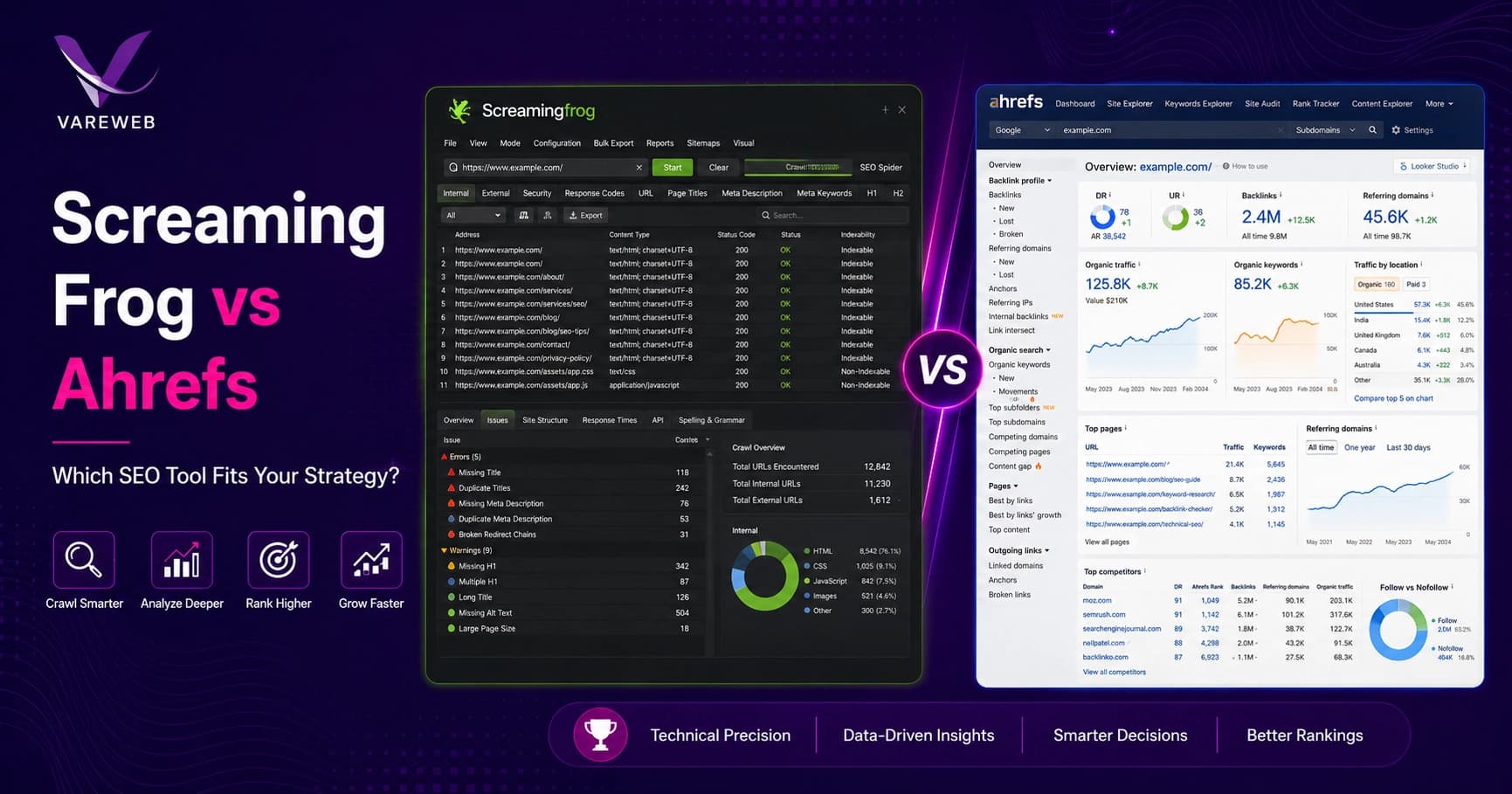
Quick Answer: If you're looking for a technical crawl or on-site audit, Screaming Frog is the better choice. If you're looking for keyword research, backlink analysis, or competitive strategy, Ahrefs is the better option. Most seasoned SEOs - including myself - use both, because there are always gaps when you try to make one tool do the job of another.
Google's May 2026 core update continues pushing toward helpful, people-first content - and AI-powered search experiences have become a permanent part of how results are discovered and surfaced. The tools you use to build and maintain your SEO foundation matter more than ever. Not just for ranking, but for whether AI engines can even access and cite your content in the first place.
What doesn't get indexed doesn't get cited: AI answer engines can't cite what they can't crawl. Conductor's Q1 2026 analysis of 21.9 million queries found that AI Overviews now appear in roughly 25% of Google searches. And being cited in those AI Overviews - rather than being ignored by them - increases organic click-through rates by 35% compared to pages that are not cited, according to Ahrefs own data. The pages that get cited are not always the ones with the most backlinks. They are the ones that are cleanly crawlable, properly structured, and technically sound.
A Search Engine Land study from October 2025 found that 63% of ChatGPT agent visits bounced immediately - before a single line of content was read - due to HTTP errors, broken redirect chains, slow load times, or bot-blocking rules. That's not a content quality problem. It's a technical SEO problem. The kind you find with a crawler, not a keyword tool.
AI bots - GPTBot, OAI-SearchBot, PerplexityBot - now account for 25% of all web requests, according to Ahrefs. They don't behave like humans. They don't retry on error. They don't wait for JavaScript to render. If your site has redirect loops, noindex tags on the wrong pages, blocked bot access, or slow server responses, those bots move on. Your content simply doesn't appear in their index.
I've run technical audits on WordPress sites with 50 pages and on e-commerce builds with 50,000 pages. I've pulled backlink profiles for local businesses and for SaaS platforms competing against high-authority domains. In all of it, the clearest thing I've learned is that Screaming Frog and Ahrefs are not interchangeable. They solve different problems at different layers of the same workflow.
With digital marketing strategy now needing to account for both traditional rankings and AI visibility simultaneously - picking the wrong tool, or forcing one tool to cover ground it was never built for, creates blind spots that cost real traffic from both.
Screaming Frog vs Ahrefs: What Each Tool Is Actually Built For
Screaming Frog SEO Spider
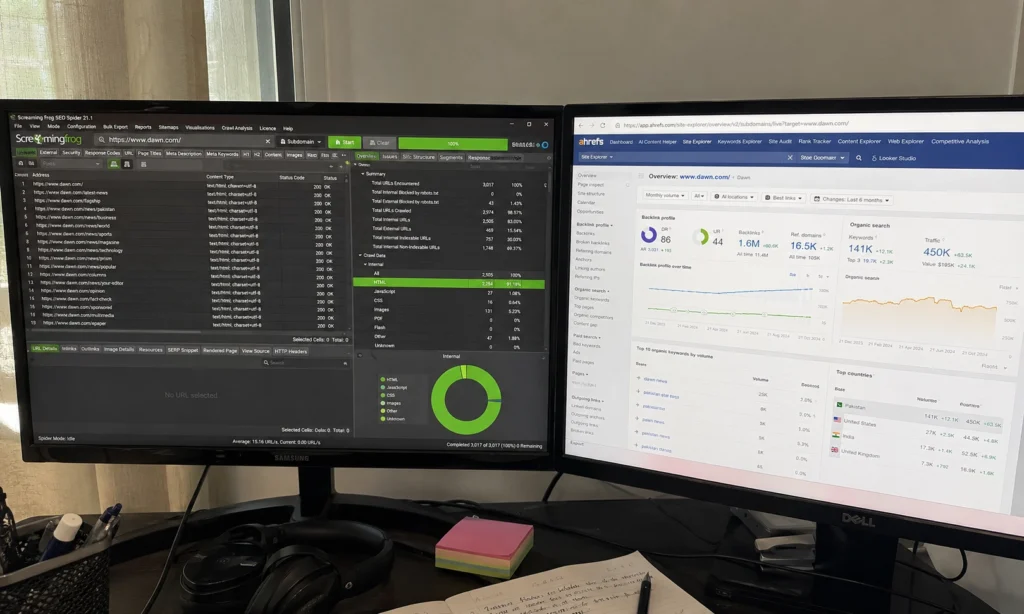
Screaming Frog SEO Spider is a desktop-based site crawler. You point it at a URL, it crawls every page it can find, and it returns a detailed report of what's broken, misconfigured, or missing. Think of it as a diagnostic tool: it identifies issues on your own site at the page level.
What it does extremely well:
- Crawls your full site to surface broken links (404s), redirect chains, and orphaned pages - pages that exist but nothing links to
- Audits meta titles, descriptions, and H1 tags across hundreds or thousands of URLs in seconds
- Checks canonical tags - these tell Google which version of a page is the 'official' one - for incorrect or missing configurations
- Flags indexability issues - whether pages are blocked by robots.txt, tagged as noindex, or have conflicting signals
- Surfaces structured data errors, duplicate content at the title or meta level, and thin pages
- Integrates with Google Search Console and Google Analytics to pull performance data alongside crawl data for richer reporting
What it won't tell you: it can't identify keywords to target, what your competitors are ranking for, who's linking to you, or whether your backlink profile is healthy. It is not a research tool. It is an audit tool.
Ahrefs
Ahrefs is a cloud-based, all-in-one SEO suite built around one of the largest backlink databases in the industry. As of March 2025, Ahrefs indexes 35 trillion external backlinks and a keyword database of 28.7 billion keywords across 217 global locations - both numbers that have been growing rapidly since 2022. Its core strength is giving you intelligence about the web: who is ranking, why they are ranking, and what opportunities you haven't yet captured.
What it does extremely well:
- Keyword Explorer surfaces keyword volume, difficulty scores, click-through rates, and SERP feature data so you can make research decisions on real numbers
- Site Explorer shows you any site's backlink profile - which domains link to them, what anchor text they use, and how that profile has changed over time
- Content Gap analysis - a genuinely useful feature that shows you keywords your competitors rank for that you do not, which is where I start most content strategies
- Rank Tracker monitors your keyword positions over time and flags movements, including in SERP features like featured snippets and People Also Ask
- Site Audit runs cloud-based technical checks - decent for surface-level issues, but not as granular as Screaming Frog for deep technical diagnosis
Its limitations: Ahrefs is expensive. The entry-level tier costs more per month than Screaming Frog's annual licence. And while its Site Audit tool is useful, I wouldn't rely on it alone when doing a serious technical overhaul of a large site.
Head-to-Head: Where Each Tool Wins
Technical SEO and Site Crawling
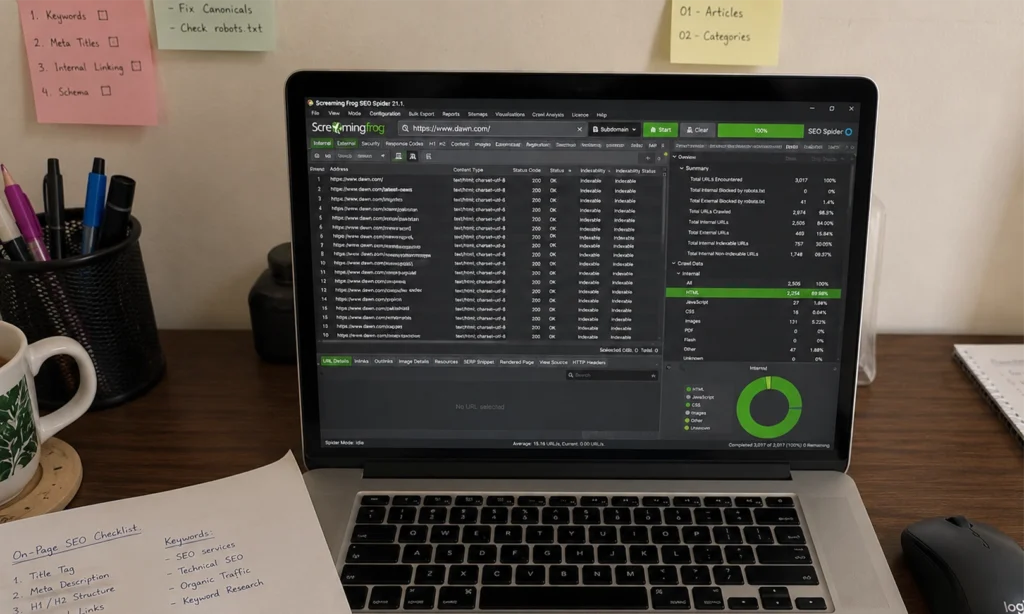
This is where Screaming Frog wins outright. No cloud-based tool - including Ahrefs Site Audit - gives you the same level of crawl depth and flexibility. With Screaming Frog, I can set custom extraction rules, crawl JavaScript-rendered pages, audit internal links, trace redirect chains step by step, and export a full spreadsheet of every URL with its status code, title length, canonical, and more.
Ahrefs Site Audit runs from the cloud, which means you are dependent on its own crawler schedule. For a pre-launch check on a site migration or a post-redesign crawl, I want Screaming Frog running in real time on my machine - not waiting for a cloud job to complete. The level of customisation is simply not comparable.
That said, Ahrefs' Site Audit does one useful thing Screaming Frog doesn't: it shows you how audit issues correlate with organic performance. If a cluster of pages with broken internal links is also losing traffic, you can see that connection directly in Ahrefs. That context is valuable for client reporting - where SEO has to talk to revenue, not just crawl data.
Keyword Research
Ahrefs wins this one clearly. Screaming Frog has no keyword research capability at all. You can integrate it with Google Search Console to pull query data, but that is a reporting function, not research.
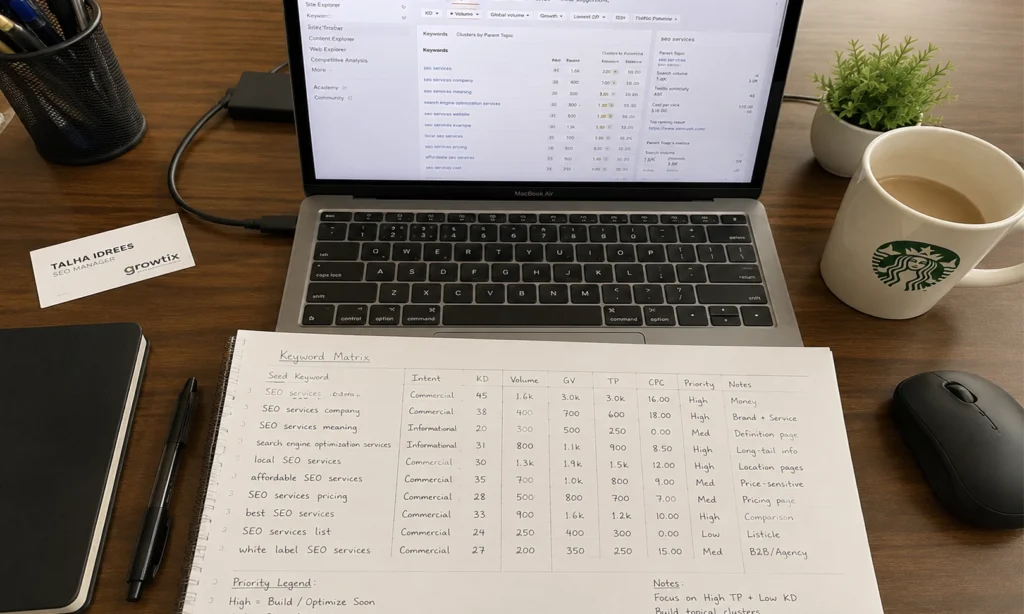
Ahrefs Keyword Explorer is one of the more reliable tools I use for building a keyword universe. I can enter a seed term, filter by difficulty range, sort by search intent signals, look at parent topics to avoid cannibalization - targeting two different URLs for keywords that Google treats as the same intent - and then export a working list for a content calendar. For a client expanding into new service areas, that research layer is not optional.
One thing I appreciate: Ahrefs shows you the actual SERP for any keyword, so you can see exactly what kind of content is ranking before you invest in writing. That alignment between keyword selection and search intent is part of what makes content viable in a post-May 2026 algorithm environment where Google is increasingly rewarding genuine topical depth over shallow keyword matching.
Backlink Analysis
Ahrefs wins this decisively. Screaming Frog can crawl internal links and flag broken outbound links on your own site, but it has no view of the wider web. It cannot tell you who is linking to you, how many referring domains you have, what your anchor text distribution looks like, or whether your competitors are actively building links in your space.
The Ahrefs backlink index is updated every 15 to 30 minutes and covers 35 trillion external links as of March 2025. In practice, that freshness matters when you are monitoring a new link-building campaign or tracking whether a toxic link has been removed. I use Ahrefs backlink data in client audits to check for low-quality or spammy referring domains, identify unlinked brand mentions worth pursuing, and benchmark link velocity against competitors.
Competitor Research
Ahrefs is the right tool here. It lets you analyse any competitor's organic traffic estimates, top-ranking pages, keyword footprint, and backlink profile from a single dashboard. The Content Gap feature is particularly useful: you input your domain alongside two or three competitors, and it surfaces keywords they all rank for that you don't.
Screaming Frog can crawl a competitor's site if you want to understand their site structure, how they use internal links, or what their page titles look like. That is occasionally useful for a deep-dive audit. But it is not a competitive intelligence platform.
Rank Tracking
Ahrefs wins this too. Screaming Frog does not have a rank tracker. Ahrefs Rank Tracker monitors keyword positions over time, tracks visibility scores, and flags SERP feature movements. For reporting to clients or internal stakeholders, having a reliable rank-tracking layer is non-negotiable.
Honest caveat: Ahrefs rank tracking, like all third-party trackers, may not match exactly what you see in Google Search Console. I treat it as directional data - useful for spotting trends, not as a precise real-time source of truth.
Content Planning
Ahrefs is the better tool for content planning, but with nuance. Its Content Gap tool, Keyword Explorer, and Top Pages report together give you a solid foundation for a content calendar. You can identify which informational queries your competitors are targeting, estimate traffic upside, and prioritise based on competition level.
Screaming Frog contributes something valuable here too: after you've built content, it helps you audit internal links - the hyperlinks connecting pages within your own site - to make sure new content is properly connected and that crawl budget isn't being wasted on thin or duplicate pages. I've used it on multiple client projects where content existed but wasn't indexed because nothing was linking to it. If you're building a blog strategy, it's worth understanding how schema markup and web design work together to make your content more discoverable - both in traditional search and in AI-powered results.
Ease of Use
Ahrefs is significantly more beginner-friendly. It is a web app with a clean interface, guided flows, and visual dashboards. You can log in, run a site audit, check backlinks, and pull keyword data within your first 30 minutes.
Screaming Frog has a steeper learning curve. The interface is desktop software from an earlier era of web tooling. There are dozens of columns, filter options, and configuration settings. If you've never used a crawler before, your first crawl will probably produce a spreadsheet of numbers you're not sure how to prioritise. It rewards experience - once you know what you're looking for, it is extremely fast. But it is not intuitive for newcomers.
Pricing and Value
Screaming Frog is much more affordable. The free version crawls up to 500 URLs, which covers a surprisingly large number of small business sites. The paid licence is approximately £149 per year - less than many tools charge per month. For a freelancer or consultant who mainly needs audit capability, that is exceptional value.
Ahrefs starts at around $129 per month for the Lite plan, which has limitations on historical data and crawl frequency. The Standard plan at $249 per month is what most agency professionals actually need. It is a significant commitment, and if you are not using keyword research, content gap analysis, and backlink tools actively, you will feel like you are paying for features you don't touch.
If you're a founder handling your own basic SEO and you only need to crawl your site once a month and run a basic backlink check, Ahrefs may not be the right starting point. If you're at an agency managing 10+ clients across verticals, it probably is.
Full Tool Breakdown
Screaming Frog SEO Spider - Deep Dive
Primary purpose:
On-site technical crawling and audit diagnosis.
Best use case:
Site migrations, post-redesign technical checks, internal link audits, finding crawl errors before they compound into ranking issues.
Key strengths:
- Unmatched depth on technical issues - redirect chains, canonical mismatches, noindex conflicts, missing alt text, duplicate titles, thin content flags.
- Integrations with GSC, GA4, PageSpeed Insights, and Ahrefs API for enriched reporting.
- Custom extraction lets you pull specific on-page elements beyond standard fields - useful for auditing schema markup, hreflang tags, and custom data attributes.
- Runs locally, so no waiting on cloud crawl schedules. Useful for time-sensitive audits before site launches.
Limitations:
- No keyword research, no rank tracking, no backlink analysis.
- Interface is dated. New users will need time to find what matters in the output.
- JavaScript rendering mode (for sites built on React, Vue, etc.) requires more RAM and is slower. On large JS-heavy sites, you may need to limit crawl scope.
Best for:
Technical SEO consultants, developers pre-launch, agencies running structured audits, anyone doing a site migration.
Who should avoid it:
Business owners managing their own SEO with no technical background. The output will be overwhelming without context.
Ahrefs - Deep Dive
Primary purpose:
SEO strategy, keyword research, backlink intelligence, and competitive analysis.
Best use case:
Building content strategies, tracking ranking performance, monitoring backlink profiles, identifying competitive gaps, managing SEO for multiple clients.
Key strengths:
- Best-in-class backlink data with a live index updated every 15–30 minutes.
- Keyword Explorer with SERP analysis, search intent signals, and click-through rate data - not just raw search volume.
- Content Gap is a genuinely useful tool that removes guesswork from content planning.
- Rank Tracker with SERP feature tracking and visibility trends.
- Supports AI visibility tracking in its newer Brand Radar feature, relevant as AI search surfaces compete with traditional SERP positions.
Limitations:
- Expensive. Most professionals will need the Standard plan ($249/month) to get the full feature set.
- Site Audit is useful but not a replacement for a dedicated crawler on complex technical issues.
- Traffic estimates are approximations. Do not use them as hard numbers in client presentations without caveating them.
Best for:
Agencies, in-house SEO teams, content strategists, freelancers who need keyword and backlink data regularly.
Who should avoid it:
Founders or small business owners who mainly need a one-time crawl audit. The monthly cost is hard to justify if you're not using it frequently across multiple workflows.
When Using Both Tools Makes Sense
In my own workflow, I use both. Not because I'm loyal to specific tools, but because the workflows genuinely complement each other and there is no meaningful overlap.
Here is how that looks in practice:
- I use Screaming Frog at the start of an engagement - a full crawl gives me the technical picture: crawl errors, redirect issues, internal link problems, indexability flags. That crawl report becomes the basis for the technical audit document.
- I use Ahrefs to understand the competitive context: which keywords the client should be targeting, how their backlink profile compares to competitors, and where the content opportunities are.
- After a site redesign, I run Screaming Frog again to verify that redirects are correctly mapped, new pages are crawlable, and internal links are pointing to the right URLs.
- For content planning, I pull Ahrefs Content Gap data and combine it with a Screaming Frog crawl of existing content - checking which pages are already indexed and how they are internally linked.
- I use Ahrefs Rank Tracker on an ongoing basis. I use Screaming Frog for quarterly or pre-launch crawls, not for daily monitoring.
For teams running full-service SEO, paid, and content together - this split is the most efficient way to work. Screaming Frog keeps technical debt from accumulating. Ahrefs keeps the strategy grounded in real data.
If you are managing client workflows across multiple projects, you might also explore how GHL automation can streamline reporting and campaign management alongside your SEO toolset - but that is a separate conversation.
When to Choose Just One
Choose Screaming Frog if:
- You are primarily a technical SEO consultant or developer who needs detailed crawl data.
- You are on a tight budget. The annual licence is under £150 - genuinely hard to beat for what you get.
- You are handling site migrations, redesigns, or technical audits and need real-time, local crawl capability.
- You already have keyword research covered through another tool or through GSC data.
Choose Ahrefs if:
- You need an all-in-one platform covering keyword research, rank tracking, backlinks, and competitive analysis.
- You are an agency or consultant with multiple clients and SEO is a major service line.
- You want to build a content strategy driven by real search demand data, not guesswork.
- Technical SEO is secondary to your work - you need to understand the competitive landscape more than you need deep crawl diagnostics.
Choose both if:
- SEO is a significant part of your job and both technical precision and strategic research matter.
- You manage multiple client sites with varying technical complexity and competitive contexts.
- You are running a full-service digital marketing operation where technical health, content strategy, and backlink growth need to work in parallel.
Decision Framework by User Type
Freelancers and Solo SEOs
Budget matters here. If you're starting out, Screaming Frog's free tier and paid licence give you solid audit capability. Ahrefs' cost is harder to absorb on thin margins. If client work justifies a monthly tool spend, the Standard Ahrefs plan is worth it once keyword research and backlink reporting become regular deliverables.
Agencies Managing Multiple Clients
You need both. A technical crawler is essential for structured onboarding audits. Ahrefs covers keyword strategy and competitive analysis across the portfolio. The combined annual cost is a line item most agencies can justify once SEO accounts for a reasonable share of recurring revenue.
In-House SEO Teams
The right split here depends on what the team focuses on. If you're in a mature SEO function with a developer or technical specialist on the team, both tools earn their place. If you're a one-person in-house team covering everything, Ahrefs plus Screaming Frog's paid licence is a practical and reasonably priced stack.
Founders and Business Owners
Be honest about your actual use pattern. If you're running Screaming Frog once a month and Ahrefs twice, you're probably not getting full value from either. For founders who want baseline SEO visibility without a heavy tool investment, working with a dedicated digital marketing agency that already has the tools running is often more efficient than paying for licences you won't fully use.
Consultants Advising on SEO Infrastructure
Recommend based on workflow maturity. A client doing their first SEO audit probably needs Screaming Frog and GSC before they need Ahrefs. A client who has done the technical groundwork and is now focused on growing organic traffic through content and links needs Ahrefs. The sequencing matters.
Comparison Table: Screaming Frog vs Ahrefs
| Feature | Screaming Frog | Ahrefs | Winner | Notes |
| Primary Purpose | Technical site crawling & audit | SEO strategy, research & backlink intelligence | Different tools | Not comparable - different problems |
| Technical Audits | ★★★★★ Best-in-class | ★★★☆☆ Solid but limited | Screaming Frog | SF gives far more granular crawl control |
| Keyword Research | None | ★★★★★ Best-in-class | Ahrefs | SF has zero keyword functionality |
| Backlink Analysis | Internal links only | ★★★★★ 35T link index | Ahrefs | Ahrefs wins decisively here |
| Competitor Research | Site structure crawl only | ★★★★★ Full competitive suite | Ahrefs | SF can crawl competitor structure; no intel |
| Rank Tracking | None | ★★★★☆ Reliable trends | Ahrefs | SF has no rank tracking at all |
| Content Planning | Supports via crawl data | ★★★★★ Content Gap + Explorer | Ahrefs (primary) | SF useful for auditing existing content |
| Ease of Use | ★★☆☆☆ Steep learning curve | ★★★★☆ Beginner-friendly | Ahrefs | SF rewards experience but isn't intuitive |
| Learning Curve | High - complex interface | Moderate - clean UI | Ahrefs | SF needs hands-on training to get value from |
| Pricing / Value | ~£149/year (paid) | ~$249/month (Standard) | Screaming Frog | SF is significantly more affordable |
| Solo / Freelancer Fit | ★★★★★ Excellent value | ★★★☆☆ Cost is a factor | Screaming Frog | SF annual licence beats monthly Ahrefs plans |
| Agency / Team Fit | ★★★★☆ Essential for audits | ★★★★★ Essential for strategy | Use both | Most agencies need both in the stack |
FAQs
Is Screaming Frog better than Ahrefs for technical SEO?
Yes - for deep technical crawls, Screaming Frog is the stronger tool. It gives you more granular control over what gets crawled, how it's analysed, and what gets flagged. Ahrefs Site Audit is useful but is not designed for the same level of technical diagnosis.
Is Ahrefs better than Screaming Frog for backlink research?
Without question. Screaming Frog has no external backlink data at all. Ahrefs' backlink index is one of the largest and most frequently updated in the industry. For backlink analysis, link prospecting, or competitor link research, Ahrefs is the tool.
Do I need both Screaming Frog and Ahrefs?
If SEO is central to your work - whether you're a freelancer, consultant, in-house professional, or agency - having both is worth the combined cost. They cover different layers of SEO and there is almost no functional overlap.
Which tool is better for freelancers?
It depends on the work. If you're doing technical audits, Screaming Frog's paid licence is exceptional value. If you're doing strategy, keyword research, and backlink analysis for clients, Ahrefs is the right investment. Many freelancers eventually end up with both.
Which tool is better for agencies?
Both. Screaming Frog is essential for structured technical onboarding audits. Ahrefs is essential for keyword strategy, competitive research, and ongoing rank tracking. Treating them as competing purchases is the wrong framing - they serve different parts of the SEO workflow.
Which tool is easier for beginners?
Ahrefs. The web interface is clean, well-documented, and gives you useful outputs without needing to configure much. Screaming Frog produces a lot of data that can be confusing without context. If you're just starting out, Ahrefs is the more accessible entry point.
Can Screaming Frog replace Ahrefs?
No. Screaming Frog cannot do keyword research, track rankings, analyse backlinks, or provide competitive intelligence. It is a technical crawler. Anyone trying to use it as a substitute for Ahrefs is using the wrong tool for most of what Ahrefs does.
Can Ahrefs replace Screaming Frog?
Not fully. Ahrefs Site Audit covers common technical issues, but it does not match Screaming Frog for crawl depth, custom extraction, JavaScript rendering, or the kind of detailed technical diagnosis you need for a serious migration or overhaul. For surface-level technical monitoring, Ahrefs is adequate. For a real technical audit, you want Screaming Frog.
The Bottom Line
Most of the confusion around this comparison comes from treating it as a competition. It isn't. Screaming Frog is a diagnostic tool. Ahrefs is a research and strategy platform. The decision is not which one is better - it's which one your current workflow needs, and whether you have both problems to solve.
If you're just getting started and budget is a real constraint, Screaming Frog covers the technical layer cheaply and well. Add Ahrefs when your SEO work expands to require keyword strategy, competitive research, and backlink intelligence - and when the client value you generate justifies the monthly cost.
If you're already operating at any serious professional level - managing multiple clients, producing content at volume, or running campaigns where organic traffic directly drives revenue - you probably need both. Pick the right tool for each layer of the job, and your SEO work will be considerably less frustrating.

Written by
Kashaf
Kashaf is a veteran SEO specialist with deep expertise in AI SEO, generative engine optimization, ORM, web strategy, and marketing automation. With a Master's in Computer Science, he blends search strategy with technical insight into websites, automation workflows, and AI-driven platforms, helping brands dominate traditional search while adapting to the future of AI-powered discovery.